
 By Sonam Tripathi

Ask most first-time investors how much they should put into a SIP and they quote a number. Ask them when they should begin and they shrug. Yet when you work the maths, the second question matters far more than the first.
In this guide we fix one target, ₹1 crore at age 60, and work backwards. How much must you invest every month if you begin at 25, 30, 35, 40 or 45? We then test those answers against slower markets, rising prices and tax, and finish with a practical 30-day plan. All data and rules used here are Indian.
|
The short version • To build ₹1 crore by 60, a 25-year-old needs about ₹2,600 a month. A 35-year-old needs about ₹7,500. A 45-year-old needs about ₹24,000. • Each year of delay raises the monthly amount you need by roughly 11%. • Ten years of early investing can beat twenty-five years of late investing. • All figures are assumptions at 10% a year. Real returns will vary. |
Working backwards from ₹1 crore
Think of ₹1 crore as the finish line and your age as the starting block. The table shows the monthly SIP required, assuming your money grows at 8%, 10% or 12% a year and you never skip an instalment.
|
Start age |
At 8% |
At 10% |
At 12% |
Total paid in (10%) |
|
25 |
₹4,359 |
₹2,634 |
₹1,555 |
₹11.1 lakh |
|
30 |
₹6,710 |
₹4,424 |
₹2,861 |
₹15.9 lakh |
|
35 |
₹10,515 |
₹7,537 |
₹5,322 |
₹22.6 lakh |
|
40 |
₹16,977 |
₹13,169 |
₹10,109 |
₹31.6 lakh |
|
45 |
₹28,899 |
₹24,127 |
₹20,017 |
₹43.4 lakh |
Illustration: fixed monthly SIP, compounded monthly, ₹1 crore at age 60, before fund costs and tax.
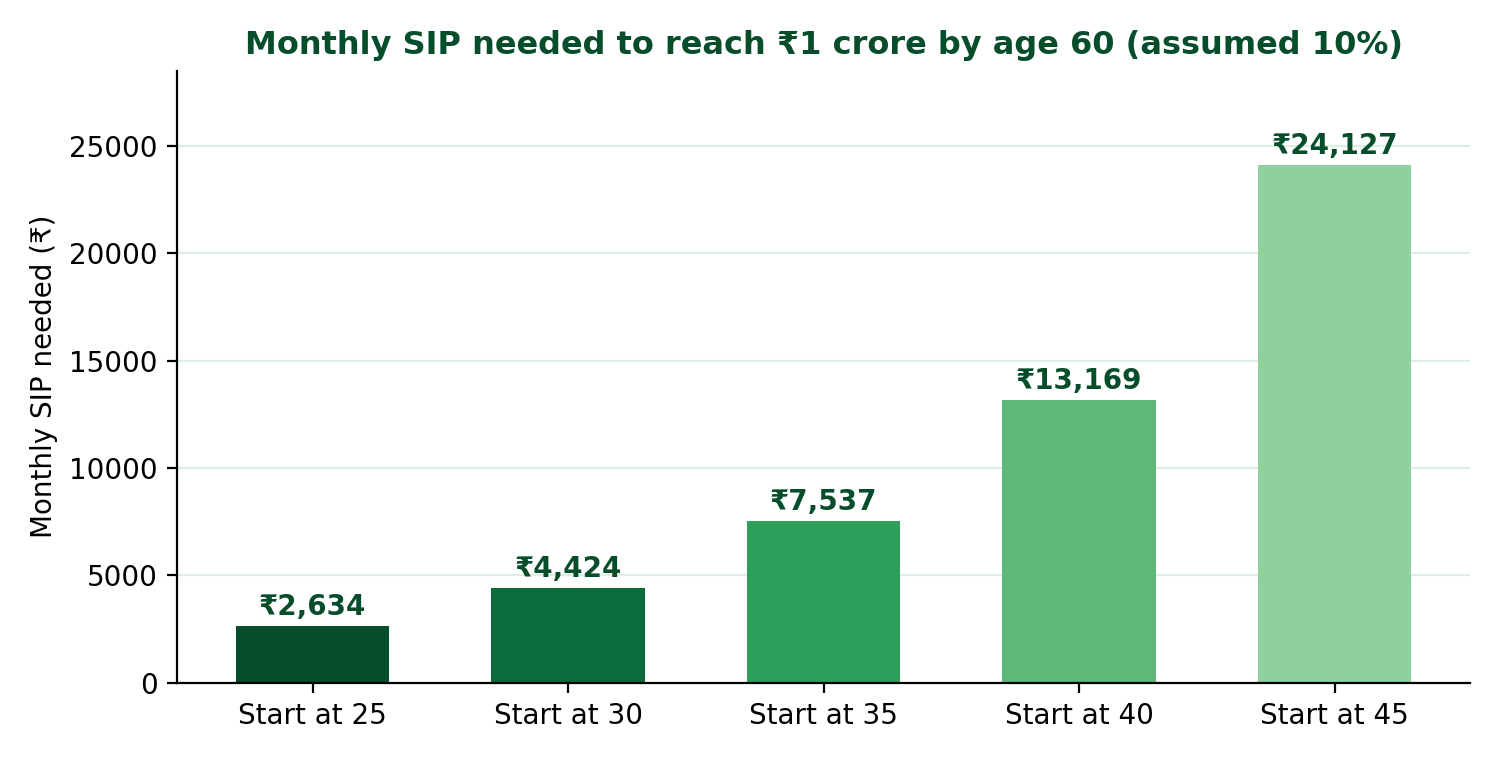
Notice what happens between 25 and 45. The monthly amount rises nine-fold, from about ₹2,600 to about ₹24,000, while the target stays the same. A 45-year-old ends up paying in almost four times the money a 25-year-old does to reach the identical goal.
The hidden price tag of waiting
At 10% a year, delaying your start from 30 to 31 lifts the SIP you need by about 11%. The penalty keeps growing because the final years of any SIP do most of the work, and every year you skip is one of those years.
Most people picture a delay as losing a year of savings. The real loss is a year of compounding on the biggest balance you will ever hold. That is why a late start cannot be fixed by saving a little harder for a short while.
Aarav and Meera: a tale of two timelines
Two friends each put ₹5,000 a month into an equity-oriented fund that earns an assumed 10% a year. Aarav begins at 25, invests for ten years, then stops and leaves the money alone. Meera waits until 35, then invests every month until she turns 60.
|
|
Years investing |
Total paid in |
Value at 60 |
|
Aarav (25 to 35) |
10 |
₹6 lakh |
₹1.23 crore |
|
Meera (35 to 60) |
25 |
₹15 lakh |
₹66.3 lakh |
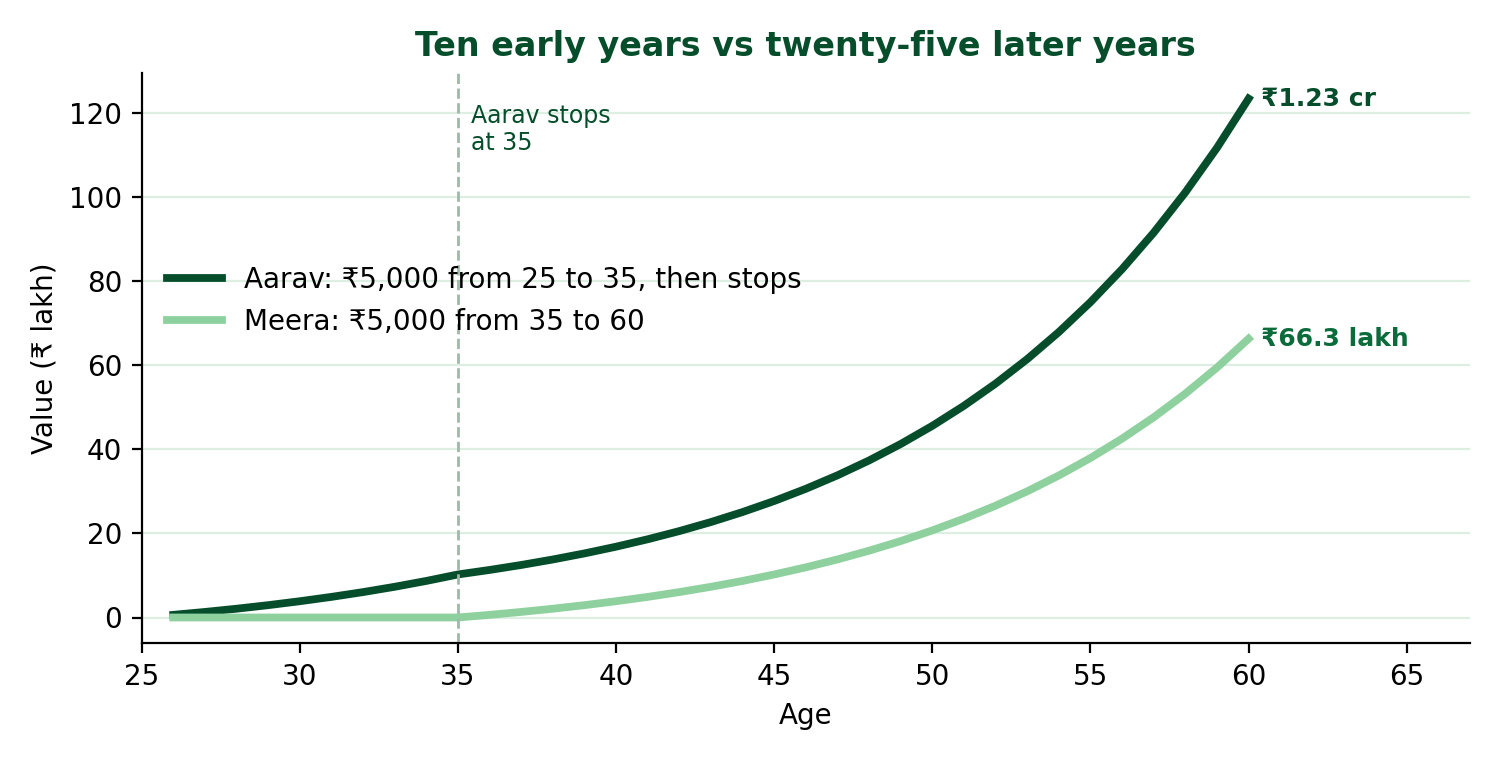
Meera pays in two and a half times as much money and still finishes with roughly half of Aarav’s total. This is an extreme comparison, and we are not suggesting anyone stop investing at 35. The point is that early rupees are the most valuable rupees you will ever invest.
What twenty years of real Indian markets looked like
Projections are assumptions, so it helps to look at a real record. HDFC Mutual Fund’s investor-education material shows a ₹1,000 monthly SIP in HDFC Flexi Cap Fund, increased by 10% every year for 20 years. The total invested was ₹6.87 lakh and the value on 31 August 2026 was ₹26.50 lakh.
The same material also shows the climb was uneven, with a visible dip around 2020 before recovery. Investors who stayed on through the fall were the ones who benefited. This is one fund’s history, shown for education. Past performance may or may not be sustained, and it is not a recommendation.
Stress-testing the plan
- Slower returns. Look back at the table. At 8%, a 35-year-old needs about ₹10,500 a month instead of ₹7,500. Plan with a buffer rather than assuming the best case.
- Rising prices. Retail inflation was 4.82% in August 2026 according to MoSPI, and the RBI projects about 5% for 2026-27. At 5% a year, ₹1 crore thirty years from now buys what roughly ₹23 lakh buys today. At 6%, it is closer to ₹17 lakh. So treat ₹1 crore as a starting target and revisit it as prices move.
- Rising your SIP. A 30-year-old who starts at ₹4,424 can reach ₹1 crore with a flat SIP. Starting at only about ₹2,800 and raising it 5% each year gets there too. Starting at about ₹1,570 and raising it 10% yearly also works, which suits people whose salary grows.
Tax in plain words
Tax applies when you sell, not while the money is growing. The rules for equity-oriented mutual funds in FY 2026-27 are below. They can change, so confirm them before you act.
|
Holding period |
Tax rate |
What to remember |
|
12 months or less |
20% (short-term) |
Applies to every rupee of gain |
|
More than 12 months |
12.5% (long-term) |
First ₹1.25 lakh of long-term gains in a year is tax-free |
Fund expense ratios also trim your returns every year. Compare them before choosing a scheme.
Get these basics right before you scale up
A SIP only compounds if you can keep it running. These four checks protect it from being cancelled by a bad month.
|
Area |
A sensible benchmark |
Why it matters |
|
Emergency fund |
3 to 6 months of basic expenses in a savings account or liquid fund |
Stops you breaking your SIP when something unexpected happens |
|
Health cover |
Your own policy plus a check on your parents’ cover |
A Policybazaar study reported by Business Standard found 75% of Indian buyers hold ₹10 lakh or less |
|
Debt |
Clear card dues first; keep EMIs well below 40% of take-home pay |
Card interest usually outruns what a SIP earns |
|
Goals |
One to three goals with rough dates |
A SIP with a purpose is harder to abandon |
If you are missing an emergency fund, begin with a SIP of ₹1,000 to ₹2,000 and direct the remaining savings to the fund. Raise the SIP once the cushion is in place.
India’s investing boom, in numbers
Participation is rising quickly, led by younger Indians. Understanding is catching up more slowly.
|
What the data shows |
Latest reading |
|
Median age of NSE registered investors |
33 in June 2026, from 38 in March 2020 |
|
Share of investors under 30 |
37.9%, from 23.5% in March 2020 |
|
Monthly SIP collections (AMFI) |
₹32,297 crore in August 2026, a record |
|
SIP accounts contributing in a month |
10.02 crore, the first time above 10 crore |
|
Adults classed as financially literate (NCFE 2019) |
27% |
Sources: NSE Market Pulse, AMFI monthly data, NCFE Financial Literacy and Inclusion Survey 2019.
AMFI’s SIP stoppage ratio stood at 81.1% in August 2026. It compares SIPs that ended or matured with new ones registered that month, so it does not mean most investors quit. It is a reminder that starting a SIP is easy and finishing one takes discipline and knowledge.
Matching money to the date you need it
|
Need it in |
Typical goals |
Where it usually fits |
|
Under 3 years |
Emergency fund, holiday, gadgets |
Savings account, liquid or short-duration debt funds |
|
3 to 5 years |
Wedding, higher studies, car |
Debt and hybrid funds, depending on risk comfort |
|
5 to 10 years |
Home down payment, child’s education |
Equity-oriented funds, moving safer as the date nears |
|
10+ years |
Retirement, long-term wealth |
Equity-oriented SIPs, alongside EPF, PPF or NPS |
Your 30-day starter plan
|
When |
What to do |
|
Week 1 |
Write down your take-home pay, EMIs, card dues and monthly expenses |
|
Week 2 |
Ask your parents about their health policy and read what your office cover includes |
|
Week 3 |
Open a separate account or fund for your emergency money and set a monthly transfer |
|
Week 4 |
Start a SIP you can comfortably keep going, and set a yearly reminder to raise it |
Find your own number with SJS Finserve
The tables above are averages. Your age, income, goals and responsibilities are specific to you. SJS Finserve can help you choose a SIP amount you can sustain, link it to what you are saving for, and review it as life changes.
Sources and References
Mutual fund and SIP data
• AMFI Monthly Data, August 2026: SIP inflow and contributing accounts
• SIP inflows hit record ₹32,297 crore in August: stoppage ratio and total SIP accounts
• AMFI (Association of Mutual Funds in India): official website
Investor demographics
• NSE Market Pulse, July 2026: median investor age and under-30 share
• India’s median investor age drops to 33: NSE report coverage (Tribune India)
• NSE (National Stock Exchange of India): official website
Inflation
• MoSPI press release: Consumer Price Index for August 2026
Tax
• Income Tax Department: special tax rates for equity-oriented mutual funds
Financial literacy and insurance
• NCFE Financial Literacy and Inclusion Survey 2019
• 75% in India have health policies below ₹10 lakh cover (Business Standard)
Fund example
• HDFC Mutual Fund: official website
FAQs
1. Is ₹5,000 a month enough to start a SIP?
Yes. ₹5,000 is a perfectly good starting point, and even ₹1,000 to ₹2,000 works if your budget is tight. The habit and the number of years matter more than the first amount. Raise it as your income grows.
2. What is the best age to start a SIP?
As early as you can sustain it. To reach ₹1 crore by 60, a 25-year-old needs about ₹2,600 a month. A 35-year-old needs about ₹7,500, and a 45-year-old needs about ₹24,000 (at an assumed 10% a year). Each year of delay raises the monthly amount by roughly 11%.
3. Are SIP returns guaranteed?
No. Mutual fund returns depend on market conditions and will vary from year to year. The figures in this guide assume 10% a year only to show how compounding works. At 8% instead, a 35-year-old would need about ₹10,500 a month for the same ₹1 crore.
4. Should I build an emergency fund before starting a SIP?
Ideally, build both together. Aim for 3 to 6 months of expenses in a savings account or liquid fund. If you have nothing saved yet, start a small SIP of ₹1,000 to ₹2,000 and put the rest into the emergency fund until it is complete.
5. How is the money taxed when I sell?
For equity-oriented mutual funds, gains on units held 12 months or less are taxed at 20%. Gains on units held longer are taxed at 12.5% above ₹1.25 lakh in a financial year. Tax rules can change, so check the current rules or ask your tax advisor before selling.