
If someone offered you two insurance policies and said, “Pay ₹50,000 a year. One gives you a large life cover. The other gives you life cover plus a maturity amount,” which one would you choose? For many investors, the second option sounds better.
Nobody likes the idea of paying insurance premiums for 20 or 30 years and receiving nothing at maturity. Endowment plans address that concern by combining insurance with savings, giving policyholders life cover during the policy term and a maturity benefit if the policy reaches completion.
But there is a question that often gets overlooked:
How much financial protection are you actually getting for the premium you are paying?
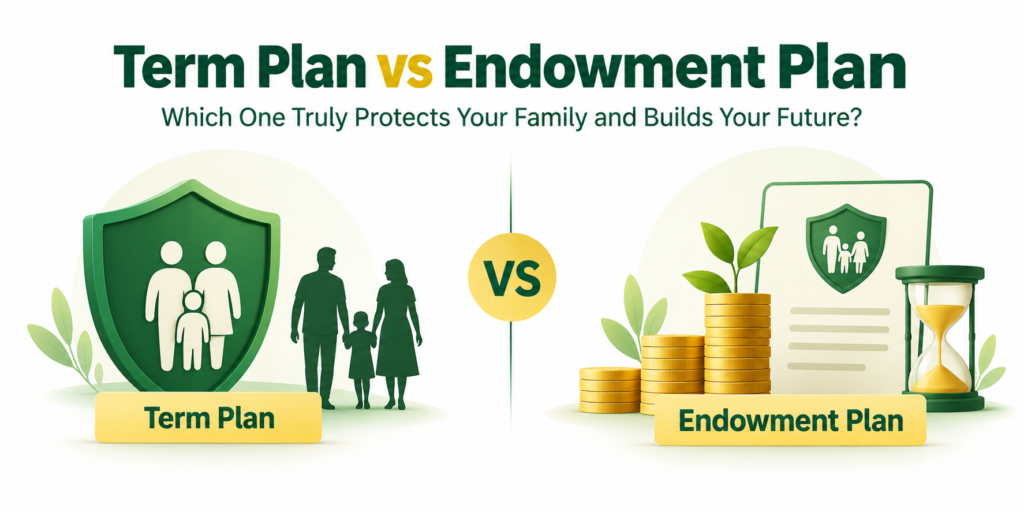
Term insurance and endowment plans are built around different objectives. A term plan focuses primarily on life protection, while an endowment plan combines protection with savings. For most investors, the decision should therefore begin with the financial risk they are trying to protect, not simply with whether a policy gives money back.
Term Plan vs Endowment Plan: The Key Difference
| Feature | Term Insurance | Traditional Endowment Plan |
|---|---|---|
| Primary objective | Life protection | Life protection + savings |
| Life cover | Generally high | Generally lower for a similar premium |
| Premium | Relatively low | Relatively high |
| Maturity benefit | Usually none | Yes, subject to policy terms |
| Savings component | No | Yes |
| Investment risk | No direct market-linked investment component | Traditional plans are generally not directly market-linked |
| Bonuses | Not applicable | Participating plans may provide bonuses |
| Liquidity | No investment value | Surrender/withdrawal options may exist, subject to terms |
| Riders | Available, depending on product | Available, depending on product |
The difference in premium exists because the products are doing different jobs. A term plan concentrates the premium on insurance protection. An endowment plan combines insurance with a savings component, which increases the premium.
That difference becomes particularly important when determining how much cover a family actually needs.
Term Insurance vs Endowment Plan: The Coverage Gap
Consider a simplified illustration for a 30-year-old non-smoker looking at a 30-year policy term. A pure term policy might provide around ₹1 crore of life cover for an annual premium of approximately ₹12,000 to ₹15,000, depending on the insurer and underwriting profile.
A traditional endowment policy with an annual premium of around ₹30,000 could provide a much smaller life cover, potentially around ₹4 lakh to ₹5 lakh, depending on the policy structure.
These are illustrative figures, not quotations. Actual premiums and benefits depend on factors such as age, health, policy term, insurer and underwriting.
| Illustration | Pure Term Plan | Traditional Endowment Plan |
|---|---|---|
| Annual premium | ₹12,000 to ₹15,000 | ₹30,000 |
| Illustrative life cover | ₹1 crore | ₹4 lakh to ₹5 lakh |
| Maturity benefit | ₹0 | Payable subject to policy terms |
| Primary objective | Protection | Protection + savings |
This is the coverage gap that investors need to understand. If your family needs ₹1 crore of protection, an endowment policy offering a few lakh rupees of life cover may not address the primary financial risk simply because it also provides a maturity benefit.
The reverse is also important. An endowment policy can be appropriate for someone who deliberately wants insurance and disciplined savings within the same product.
The right question is not “Which policy gives me money back?” It is “Which financial problem am I asking this policy to solve?”
Buy Term and Invest the Difference: The Mathematics
This is where the traditional “you get something back” argument deserves a closer look. Suppose an investor has ₹50,000 a year available for insurance and related savings over a 20-year period.
Consider two simplified approaches.
Option A: Endowment Plan
-
Annual premium: ₹50,000
-
Policy duration: 20 years
-
Illustrative life cover: ₹7.5 lakh
-
Illustrative maturity value at approximately 5% IRR: ₹16.5 lakh
Option B: Term Insurance + Separate Investment
-
Term insurance premium: ₹12,000 a year for an illustrative ₹1 crore cover
-
Amount available for investment: ₹38,000 a year
-
Life cover: ₹1 crore
-
Investment period: 20 years
At an illustrative 7.1% annual return, ₹38,000 invested annually for 20 years grows to approximately ₹15.8 lakh, assuming year-end contributions and a constant rate. At an illustrative 12% annualised return, the same contributions grow to approximately ₹27.4 lakh.
The 12% scenario is not guaranteed. Equity investments are market-linked and actual returns can be substantially higher or lower.
| 20-year illustration | Endowment | Term + 7.1% scenario | Term + 12% scenario |
|---|---|---|---|
| Annual amount | ₹50,000 | ₹12,000 + ₹38,000 invested | ₹12,000 + ₹38,000 invested |
| Life cover | ₹7.5 lakh | ₹1 crore | ₹1 crore |
| Return assumption | ~5% IRR | 7.1% | 12% |
| Illustrative corpus | ₹16.5 lakh | ₹15.8 lakh | ₹27.4 lakh |
The point is not that an equity investment will always outperform an endowment plan. It will not.
The point is that insurance and investment can be evaluated separately. A term plan can provide substantial protection while the remaining money can be invested according to the investor’s risk profile and financial goals. For disciplined investors, this separation can provide greater transparency over both costs and returns.
What About TROP?
There is also an option for people who dislike the idea of receiving no maturity benefit from a conventional term plan.
Term Insurance with Return of Premium, or TROP, provides a maturity benefit subject to the policy terms if the policyholder survives the policy period. Under the relevant regulatory framework, pure term products can be offered with or without return of premium.
The trade-off is cost. TROP generally carries a higher premium than conventional pure term insurance because it includes a maturity benefit.
Therefore, someone who wants protection but also strongly values a return of premium does not necessarily have to move directly to an endowment policy.
The comparison can instead be:
Pure Term vs TROP vs Endowment.
The decision should be based on the amount of cover required, total premium commitment, maturity benefits and the role the policy plays in the overall financial plan.
Traditional Endowment Plans vs ULIPs
Not every savings-oriented insurance product carries the same investment risk. Traditional endowment plans and ULIPs should be evaluated separately. Traditional participating endowment policies may provide bonuses in addition to the guaranteed benefits specified under the policy. These bonuses should not automatically be treated as guaranteed returns.
ULIPs are different because premiums are allocated to market-linked investment funds, subject to applicable charges and policy terms. The investment risk is borne by the policyholder.
Calling every endowment-style insurance product a “safe investment” ignores the difference between traditional insurance savings products and market-linked insurance products.
Before purchasing, investors should examine the benefit illustration carefully and distinguish guaranteed benefits from non-guaranteed projections.
How Much Life Insurance Do You Need?
The starting point for insurance planning should be the amount your family would require if your income were no longer available.
A commonly used rule of thumb is:
Ideal Life Cover = (Current Annual Income × 10 to 15) + Outstanding Loans – Existing Assets
For example, assume annual income is ₹10 lakh and outstanding home loans are ₹30 lakh.
Using a 12-times income multiple:
₹10 lakh × 12 + ₹30 lakh = ₹1.50 crore
This gives an indicative requirement of ₹1.5 crore before considering relevant existing assets.
It is only a starting point. A personalised calculation should consider dependants, children’s future goals, existing investments, retirement requirements, inflation and the period for which income would need to be replaced.
The important principle is simple:
Choose the level of insurance based on the financial risk, not based on the premium you happen to be comfortable paying.
Endowment Plan Tax Benefits: What Investors Need to Know
Tax treatment is another area where outdated insurance advice can create confusion.
Under the old tax regime, eligible life insurance premiums can form part of the deductions available under Section 80C, subject to the overall ₹1.5 lakh limit and applicable conditions. However, the tax treatment of high-premium life insurance policies changed from April 1, 2023.
For specified non-ULIP life insurance policies issued on or after April 1, 2023, where the aggregate premium payable exceeds ₹5 lakh in a previous year, the maturity proceeds may not qualify for the Section 10(10D) exemption, subject to the applicable provisions and exceptions.
This means the statement “insurance maturity is tax-free” is no longer sufficient for evaluating a high-value endowment policy.
Investors should examine the policy issue date, premium structure, aggregate premiums across relevant policies and applicable tax rules before making a decision.
For current tax provisions, refer to the Income Tax Department. Regulatory information is available through IRDAI and IRDAI’s Policyholder portal.
When Does an Endowment Plan Make Sense?
Endowment plans can make sense when an investor deliberately wants a combination of life insurance and disciplined savings.
The forced-savings element can be useful for people who find it difficult to maintain a separate investment habit. A policy can also appeal to investors who prioritise specified guaranteed benefits and are comfortable with the policy’s long-term commitment.
But the policy should be evaluated on its actual economics.
Before purchasing, examine:
-
Total premiums payable
-
Guaranteed maturity benefits
-
Non-guaranteed bonuses
-
Actual life cover
-
Policy and premium-paying term
-
Surrender value
-
Liquidity provisions
-
Rider costs
-
Tax treatment
-
IRR on the actual cash flows
A maturity amount by itself does not tell you whether the policy represents an attractive financial proposition.
Term Insurance vs Endowment Plan: Our View
For most salaried individuals under 40 with dependants, loans and significant long-term financial responsibilities, we would generally start by establishing adequate term insurance cover before considering an endowment policy for savings.
The reason is not complicated.
Life insurance needs to protect the financial consequences of premature death. If the family requires ₹1 crore or ₹1.5 crore of protection, the policy should be evaluated on whether it can provide that level of cover at an affordable premium.
Once that risk is adequately covered, wealth creation can be addressed separately through investments suited to the investor’s goals, time horizon and risk tolerance.
That does not make endowment plans universally unsuitable.
For someone who values disciplined savings, wants insurance and savings in one product and understands the return and liquidity trade-offs, an endowment policy may still have a role.
But “you get your money back” should not be the investment thesis.
The better question is whether the combination of protection, savings, return, liquidity and cost makes sense for your overall financial plan.
For a broader look at the role insurance plays in financial planning, read Insurance: Meaning, Types, Benefits, Components and Why It Matters.
If you are unsure how much life cover you need, whether an existing endowment policy still fits your goals, or how much you could invest after paying for insurance, SJS Finserve can help you review the numbers across your complete financial picture. Book a consultation for a personalised assessment of your insurance requirements, existing policies and investment strategy.
Frequently Asked Questions
Is term insurance better than an endowment plan?
It depends on the objective. Term insurance is designed primarily for high life cover at a relatively lower premium. Endowment plans combine life insurance with savings and a maturity benefit. For investors who need substantial family protection, we would generally assess the required term cover first.
What is the return on an endowment plan?
There is no single return applicable to every endowment plan. Guaranteed benefits and non-guaranteed bonuses need to be separated, and the actual IRR should be calculated using the policy’s premium schedule and benefits.
Is TROP better than regular term insurance?
TROP provides a maturity benefit subject to policy terms but generally costs more than conventional term insurance. The choice depends on whether the additional maturity feature justifies the higher premium for the investor.
Are endowment plan maturity proceeds tax-free?
Not always. Tax treatment depends on the policy, issue date, premium levels and applicable provisions. For specified non-ULIP policies issued on or after April 1, 2023, the ₹5 lakh aggregate premium threshold can affect Section 10(10D) exemption eligibility.
Should I buy term insurance and invest the difference?
For disciplined investors, separating insurance from investments can make the cost of protection and investment performance easier to evaluate. The appropriate strategy depends on risk tolerance, financial goals, investment discipline and the amount of life cover required.