
The real risk is not owning mutual funds. It is owning the wrong portfolio.
Investors often ask, “Which mutual fund should I buy?” A better question is: “How much risk am I actually taking across my entire portfolio?”
A portfolio containing five or six mutual funds may look diversified while still being heavily exposed to the same companies, sectors or market factors. Similarly, a debt fund may appear conservative until interest-rate, credit or liquidity risk is examined.
SEBI itself states that mutual funds carry investment risks and that investors should evaluate risks against expected returns before investing. Mutual fund returns are not guaranteed, and the NAV can rise or fall depending on the underlying securities and market conditions.
That makes risk management in mutual funds less about finding a “risk-free” investment and more about deciding which risks are appropriate for a particular financial goal.
SEBI’s Mutual Fund Investor Education Guide
SJS Finserve: A portfolio-first approach
SJS Finserve approaches investing through goal-based planning, portfolio construction and ongoing review rather than simply selecting individual products.
According to SJS Finserve’s published information, the firm has 7+ years of advising experience, has guided 100+ families and has ₹30Cr+ assets advised. Its team is led by Sonam Tripathi, Director, who has more than seven years of experience across banking, insurance and financial services. SJS Finserve identifies itself as a Mutual Fund Distributor and provides mutual fund distribution, portfolio diversification, risk management and wealth management services.
The firm’s stated process is built around understanding the investor, identifying goals, designing a roadmap, implementing investments and reviewing the portfolio over time.
That distinction matters because fund selection and portfolio management are not the same thing.
Types of mutual fund risks investors need to understand
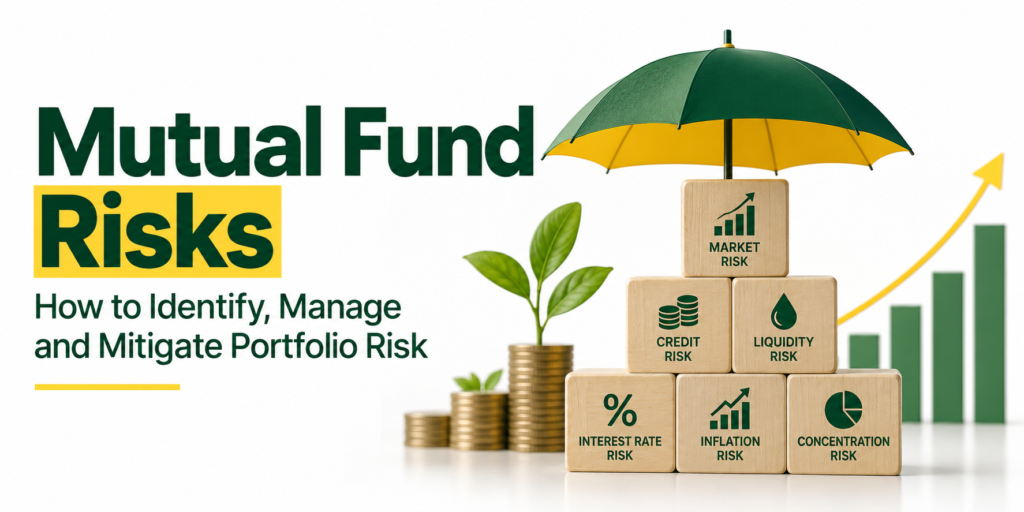
The most important risks can be grouped into a few categories rather than treated as eight separate textbook definitions.
| Risk | What can cause it | What investors should examine |
|---|---|---|
| Market and price risk | Equity prices fluctuate due to company, sector and economic developments | Equity allocation and investment horizon |
| Interest-rate risk | Bond prices generally move inversely to interest rates | Duration and debt portfolio composition |
| Credit risk | An issuer may face difficulty meeting interest or principal obligations | Credit quality and issuer concentration |
| Liquidity risk | Securities may become difficult or costly to sell | Portfolio liquidity and redemption requirements |
| Inflation risk | Returns may fail to maintain purchasing power | Real return and long-term goal |
| Concentration risk | Multiple investments may have similar underlying exposure | Portfolio overlap |
| Currency risk | Exchange-rate movements affect foreign investments | Foreign exposure and currency impact |
| Reinvestment risk | Cash flows may have to be reinvested at lower rates | Maturity and interest-rate environment |
SEBI and AMFI identify market, liquidity, default, interest-rate, currency and other risks as factors that can affect mutual fund investments. The appropriate risk depends on the scheme and its underlying portfolio.
Equity risk is not the same as portfolio risk
Equity funds can experience significant price fluctuations. Company earnings, economic conditions, regulations, interest rates and sector-specific events can all affect valuations.
But the more important portfolio question is how much equity exposure you have relative to your goals.
Consider a hypothetical investor with four large-cap mutual funds. Each fund may appear different because the fund names, AMCs and recent returns are different. But if several funds repeatedly hold many of the same large companies, the investor may have considerably more concentration than expected.
This is why simply counting the number of mutual funds in a portfolio is not enough.
Four funds do not automatically mean four independent sources of risk.
Debt funds have risks too
Debt funds are often viewed as the stable side of a portfolio, but they are not risk-free.
Interest-rate risk is particularly important. When interest rates rise, the market value of existing fixed-income securities generally falls. The impact depends partly on factors such as maturity, coupon and yield.
Credit risk is different. It relates to the ability of an issuer to meet its interest and principal obligations. Credit spreads can also change as market perceptions and liquidity conditions change.
The Reserve Bank of India’s rate data showed a 5.25% policy repo rate as of August 6, 2026, illustrating why the interest-rate environment remains relevant when evaluating fixed-income portfolios. For debt investors, therefore, “debt” is not a sufficient risk description. Duration, credit quality and liquidity also matter.
Liquidity risk becomes visible when you need the money
Liquidity risk is often ignored during normal market conditions. The problem appears when an investor needs to sell an investment and discovers that the security cannot be sold easily at its expected value. This is particularly relevant when an investment portfolio is being used for a financial goal with a fixed deadline.
Money required for a near-term obligation should not be exposed to risks that could make its value or availability uncertain at precisely the wrong time.
Inflation quietly reduces wealth
An investment can generate a positive nominal return and still lose purchasing power.
For example, a portfolio earning 7% when inflation is 5% has generated a positive nominal return, but the purchasing-power gain is considerably smaller than the headline number suggests.
This is why long-term portfolio construction needs to consider both capital preservation and growth. A portfolio that is too conservative for a long-term goal may reduce volatility while failing to generate sufficient growth to meet the future requirement.
The biggest portfolio risk may be the investor
Market movements are outside an investor’s control. Behaviour is not.
Recency bias can lead investors to chase recent top performers. Herding can encourage investors to follow popular market themes. Loss aversion can cause investors to sell after a fall simply because the decline feels uncomfortable.
Market timing creates another problem. Investors may wait for a “better” entry point, invest after markets have already risen or exit after a decline. SEBI’s investor education material also cautions investors against relying on tips and encourages independent research and regulated investment guidance.
This is where a disciplined portfolio review can add value.
The objective is not to predict every market movement. It is to reduce avoidable mistakes in the decisions that can be controlled.
The SJS Portfolio Risk Map
At SJS Finserve, the portfolio can be assessed through a simple four-part framework:
1. Goal Risk
What is the money actually required for, and when will it be needed?
2. Allocation Risk
How much is currently invested in equity, debt and other assets, and does that allocation correspond with the investor’s objectives?
3. Concentration Risk
Are multiple mutual funds creating overlapping exposure to the same companies, sectors or themes?
4. Behaviour and Review Risk
Is the investor likely to make emotional changes during market volatility, and does the portfolio need periodic rebalancing as goals or circumstances change?
The output is not simply a list of funds to buy. It is a clearer view of where the portfolio is taking risk and why that risk exists.
SJS Finserve also provides portfolio diversification and risk-management services designed around spreading exposure with purpose and aligning investments with long-term goals.
Read SJS Finserve’s guide to mutual fund categories
How to review your existing mutual fund portfolio
Before adding another mutual fund, investors should ask:
- Are my investments aligned with specific financial goals?
- Do I know my total equity exposure across all funds?
- Are my mutual funds substantially overlapping?
- Is my debt portfolio exposed to unnecessary duration or credit risk?
- Do I have enough liquidity for upcoming financial requirements?
- Am I choosing funds because of recent performance?
- Has my financial situation changed since I built the portfolio?
Recent market data also demonstrates why chasing flows or categories can be misleading. In August 2026, equity mutual fund inflows rose to ₹29,329 crore, with small-cap and mid-cap funds attracting significant investor allocation while large-cap funds recorded outflows. Such industry-level flows can describe investor behaviour, but they do not establish what an individual investor’s portfolio should hold.
The decision should begin with the goal, not the headline.
Why portfolio management matters more than fund selection
Choosing one good mutual fund does not automatically create a good portfolio.
A portfolio needs to be evaluated as a whole.
An investor may own several individually reasonable funds but still have excessive equity exposure, overlapping holdings, insufficient liquidity or an asset allocation that no longer matches the original financial objective.
This is why SJS Finserve’s approach focuses on research-based and goal-based investing. The purpose is to connect fund selection with portfolio construction, risk management and ongoing review.
The firm’s published process begins with understanding the investor and goals, followed by designing a Protect, Grow and Multiply roadmap, implementation and periodic review.
For investors who are unsure whether their existing investments are working together effectively, a portfolio review can answer a more useful question than “Which fund will give me the highest return?”
It can show where the portfolio is exposed, what risks are being taken and whether those risks are connected to the goals the money is supposed to fund.
Review Your Portfolio Before Adding Another Fund
Mutual fund investing is not about eliminating risk. It is about understanding the risks you are taking and making sure they have a purpose within your financial plan.
At SJS Finserve, the focus is on research-based fund selection, goal-based investing, portfolio construction and ongoing management. The objective is to help investors build portfolios that are aligned with their goals while managing avoidable concentration, allocation and behavioural risks.
If you already have mutual funds but are unsure whether your portfolio is properly diversified, aligned with your goals or taking more risk than necessary, book a free portfolio review with SJS Finserve. We can help you map your existing investments against your goals, identify key portfolio risks and build a more structured investment roadmap.
Frequently Asked Questions
Is mutual fund investment risk-free?
No. Mutual funds are market-linked investments and returns are not guaranteed. The value of investments can rise or fall depending on the underlying securities and broader market conditions.
What is the safest type of mutual fund?
There is no single mutual fund category that is universally safest for every investor or every goal. SEBI’s Risk-o-meter provides a scheme-level indication of risk, but investors also need to consider their own goals, time horizon and overall portfolio.
How much risk should I take in my 30s?
Age alone should not determine portfolio risk. Income stability, financial responsibilities, emergency reserves, investment horizon, financial goals and ability to tolerate losses should also be considered.
Can I reduce mutual fund risk through diversification?
Diversification can spread exposure, but owning more funds does not automatically create better diversification. Overlapping holdings can leave investors exposed to similar companies or sectors across multiple schemes.
Should I change my mutual funds when the market falls?
A market decline alone does not establish that a portfolio needs to be changed. Investors should first examine whether the original asset allocation, investment objective and financial goal have changed.
How can I check whether my mutual fund portfolio is too risky?
Review your overall asset allocation, portfolio overlap, equity exposure, debt credit quality, liquidity requirements and investment horizon. A professional portfolio review can help bring these factors together rather than evaluating each fund separately.