
Investors often ask a simple question: Which mutual fund should I invest in?
But with dozens of mutual fund categories, that may not be the right place to start. The more important question is which type of mutual fund fits the investor’s objective, time horizon and risk tolerance.
This has become particularly important after the Securities and Exchange Board of India (SEBI) introduced a revised framework for the categorization and rationalization of mutual fund schemes on February 26, 2026.
The new framework replaces the earlier classification structure and introduces important changes, including a new Life Cycle Funds category, a new Flexi Cap Fund category within the equity framework, changes to several debt fund names and characteristics, new portfolio-overlap requirements for sectoral and thematic funds, and the discontinuation of the Solution-Oriented Schemes category.
Read the Official SEBI Circular on Categorization and Rationalization of Mutual Fund Schemes
What Are the Main Types of Mutual Funds?
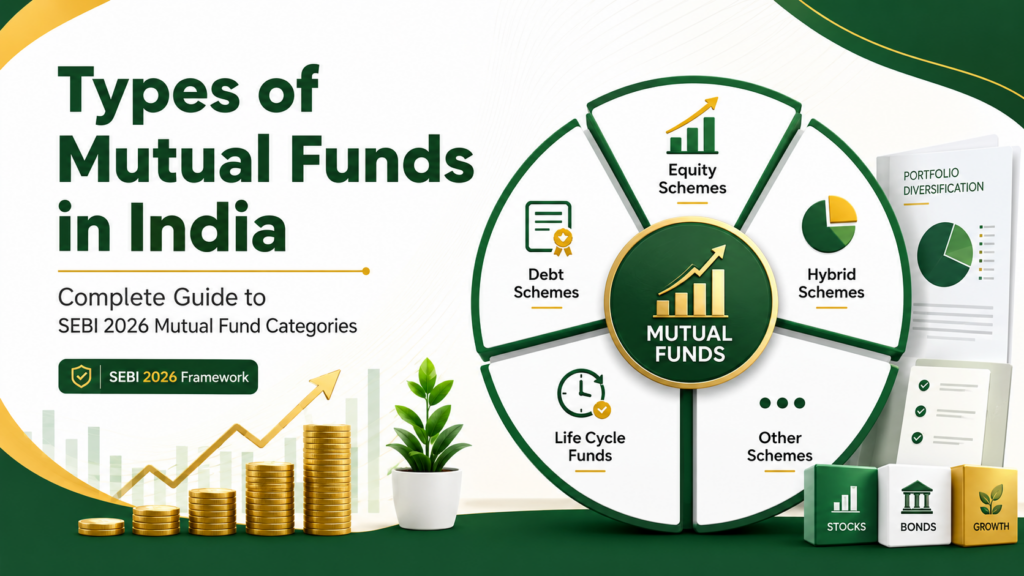
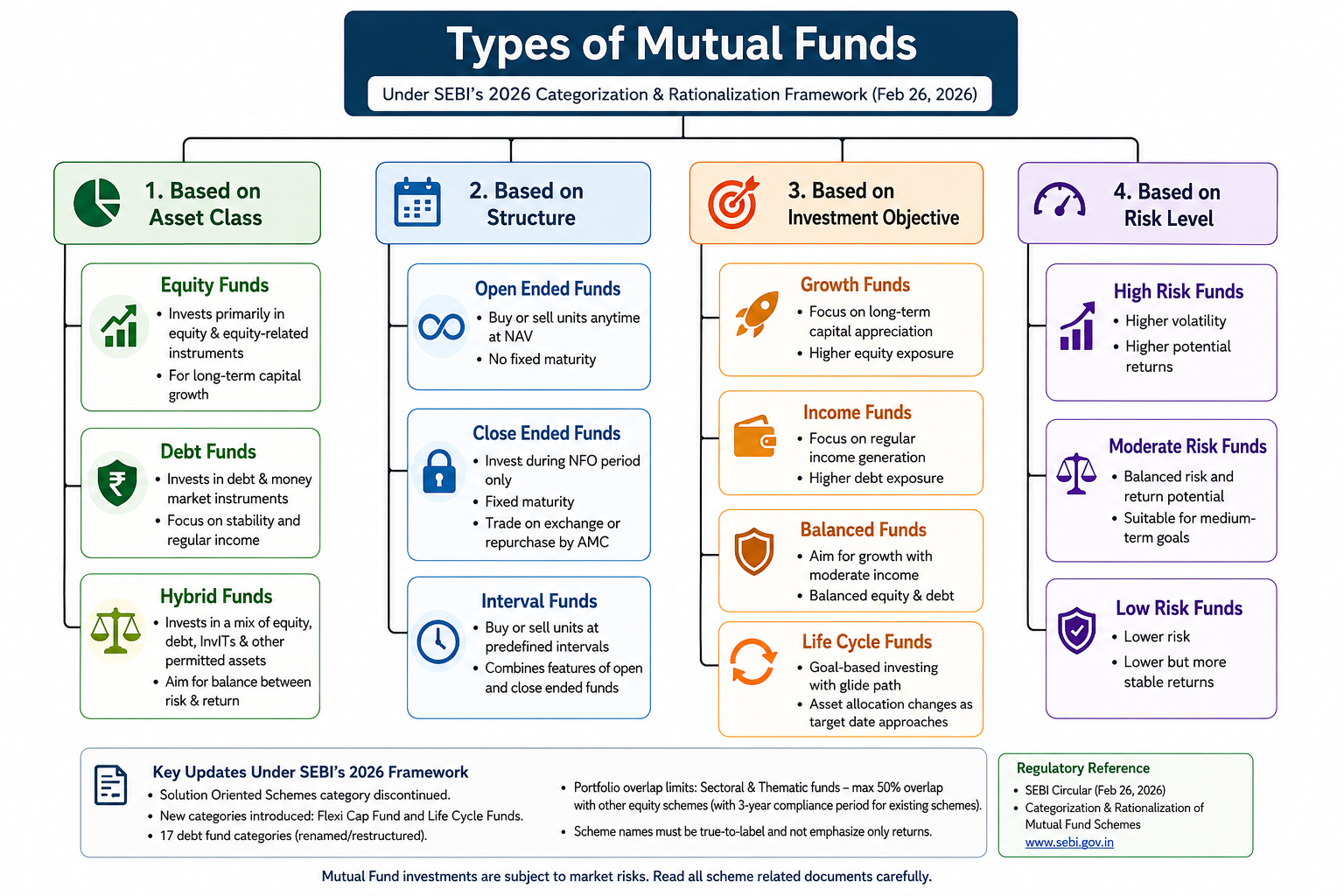
Under SEBI’s February 2026 framework, mutual fund schemes are broadly classified into five groups:
| Broad Category | What It Primarily Covers |
|---|---|
| Equity Schemes | Equity and equity-related instruments |
| Debt Schemes | Debt and debt-related instruments |
| Hybrid Schemes | A mix of permitted asset classes |
| Life Cycle Funds | Goal-based investing using a predefined glide path |
| Other Schemes | Index Funds/ETFs and Fund of Funds |
The key change is that Solution-Oriented Schemes are no longer a separate category. SEBI has discontinued this category with effect from February 26, 2026. Existing schemes in this category are required to stop subscriptions immediately and may be merged with schemes having similar asset allocation and risk profiles, subject to SEBI approval.
So, if you are reading older articles about “types of mutual funds in India”, some of the classifications and allocation limits may no longer reflect the latest SEBI framework.
1. Equity Mutual Funds
Equity mutual funds primarily invest in shares and equity-related instruments. They are generally used by investors seeking long-term capital growth, although the value of an equity fund can fluctuate significantly over shorter periods.
Under the revised framework, SEBI has specified 13 equity scheme categories.
| Equity Fund Category | Minimum Investment Requirement / Key Feature |
|---|---|
| Multi Cap Fund | Minimum 75% in equity and equity-related instruments, with at least 25% each in large cap, mid cap and small cap. |
| Large Cap Fund | Minimum 80% in large cap companies. |
| Large & Mid Cap Fund | Minimum 35% each in large cap and mid cap companies. |
| Mid Cap Fund | Minimum 65% in mid cap companies. |
| Small Cap Fund | Minimum 65% in small cap companies. |
| Flexi Cap Fund | Minimum 65% in equity and equity-related instruments, investing across large, mid and small caps. |
| Dividend Yield Fund | Minimum 80% in equity and equity-related instruments, predominantly investing in dividend-yielding stocks. |
| Value Fund | Minimum 80% in equity and equity-related instruments, following a value strategy. |
| Contra Fund | Minimum 80% in equity and equity-related instruments, following a contrarian strategy. |
| Focused Fund | Maximum 30 stocks and minimum 80% in equity and equity-related instruments. |
| Sectoral Fund | Minimum 80% in equity and equity-related instruments of a particular sector. |
| Thematic Fund | Minimum 80% in equity and equity-related instruments of a particular theme. |
| ELSS Tax Saver Fund | Minimum 80% in equity and equity-related instruments. |
These requirements come directly from SEBI’s February 2026 categorization framework.
What Changed for Equity Funds?
One of the most notable changes is the introduction of Flexi Cap Fund as a separate category.
The revised framework also changes the minimum allocation for several categories. For example, a Multi Cap Fund now requires at least 75% of total assets in equity and equity-related instruments, including a minimum of 25% each in large cap, mid cap and small cap companies.
The framework also allows mutual funds to offer both Value and Contra funds, subject to a condition that portfolio overlap between the two schemes should not exceed 50%.
For sectoral and thematic funds, SEBI has introduced another important safeguard. Portfolio overlap with other equity schemes is generally capped at 50%, subject to the specific framework and exceptions set out in the circular. Existing sectoral and thematic schemes have a three-year glide path to comply with the overlap requirement.
For investors, the practical takeaway is simple: the name of an equity fund is now more closely tied to what the portfolio is expected to hold.
2. Debt Mutual Funds
Debt funds invest primarily in debt and money market instruments. These can include government securities, corporate bonds and other fixed-income instruments.
The biggest mistake investors make with debt funds is treating them as one broad “low-risk” category but they are not.
A fund investing in overnight securities behaves very differently from one holding longer-duration bonds. Similarly, a fund investing in higher-rated corporate bonds has a different credit profile from a Credit Risk Fund.
SEBI’s revised framework contains 17 debt fund categories.
| Debt Fund Category | Key Feature |
|---|---|
| Overnight Fund | Invests in securities with a maturity of 1 day. |
| Liquid Fund | Invests only in debt and money market securities with maturity up to 91 days. |
| Ultra Short Term Fund | Macaulay duration between 3 and 6 months. |
| Ultra Short to Short Term Fund | Macaulay duration between 6 and 12 months. |
| Money Market Fund | Invests in money market instruments with maturity up to 1 year. |
| Short Term Fund | Macaulay duration between 1 and 3 years. |
| Medium Term Fund | Macaulay duration between 3 and 4 years. |
| Medium to Long Term Fund | Macaulay duration between 4 and 7 years. |
| Long Term Fund | Macaulay duration above 7 years. |
| Dynamic Term Fund | Invests across durations. |
| Corporate Bond Fund | Minimum 80% in AA+ and above rated corporate bonds. |
| Credit Risk Fund | Minimum 65% in AA and below rated corporate bonds, excluding AA+. |
| Banking and PSU Debt Fund | Minimum 80% in debt instruments of banks, PSUs, PFIs and municipal bonds. |
| Gilt Fund | Minimum 80% in government securities. |
| 10-Year Constant Maturity Gilt Fund | Minimum 80% in government securities with portfolio Macaulay duration of 10 years. |
| Floating Interest Rates Fund | Minimum 65% in floating-rate instruments. |
| Sectoral Fund | Minimum 80% in debt and debt-related instruments of a particular sector. |
What Does Macaulay Duration Mean?
Macaulay duration sounds technical, but the basic idea is relatively simple.
Think of it as an approximate measure of how long it takes a bond portfolio to receive its cash flows.
It also helps investors understand how sensitive a debt portfolio can be to interest-rate movements. Generally, longer-duration portfolios can be more sensitive to changes in interest rates than shorter-duration portfolios.
SEBI’s revised framework requires Macaulay duration to be explained in the scheme information document and reported at the portfolio level.
This is why comparing a Liquid Fund with a Long Term Fund simply because both are “debt funds” can be misleading.
3. Hybrid Mutual Funds
Hybrid funds combine equity and debt, with some categories also permitted to invest in other asset classes under SEBI’s framework.
The purpose is not necessarily to eliminate risk. Instead, the mix of assets can create a different balance between growth and stability.
SEBI’s revised framework contains seven hybrid categories.
| Hybrid Fund | Allocation / Key Feature |
|---|---|
| Conservative Hybrid Fund | 10% to 25% equity; 75% to 90% debt. |
| Balanced Hybrid Fund | 40% to 60% equity and 40% to 60% debt; no arbitrage permitted. |
| Aggressive Hybrid Fund | 65% to 80% equity; 20% to 35% debt. |
| Dynamic Asset Allocation Fund | Equity and debt allocation managed dynamically. |
| Multi Asset Allocation Fund | At least 10% each in at least three asset classes. |
| Arbitrage Fund | Minimum 65% in equity and equity-related instruments, following an arbitrage strategy. |
| Equity Savings Fund | Minimum 65% in equity and equity-related instruments, with net equity exposure of 15% to 40% and minimum 10% in debt. |
The revised framework also permits residual investments in certain instruments such as InvITs, Gold ETFs and Silver ETFs, subject to the applicable regulatory limits. Arbitrage Funds have specific restrictions under the framework.
For investors, the important point is that “hybrid” does not automatically mean conservative. An Aggressive Hybrid Fund, for example, can have 65% to 80% exposure to equity and equity-related instruments.
4. Life Cycle Funds: A New Mutual Fund Category
One of the most important additions in SEBI’s 2026 framework is Life Cycle Funds.
These funds are designed around a predetermined maturity date and follow a glide path, meaning the asset allocation changes as the target date gets closer.
The concept is similar to gradually shifting gears as an investor approaches a financial goal. Earlier in the investment period, the fund can have higher equity exposure. As the maturity date approaches, the allocation can shift towards debt and other permitted assets.
SEBI permits Life Cycle Funds with a minimum tenure of 5 years and a maximum tenure of 30 years, with tenures in multiples of five years. A maximum of six Life Cycle Funds can be active for subscription at any given point in time.
For example, under the 30-year Life Cycle Fund framework, the permitted equity allocation changes as follows:
| Years to Maturity | Equity Allocation | Debt Allocation | Gold/Silver ETFs, ETCDs/InvITs |
|---|---|---|---|
| 15 to 30 years | 65% to 95% | 5% to 25% | 0% to 10% |
| 10 to 15 years | 65% to 80% | 5% to 25% | 0% to 10% |
| 5 to 10 years | 50% to 65% | 5% to 25% | 0% to 10% |
| 3 to 5 years | 35% to 50% | 25% to 50% | 0% to 10% |
| 1 to 3 years | 20% to 35% | 25% to 65% | 0% to 10% |
| Less than 1 year | 5% to 20% | 25% to 65% | 0% to 10% |
This category is particularly interesting because it moves the discussion away from simply asking “equity or debt?” and towards a more goal-based question: how should the portfolio change as the financial goal approaches?
5. Index Funds, ETFs and Fund of Funds
SEBI’s “Other Schemes” category includes two broad types:
Index Funds and ETFs
These schemes seek to replicate or track a particular index.
The revised framework requires a minimum investment of 95% of total assets in securities of the index being replicated or tracked.
The objective is therefore different from an actively managed equity fund. Instead of trying to outperform an index through stock selection, a passive fund aims to track the index.
Fund of Funds
A Fund of Funds, or FoF, invests in other mutual fund schemes.
SEBI’s framework requires a minimum investment of 95% of total assets in the underlying fund.
The 2026 framework also provides a standardised framework for FoFs with multiple underlying funds, covering categories such as domestic equity-oriented FoFs, debt-oriented FoFs, hybrid FoFs, commodity-based FoFs and overseas FoFs.
What Happened to Solution-Oriented Mutual Funds?
This is one of the most important updates investors should know.
Older articles commonly list Retirement Funds and Children’s Funds under a separate “Solution-Oriented Schemes” category.
That classification is no longer current.
SEBI’s February 26, 2026 circular discontinued the Solution-Oriented Schemes category with immediate effect. Existing schemes in this category must stop subscriptions and may be merged with another scheme having a similar asset allocation and risk profile, subject to prior SEBI approval.
This is exactly why investors should be cautious when relying on older articles about mutual fund categories.
SEBI’s New True-to-Label Approach
The revised framework also focuses on making mutual fund names easier for investors to understand.
SEBI states that the name of a scheme should correspond with its category so that schemes remain “true-to-label.” The framework also says that words or phrases that emphasise only the return aspect of a scheme should not be used in its name.
For investors, this is more than a naming exercise.
A fund name should give you a reasonable starting point for understanding what the scheme is designed to do. Investors should still read the scheme documents and portfolio disclosures before investing, but standardised naming can make comparison easier.
SEBI has also required mutual funds to disclose category-wise portfolio overlap on their AMC websites on a monthly basis.
How Should You Choose Between Different Mutual Fund Types?
The best mutual fund category is not necessarily the category with the highest recent return.
A better approach is to work backwards from the portfolio requirement.
For example:
- Long-term growth: Equity categories may be relevant depending on risk tolerance and investment horizon.
- Shorter-term or liquidity needs: Shorter-duration debt categories may be considered.
- Combination of equity and debt: Hybrid categories offer different allocation structures.
- Goal-based investing with a predefined maturity: Life Cycle Funds are now part of the SEBI framework.
- Market-linked passive exposure: Index Funds and ETFs may be relevant.
- Diversification through other schemes: Fund of Funds provide this structure.
The category is only the first filter. After that, investors should examine the individual scheme, portfolio, costs, investment strategy, risk, benchmark and how it fits with the rest of their portfolio.
What Matters Most When Comparing Mutual Funds?
A fund category tells you the rules of the game. It does not tell you whether a particular scheme is the right investment for you.
Investors should pay attention to:
Asset allocation: Where is the money actually invested?
Risk: How much volatility and downside can the portfolio experience?
Investment horizon: Does the scheme’s portfolio make sense for the period you can remain invested?
Portfolio overlap: Are two funds you own actually giving you different exposure?
Costs: What are you paying for managing the investment?
Portfolio quality: In debt funds, for example, duration and credit quality can matter significantly.
This is particularly important now that SEBI has strengthened portfolio-overlap disclosures and introduced specific overlap conditions for sectoral and thematic equity schemes.
Types of Mutual Funds: Key Takeaways
The 2026 SEBI framework makes the mutual fund universe more structured, but it does not make investment decisions automatically easier.
The broad categories are now:
| Category | Number of Categories | Core Idea |
|---|---|---|
| Equity | 13 | Equity and equity-related investments |
| Debt | 17 | Debt and fixed-income investments |
| Hybrid | 7 | Combination of permitted asset classes |
| Life Cycle | 1 | Goal-based investing with a glide path |
| Other | 2 | Index Funds/ETFs and Fund of Funds |
These categories should be viewed as building blocks rather than a ranking of “best” to “worst.”
An aggressive equity fund may be appropriate for one portfolio and completely unsuitable for another. The same applies to debt, hybrid and passive funds.
Important Risk Disclosure
Mutual fund investments are subject to market risks. Mutual Fund Schemes are not guaranteed or assured-return products. The value of investments can rise or fall depending on market conditions, interest rates, liquidity, credit risk and other factors affecting the underlying securities. Past performance does not guarantee future performance.
Investors should read the scheme-related documents carefully and assess whether an investment is suitable for their financial objectives and risk profile before investing.
Final Takeaway
The biggest change in India’s mutual fund landscape is not simply the addition or removal of a few categories. SEBI’s 2026 framework is moving the industry towards clearer labels, more standardised portfolios and greater comparability between schemes.
For investors, that makes one principle particularly important: do not choose a mutual fund simply because its recent returns look attractive. Start with the role the investment needs to play in your portfolio, then select the category and scheme that fits that role.
If you are unsure whether you are using the right mix of equity, debt, hybrid or passive investments, SJS Finserve can help you evaluate your mutual fund portfolio in the context of your financial goals, risk profile and investment horizon. A professional review can help you move beyond chasing individual funds and towards building a portfolio that is aligned with the financial decisions you actually need to make.
Frequently Asked Questions
What are the main types of mutual funds in India
Under SEBI’s February 2026 framework, mutual fund schemes are broadly classified into Equity Schemes, Debt Schemes, Hybrid Schemes, Life Cycle Funds and Other Schemes, which include Index Funds/ETFs and Fund of Funds.
How many equity mutual fund categories are there under the new SEBI framework?
There are 13 equity scheme categories, including Multi Cap, Large Cap, Large & Mid Cap, Mid Cap, Small Cap, Flexi Cap, Dividend Yield, Value, Contra, Focused, Sectoral, Thematic and ELSS Tax Saver Funds.
What is the new Flexi Cap Fund category?
A Flexi Cap Fund is an open-ended dynamic equity scheme investing across large cap, mid cap and small cap stocks, with a minimum investment of 65% of total assets in equity and equity-related instruments.
What are Life Cycle Funds?
Life Cycle Funds are open-ended funds with a predetermined maturity and a glide path for goal-based investing. Their asset allocation changes as the fund approaches its target maturity.
Are Solution-Oriented Mutual Funds still a separate category?
No. SEBI discontinued the Solution-Oriented Schemes category with effect from February 26, 2026. Existing schemes are required to stop subscriptions and may be merged with schemes having similar asset allocation and risk profiles, subject to SEBI approval.