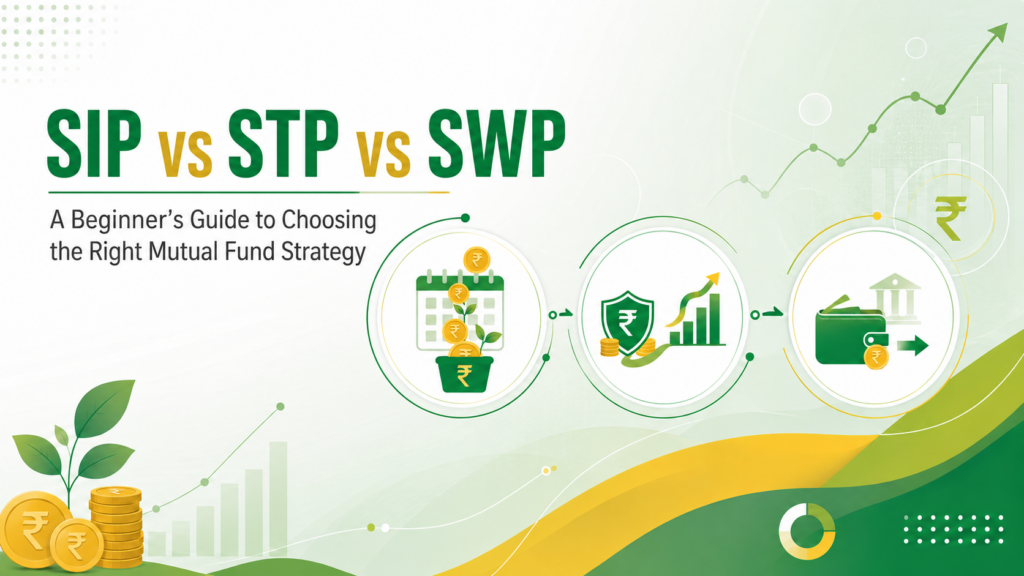
If you’re just beginning your mutual fund journey, chances are you’ve come across terms like SIP, STP, and SWP.
At first glance, they sound technical. Many first-time investors assume they are different investment products or complicated financial strategies meant only for experienced investors.
They aren’t.
These are simply three different ways of managing your money inside mutual funds. One helps you invest regularly, another helps you invest a lump sum more intelligently, and the third helps you withdraw money systematically whenever you need it.
Understanding these three concepts can completely change how you invest. Instead of worrying about “Is this the right time to invest?” or “How do I generate monthly income from my investments?”, you’ll have a structured approach for every stage of your financial journey.
The best part is that SIP, STP, and SWP are not competitors. They complement each other. Most experienced investors use all three at different phases of their investing life.
Let’s understand them one by one.
What is SIP (Systematic Investment Plan)?
A Systematic Investment Plan (SIP) is a method of investing a fixed amount into a mutual fund at regular intervals, usually every month.
Instead of waiting until you’ve accumulated a large amount, SIP allows you to start with small investments and gradually build wealth over time.
Think of it like setting aside a portion of your salary every month before you spend it. Once your SIP is registered, the investment happens automatically on your chosen date without requiring you to remember it every month.
For many investors, this becomes the easiest way to develop financial discipline.
Suppose you decide to invest ₹5,000 every month into an equity mutual fund. Whether markets are rising, falling, or moving sideways, your investment continues automatically.
This consistency is what makes SIP powerful.
Why is SIP So Popular?
Most investors struggle with one question:
“Should I invest now, or should I wait for the market to fall?”
Unfortunately, nobody can consistently predict market movements.
SIP removes this problem completely.
Since you invest every month regardless of market conditions, you automatically buy more units when prices are low and fewer units when prices are high. Over time, this averages your purchase cost, reducing the impact of market volatility.
Instead of trying to time the market, you spend more time being invested in the market.
That is often a better strategy for long-term wealth creation.
How SIP Works
Let’s understand with a simple example.
Suppose you invest ₹5,000 every month in a mutual fund.
| Month | Investment | NAV | Units Purchased |
|---|---|---|---|
| January | ₹5,000 | ₹100 | 50 |
| February | ₹5,000 | ₹125 | 40 |
| March | ₹5,000 | ₹95 | 52.63 |
| April | ₹5,000 | ₹110 | 45.45 |
Notice how you receive more units when prices fall and fewer units when prices rise.
Over several years, this helps average your buying price.
Benefits of SIP
- Builds investing discipline.
- Suitable for salaried individuals.
- Reduces the stress of market timing.
- Benefits from rupee cost averaging.
- Helps create long-term wealth through compounding.
- Can be started with a relatively small investment amount.
What is STP (Systematic Transfer Plan)?
Imagine receiving a bonus, selling a property, or getting maturity proceeds worth ₹10 lakh.
Should you invest the entire amount into equity funds immediately?
Maybe.
But what if the market corrects sharply right after your investment?
This is where a Systematic Transfer Plan (STP) becomes useful.
Instead of investing your entire lump sum directly into an equity fund, you first park it in a relatively stable debt or liquid mutual fund. Then, a fixed amount is transferred periodically into your chosen equity fund.
This allows your money to start earning returns while gradually entering the equity market.
Why Investors Use STP
One of the biggest risks with lump sum investing is poor timing.
Even fundamentally strong markets experience temporary corrections.
An STP helps reduce this timing risk by spreading investments over several months instead of investing everything at once.
Meanwhile, the untransferred amount continues to remain invested in the debt or liquid fund instead of lying idle in a savings account.
Example of STP
Suppose you have ₹12 lakh available for investment.
Instead of investing the entire amount into an equity fund today, you may choose the following strategy:
- Invest ₹12 lakh in a Liquid Fund.
- Transfer ₹50,000 every month.
- Continue transfers for 24 months.
This way, your investment gradually enters equity while the remaining money stays invested in a lower-risk fund.
How STP Works
| Month | Balance in Liquid Fund (Before Transfer) | Amount Transferred to Equity Fund |
|---|---|---|
| 1 | ₹12,00,000 | ₹50,000 |
| 2 | ₹11,50,000 | ₹50,000 |
| 3 | ₹11,00,000 | ₹50,000 |
| 4–23 | Balance reduces after each transfer | ₹50,000 every month |
| 24 | ₹50,000 | ₹50,000 (Final Transfer) |
Benefits of STP
- Ideal for investing lump sum money gradually.
- Reduces market timing risk.
- Money remains invested while waiting to enter equity.
- Creates a disciplined transition from debt to equity.
- Helps investors avoid emotional investing.
What is SWP (Systematic Withdrawal Plan)?
Investing is only one side of financial planning.
Eventually, there comes a stage when your investments need to start paying you.
This is exactly what a Systematic Withdrawal Plan (SWP) is designed for.
Instead of withdrawing your entire mutual fund investment at once, SWP allows you to receive a fixed amount at regular intervals while the remaining investment continues to stay invested.
It works almost like creating your own monthly salary from your investment portfolio.
Who Should Use SWP?
SWP is particularly useful for investors who need predictable cash flow.
For example:
- Retired individuals
- People seeking passive income
- Investors funding children’s education
- Individuals meeting monthly living expenses
Rather than redeeming your entire investment during a market downturn, SWP allows gradual withdrawals, which may help preserve the remaining corpus over the long term.
Example of SWP
Suppose you have accumulated ₹20 lakh in a mutual fund.
You decide to withdraw ₹20,000 every month.
Each month, only the number of units required to generate ₹20,000 is redeemed. If the fund value grows over time, fewer units may need to be sold for the same withdrawal amount.
This allows the remaining investment to continue participating in market growth.
Benefits of SWP
- Generates regular income.
- Remaining investment stays invested.
- Useful for retirement planning.
- Avoids withdrawing the entire corpus at once.
- Can be more tax-efficient than redeeming everything together, depending on the fund type and applicable tax rules.
SIP vs STP vs SWP: Key Differences
| Feature | SIP | STP | SWP |
|---|---|---|---|
| Purpose | Regular Investing | Gradual Transfer of Lump Sum | Regular Withdrawals |
| Money Comes From | Bank Account | Existing Mutual Fund | Existing Mutual Fund |
| Ideal For | Monthly Investors | Lump Sum Investors | Retirees & Income Seekers |
| Cash Flow | Money Goes Into Investment | Money Moves Between Funds | Money Comes Back to Bank Account |
| Primary Objective | Wealth Creation | Reduce Timing Risk | Generate Income |
| Investment Frequency | Monthly, Weekly or Quarterly | Daily, Weekly or Monthly | Monthly, Quarterly or Annually |
Which One Should You Choose?
There isn’t a single strategy that’s universally better. The right choice depends entirely on your financial situation and objective.
If you’re earning a regular monthly income and want to build wealth over the long term, SIP is usually the most suitable starting point because it encourages disciplined investing.
If you’ve received a significant lump sum, such as a bonus, inheritance, or proceeds from selling an asset, investing it gradually through an STP can help reduce the risk of entering the market at an unfavourable time.
If you’ve already built a sizeable investment corpus and now need regular cash flow, an SWP allows you to receive periodic income while keeping the remaining money invested.
Many experienced investors don’t choose just one approach. They often combine all three as their financial needs evolve.
A common journey looks like this:
- Start with a SIP during your earning years.
- Use an STP whenever you receive a large lump sum.
- Switch to an SWP after retirement or when regular income is required.
Taxation of SIP, STP and SWP
Although these three facilities operate differently, taxation follows a common principle: tax generally arises only when units are redeemed or transferred.
With SIP, every instalment is treated as a separate investment. When you redeem units, the applicable capital gains tax depends on the type of mutual fund and the holding period of those specific units.
In an STP, each transfer from one mutual fund scheme to another is treated as a redemption from the source scheme. As a result, every transfer can trigger capital gains tax based on the nature of the source fund and how long the units were held.
Similarly, under an SWP, every withdrawal involves redeeming units. Tax applies only to the capital gains component of those redeemed units, not to the entire withdrawal amount.
Since mutual fund taxation is subject to changes in government regulations, investors should always refer to the latest tax rules or consult a qualified financial advisor before making investment decisions.
Common Mistakes Beginners Make
Many first-time investors make avoidable mistakes simply because they don’t understand how these facilities are meant to be used.
Some of the most common ones include:
- Trying to time the market instead of investing consistently.
- Investing a large lump sum directly into equity without a plan.
- Stopping SIPs during market corrections.
- Withdrawing the entire investment instead of using SWP for planned income.
- Choosing a strategy based on market sentiment rather than financial goals.
The most successful investors focus less on predicting markets and more on following a disciplined investment process.
Final Thoughts
SIP, STP, and SWP are not different investment products. They are different ways of investing, transferring, and withdrawing money from mutual funds based on your financial needs.
If you’re beginning your investment journey, SIP provides a disciplined path to long-term wealth creation. If you have a lump sum to deploy, STP helps you enter the market more gradually. And when it’s time for your investments to support your lifestyle, SWP can provide a steady stream of income while allowing the rest of your portfolio to remain invested.
The key is not choosing one over the others, but understanding when each strategy fits your financial journey.
Every investor’s goals, income, risk tolerance, and life stage are different. Choosing the right combination of SIP, STP, and SWP can make your investment journey smoother, more disciplined, and better aligned with your long-term objectives.
If you’re unsure which strategy is right for your portfolio, consider speaking with the experts at SJS Finserve. A personalized investment plan can help you align your mutual fund strategy with your financial goals, risk profile, and future income needs, ensuring that every investment decision works toward building lasting wealth.