Investors saving for a long-term goal often face the same problem: how much equity should the portfolio hold today, and when should that risk start coming down?
Keeping too much equity exposure close to an important financial goal can leave the portfolio vulnerable to a poorly timed market decline. Reducing equity too early, however, can limit the portfolio’s ability to participate in long-term growth.
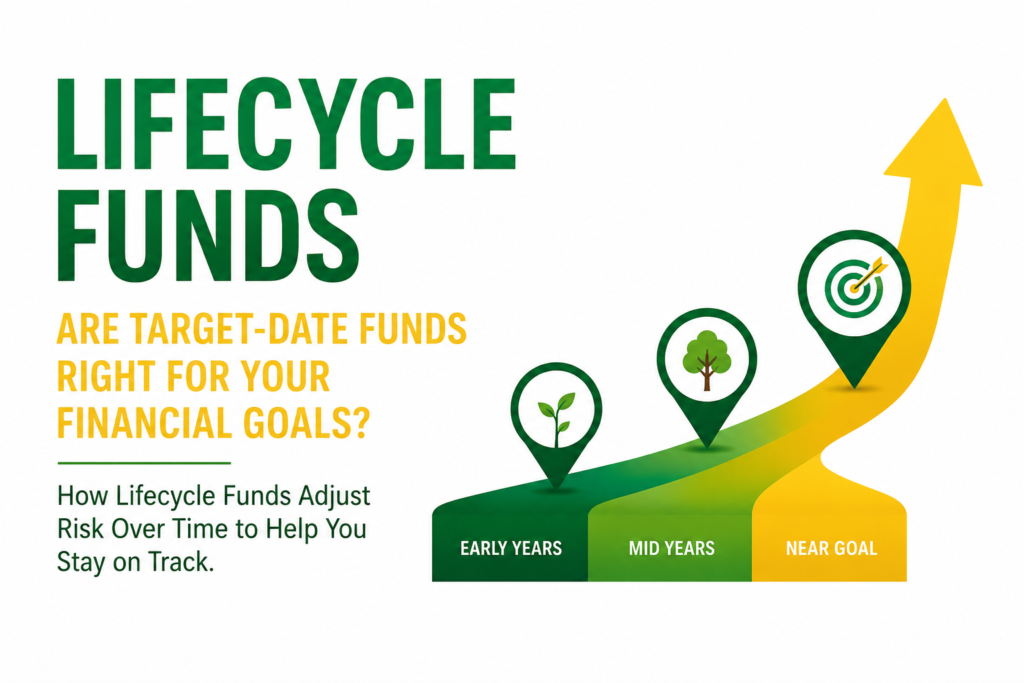
Lifecycle funds, also called target-date funds, are designed around this tension. Their asset allocation changes as the fund approaches a predetermined maturity year, with equity exposure reducing and debt exposure increasing over time.
The concept has gained relevance in India following SEBI’s formal framework for Life Cycle Funds. SEBI’s February 26, 2026 circular, Categorization and Rationalization of Mutual Fund Schemes, establishes the regulatory framework for the category.
But an automatic glide path does not automatically make a fund suitable for every investor. The important question is whether the fund’s target date and changing asset allocation actually fit the investor’s financial goals, risk tolerance and wider portfolio.
Quick Takeaway
- Who may suit lifecycle funds: Investors with a defined time horizon who prefer an automatic, rules-based shift from higher equity exposure toward more conservative allocation as the goal approaches.
- Who may need a more customized strategy: Investors with multiple goals, specific asset-allocation requirements, low tolerance for equity volatility or a strong preference for managing their portfolio themselves.
- One key number: The supplied data shows that the Lifecycle Fund 2046 can have 65% to 95% equity exposure when 15 to 20 years remain, illustrating how aggressively the allocation can be positioned when the target is still distant.
What Are Lifecycle Funds and Target-Date Funds?
A lifecycle fund is built around a specified maturity year. Instead of maintaining the same asset allocation throughout the investment period, the fund follows a defined path in which the equity and debt mix changes as the maturity date gets closer.
SEBI’s February 2026 circular provides the regulatory framework for the Life Cycle Fund category. For investors looking for the primary regulatory reference, the SEBI circular on Categorization and Rationalization of Mutual Fund Schemes is the most relevant source.
For broader mutual fund and investor-education information, investors can also refer to the Association of Mutual Funds in India (AMFI), which describes itself as a source for mutual fund services and information.
The basic investment logic is relatively straightforward. When the target is far away, the fund can maintain a higher allocation to equity. As the target approaches, equity exposure comes down and debt exposure rises.
That progression is commonly described as a glide path.
The distinction matters because a target-date fund is not simply a mutual fund with a year attached to its name. The target year is linked to how the portfolio is expected to evolve over the investment period.
A plain-language explanation of the new category and its glide-path structure is also available from Value Research’s guide to Life Cycle Funds.
How the Lifecycle Fund Glide Path Works
The data provided shows three lifecycle funds with different maturity years: 2036, 2041 and 2046.
Their allocations change depending on how many years remain until maturity.
|
Years remaining |
Lifecycle Fund 2036 |
Lifecycle Fund 2041 |
Lifecycle Fund 2046 |
|
15 to 20 years |
Not applicable |
Not applicable |
Equity 65% to 95%; Debt 5% to 25% |
|
10 to 15 years |
Not applicable |
Not applicable |
Equity 65% to 80%; Debt 5% to 25% |
|
9 to 10 years |
Equity 60% to 65%; Debt 5% to 25% |
Equity 65% to 80%; Debt 5% to 25% |
Equity 65% to 80%; Debt 5% to 25% |
|
5 to 10 years |
Equity 35% to 50%; Debt 5% to 25% |
Equity 50% to 65%; Debt 5% to 25% |
Equity 50% to 65%; Debt 5% to 25% |
|
5 to 9 years |
Equity 35% to 50%; Debt 5% to 25% |
Equity 50% to 65%; Debt 5% to 25% |
Not separately specified in supplied table |
|
3 to 5 years |
Equity 30% to 50%; Debt 25% to 50% |
Equity 35% to 50%; Debt 25% to 50% |
Equity 35% to 50%; Debt 25% to 55% |
|
1 to 3 years |
Equity 20% to 35%; Debt 25% to 65% |
Equity 30% to 35%; Debt 25% to 55% |
Equity 20% to 35%; Debt 25% to 65% |
|
Less than 1 year |
Equity 5% to 20%; Debt 25% to 65% |
Equity 5% to 20%; Debt 25% to 65% |
Equity 5% to 20%; Debt 25% to 65% |
The table shows the central feature of lifecycle investing: the portfolio becomes more conservative as the maturity date approaches.
The ranges also matter. A lifecycle fund does not necessarily have to sit at one fixed equity percentage at every point in time. The allocation can operate within the permitted range.
That gives the fund manager room to position the portfolio while maintaining the broader maturity-linked structure.
For investors, this is an important distinction. Two lifecycle funds with similar target dates should not automatically be assumed to carry identical portfolios. Their positioning within the permitted allocation ranges can differ.
Lifecycle Funds vs Regular Mutual Funds
The main difference between lifecycle funds and regular funds is who takes responsibility for changing the asset allocation.
With a lifecycle fund, the investment structure incorporates a maturity date and a changing allocation. With a regular fund, the investor has more responsibility for deciding when the portfolio should be rebalanced and how much equity and debt exposure should be maintained.
|
Lifecycle Fund |
Regular Fund |
|
Has a predetermined maturity or target date |
No specific maturity date |
|
Asset allocation changes as maturity approaches |
Investor decides when to change allocation |
|
Designed around a defined time horizon |
Can be used for different investment objectives |
|
Rebalancing is incorporated into the fund structure |
Investor takes responsibility for rebalancing |
|
Equity exposure reduces as the target approaches |
Allocation can remain unchanged unless the investor acts |
Neither structure is inherently better.
The choice depends on whether an investor values automation or wants greater control over the portfolio’s asset allocation.
This is also where the concept becomes relevant to behavioral finance. An investor may understand that risk should reduce as a goal approaches but still postpone the decision to rebalance because equity markets are performing well. A lifecycle fund builds that adjustment into the investment structure instead of leaving the entire decision to the investor.
Why Automatic De-Risking Can Help
The strongest argument for lifecycle funds is the discipline they can bring to long-term investing.
Consider an investor who is saving for a financial goal several years away. Early in the investment period, equity can have a larger role because there is more time before the money is required. As the goal approaches, the consequences of a major equity-market decline become more significant.
This is where sequence risk becomes relevant. Sequence risk refers to the risk that poor investment returns occur at an unfavourable point in the investment period, particularly when an investor is approaching the point at which the money will be needed.
A decline several years before a goal may leave time for the portfolio to recover. A similar decline immediately before the goal can create a much more difficult situation.
Lifecycle funds address this problem by gradually changing the portfolio rather than relying on the investor to make a large allocation decision at the last minute.
The supplied material also highlights tax deferral as one of the features of target-date funds. Investors should consider that feature alongside the fund’s asset allocation, maturity structure and suitability rather than treating tax considerations as a substitute for portfolio planning.
Where Target-Date Fund Risk Can Be Misjudged
The simplicity of a target-date fund can make it appealing, but simplicity can also encourage investors to overlook an important question: does the predetermined glide path actually match their circumstances?
Two investors can have the same financial target year and still require very different portfolios.
One investor may have substantial investments elsewhere and therefore already have considerable equity exposure. Another may be relying almost entirely on the lifecycle fund for a future financial goal.
Their target years could be identical, but their overall portfolio risks would not be.
The supplied material identifies several situations where a lifecycle fund may not be appropriate. These include investors who have a specific allocation requirement, want to manage their asset allocation themselves, cannot tolerate the prescribed equity exposure, have no clear goal or target year, or want to take a more concentrated approach.
This is the central limitation of any predetermined investment framework. It can manage the allocation according to its rules, but it cannot automatically know whether those rules remain appropriate for the investor’s complete financial situation.
That is why the lifecycle fund should be assessed as part of the portfolio rather than in isolation.
Who Should Consider Lifecycle Funds?
Lifecycle funds can be a reasonable fit for investors who have a clear investment horizon and want a structured approach to managing risk over time. The structure may be especially useful for someone who does not want to make repeated asset-allocation decisions or monitor when equity exposure should be reduced.
For such an investor, the maturity-linked approach can provide a predefined framework. Instead of having to determine each year whether the portfolio should become more conservative, the fund’s structure handles the transition.
The fit becomes less obvious when the investor has several competing goals.
Suppose someone is simultaneously investing for retirement, a child’s education and another long-term financial objective. Each goal can have a different deadline. A single target date may not adequately represent the risk requirements of the entire financial plan.
The same issue arises when an investor has a strong preference for controlling the equity and debt mix. In that situation, a regular fund combined with deliberate portfolio-level asset allocation may provide greater flexibility.
The decision should therefore consider three things together: the goal, the time horizon and the investor’s tolerance for the fund’s changing allocation.
What Investors Should Monitor Before Choosing a Target-Date Fund
The target year is only the beginning of the analysis.
Investors should first establish whether the fund’s maturity date corresponds to the actual date on which the money is expected to be needed. A target year selected simply because it looks close to a retirement date or another milestone may not reflect the underlying financial requirement.
Next comes the glide path. The investor needs to understand how the equity and debt allocation changes over time and whether that progression is compatible with the investor’s ability to tolerate volatility.
The wider portfolio also matters. If an investor already holds significant equity investments elsewhere, adding a lifecycle fund with a high equity allocation could result in considerably more equity exposure than intended.
The fund’s allocation should therefore be assessed at the portfolio level, not just by looking at the fund in isolation.
There is also a behavioral advantage to reviewing the strategy periodically. An investor’s financial objectives can change even when the fund’s maturity date does not. A change in income, savings requirements or the expected timing of a goal can alter the appropriate investment strategy.
Automatic de-risking is useful, but it should not mean automatic neglect of the overall financial plan.
For readers interested in the broader connection between long-term financial independence and investing decisions, this related resource may also be useful: How to Build Financial Independence Without Waiting Until 60.
What Matters Most for Investors
The most useful way to think about lifecycle funds is through the relationship between time and risk.
A goal that is far away gives an investor more time to absorb market volatility. A goal that is approaching leaves less room for a significant decline to be recovered before the money is required.
The lifecycle structure attempts to reflect that changing risk capacity by reducing equity exposure as maturity approaches.
What matters less is simply choosing the fund with the most aggressive early allocation. Higher equity exposure is accompanied by greater market exposure, and the appropriate level depends on the investor’s circumstances.
The other important point is that the glide path is not a substitute for financial planning. A fund can manage its own asset allocation according to its rules, but it does not know what other investments the investor owns, whether the goal has changed or whether the target date still makes sense.
That distinction is easy to overlook when an investment product appears to automate the entire process.
A Practical Framework for Investors
Before selecting a lifecycle or target-date fund, investors can assess the decision through four questions:
|
Question |
What to evaluate |
|
What is the goal? |
Identify the financial objective for which the investment is being made. |
|
When is the money needed? |
Match the target year with the actual expected requirement. |
|
Can I tolerate the prescribed equity exposure? |
Compare the fund’s allocation path with personal risk tolerance. |
|
What does the rest of my portfolio look like? |
Check whether the fund creates excessive equity or debt exposure when combined with existing investments. |
This framework keeps the decision focused on portfolio construction rather than simply selecting a product.
Final Thoughts
Lifecycle funds offer a useful way to introduce discipline into long-term investing by linking asset allocation to a financial goal’s time horizon. Their biggest strength is also their defining constraint: the investment path is predetermined.
For some investors, that structure can simplify portfolio management. For others, a more customized asset allocation may better reflect multiple goals, existing investments and individual risk requirements.
If you are evaluating whether a lifecycle fund or target-date fund belongs in your portfolio, a review of the entire financial plan can provide more useful answers than looking at the fund in isolation. Book a free consultation call with SJS Finserve to discuss your financial goals, portfolio allocation and investment decisions with a more personalized approach.
Frequently Asked Questions
What is a lifecycle fund?
A lifecycle fund is a mutual fund structure linked to a predetermined maturity year. Its asset allocation changes as the maturity date approaches, with equity exposure reducing and debt exposure increasing according to its glide path.
Are lifecycle funds the same as target-date funds?
The terms are commonly used to describe the same basic investment concept: a fund built around a target or maturity date that changes its asset allocation as that date approaches.
How does a lifecycle fund reduce risk?
The supplied data shows that lifecycle funds progressively reduce equity allocation as fewer years remain until maturity, while debt allocation increases. This is intended to make the portfolio more conservative as the goal approaches.
Are lifecycle funds suitable for every investor?
No. The supplied material specifically identifies circumstances where lifecycle funds may not suit investors, including situations where an investor wants to manage asset allocation independently, cannot tolerate the fund’s equity exposure, has multiple or specific financial goals, or does not have a clear target year.
Should the target year be the only factor when choosing a lifecycle fund?
No. Investors should also consider the fund’s asset-allocation path, their own risk tolerance and the investments they already hold. A target date that appears appropriate does not automatically mean the fund’s allocation is appropriate for the complete portfolio.