What if you did not have to wait until 60 to make work optional?
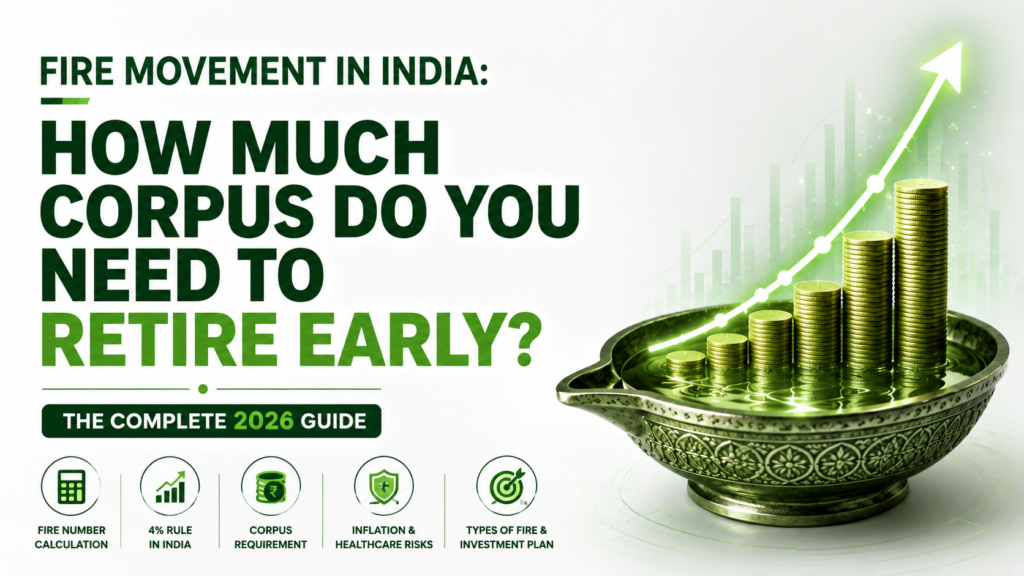
That is the central idea behind the FIRE movement in India, or Financial Independence, Retire Early. Instead of following the traditional path of working for three or four decades before retirement, FIRE focuses on saving aggressively, controlling lifestyle inflation and investing consistently so that your portfolio can eventually support your living expenses.
But FIRE is not simply about quitting your job at 40. The more useful question is whether you can build enough financial independence to choose how you spend your time.
The philosophy traces back to Vicki Robin and Joe Dominguez’s 1992 book Your Money or Your Life, which connected financial independence with moderate consumption, self-sufficiency and greater control over time. Your Money or Your Life One of its most recognised modern examples is Pete Adney, better known as Mr. Money Mustache, who retired from software engineering at 30 after keeping expenses low and investing aggressively. Mr. Money Mustache
For Indian investors, however, the real challenge is adapting the FIRE framework to Indian inflation, healthcare costs, family responsibilities and a potentially much longer retirement period.
What Is the FIRE Movement in India?
The FIRE movement is a financial strategy built around three principles: save a large portion of your income, keep expenses under control and invest the surplus for long-term growth.
FIRE followers often target savings rates of 50% to 70%, although that is not realistic for every household. The objective is to create a large gap between income and expenses and invest that surplus consistently.
This also explains why increasing income is an important part of FIRE. A better-paying job, consulting, a side business, reskilling or negotiating a salary increase can accelerate the journey without requiring extreme cuts to essential spending.
Ultimately, FIRE is less about never working again and more about making work optional.
How to Calculate Your FIRE Number in India: 25x, 30x or 33x?
Your FIRE number is the investment corpus required to support your expected retirement expenses. A traditional starting point is 25 times annual expenses, based on a 4% withdrawal rate. For an early retirement in India, a more conservative 30x to 33x target can provide a larger margin of safety because the retirement period may last several decades.
The traditional formula is:
FIRE Number = Annual Retirement Expenses × 25
For example, if you expect to spend ₹12 lakh a year after retirement, the 25x calculation gives a corpus of ₹3 crore.
The 4% rule originated from historical US market analysis associated with the Trinity Study and William Bengen. Trinity Study William Bengen
For an Indian investor retiring much earlier than the conventional retirement age, however, it is sensible to test a wider range:
|
Annual retirement expenses |
25x |
30x |
33x |
|
₹6 lakh |
₹1.50 crore |
₹1.80 crore |
₹1.98 crore |
|
₹12 lakh |
₹3.00 crore |
₹3.60 crore |
₹3.96 crore |
|
₹18 lakh |
₹4.50 crore |
₹5.40 crore |
₹5.94 crore |
The important point is that 25x is a starting framework, not a guaranteed retirement number.
Your calculation should also consider future inflation, healthcare, family commitments, children’s education, housing costs and other large expenses that may not appear in today’s monthly budget.
Does the 4% Rule Work in India?
The 4% rule is useful for understanding FIRE mathematics, but applying it mechanically to India can be risky.
The original framework was designed around US historical data and a retirement period of roughly 30 years. Someone retiring at 40 may need their portfolio to last 40 or 50 years.
That creates additional uncertainty.
Inflation can steadily increase the amount you need to withdraw. Healthcare costs can become more significant with age. And a large market decline during the first few years of retirement can have a disproportionate impact if you are withdrawing money while the portfolio is falling.
For these reasons, Indian FIRE planning often considers a more conservative withdrawal rate and a larger corpus than the classic 25x calculation. The source material specifically highlights the 30x to 33x range as a more cautious framework for early retirement in India.
The practical lesson is simple: do not ask only whether your corpus is large enough. Ask whether it is large enough for your retirement horizon and spending pattern.
How Much Corpus Do You Need to Retire Early in India?
There is no single FIRE number that works for everyone.
Consider someone who currently spends ₹80,000 a month, or ₹9.6 lakh a year. If they plan to retire 15 years from now, today’s expenses cannot simply be carried forward. They need to estimate what those expenses could look like at retirement after inflation.
This is where FIRE planning becomes more than a simple multiplication exercise.
A person targeting retirement at 40 will generally need a greater safety margin than someone retiring at 60. Similarly, someone supporting parents or funding children’s education may need a significantly larger corpus than a single investor with fewer financial obligations.
The best FIRE calculator in India is therefore not just a 25x calculator. It should allow you to change the assumptions around:
Current expenses → future inflation → retirement age → retirement expenses → corpus target → withdrawal rate
The result should be treated as a range rather than a precise number.
How to Retire Early in India: Three Levers That Matter
1. Increase your savings rate
Saving 50% to 70% of income is difficult if income itself is limited.
That is why FIRE investors often focus on both sides of the equation. Increasing income through a job switch, consulting, a side hustle or additional skills can create investible surplus without requiring drastic reductions in essential spending.
The key is to avoid allowing every salary increase to become lifestyle inflation.
2. Spend wisely, not blindly
FIRE does not require eliminating every enjoyable expense.
Instead, focus on the expenses that have a large recurring impact. Housing, vehicles, debt, dining and lifestyle upgrades can materially change the amount you need to save and eventually the corpus you need to retire.
Every ₹1 lakh reduction in annual retirement spending also reduces the corpus required to fund that spending.
That makes thoughtful spending one of the most powerful FIRE tools.
3. Invest consistently
Saving money is only the accumulation half of the FIRE equation. The surplus also needs an investment strategy capable of supporting long-term wealth creation.
Index funds and ETFs are commonly associated with the FIRE philosophy because they provide broad market exposure through passive investing. AMFI describes index funds as funds that mirror a market index, while ETFs are exchange-traded securities that track an index or other underlying assets.
For Indian investors, understanding the difference between equity, debt and hybrid funds is also important when building a portfolio suited to their risk tolerance and time horizon. Equity vs Debt vs Hybrid Mutual Funds: Which Is Right for You?
Similarly, choosing between large-cap, mid-cap, small-cap and flexi-cap exposure requires understanding how different segments behave across market cycles. Large Cap vs Mid Cap vs Small Cap vs Flexi Cap Funds
For investors building their FIRE corpus through SIPs, the objective should be consistency rather than trying to perfectly time every market movement. How much you invest matters, but so does how long you remain invested. Small-Ticket SIPs Decline by 1.4 Million in FY26 as Larger SIPs Continue to Grow
Types of FIRE: Lean, Fat, Barista and Coast FIRE Explained
FIRE is not a single lifestyle.
- Lean FIRE focuses on a minimalist lifestyle and lower expenses.
- Regular FIRE aims for financial independence while maintaining a comfortable lifestyle.
- Fat FIRE targets a substantially larger corpus so that retirement does not require major lifestyle compromises.
- Barista FIRE combines investment income with part-time work, reducing the amount that must be withdrawn from the portfolio.
- Coast FIRE involves building substantial investments early and then allowing compounding to do much of the remaining work.
For many Indian households, Barista FIRE can be particularly practical because part-time income can reduce pressure on the investment portfolio while still providing greater control over time.
FIRE Movement in India: Inflation, Healthcare and Family Obligations
The biggest risk in an Indian FIRE plan may not be today’s expenses. It is underestimating what those expenses could become over several decades.
Healthcare deserves particular attention because early retirees lose the natural connection between employment and employer-provided benefits. A dedicated healthcare buffer and appropriate insurance can help protect the retirement corpus from large unexpected expenses. For insurance-related information, investors can refer to the Insurance Regulatory and Development Authority of India (IRDAI).
Family responsibilities also need to be built into the FIRE calculation from the beginning. Children’s education, support for parents and other major family commitments should not be treated as surprises after retirement.
For inflation and monetary-policy data, the Reserve Bank of India remains the appropriate primary source.
Is FIRE Possible in India?
Yes, but it is not equally achievable for everyone.
A high-income professional with controlled expenses may be able to accumulate a substantial corpus much faster than someone with a lower income and significant family responsibilities. That does not make FIRE an all-or-nothing goal.
You do not have to retire at 40 for the strategy to work.
Reaching a point where you can take a career break, switch to lower-stress work, start a business or reduce working hours can itself represent meaningful financial independence.
The biggest mistake is treating FIRE as a race to accumulate a fixed number. The better approach is to build a portfolio that matches the life you actually want to live.
The Bottom Line
The FIRE movement in India offers a different way to think about retirement. Instead of asking when you are allowed to retire, it asks how much financial independence you can build and how much control you want over your time.
The traditional 25x rule provides a useful starting point for FIRE number calculation, but early retirees should stress-test their plan against longer retirement horizons, inflation, healthcare and family obligations. A 30x to 33x framework may offer a more conservative starting range, but the right number ultimately depends on your personal circumstances.
FIRE is therefore not simply about saving more. It is about designing a financial plan in which your income, expenses, investments and future goals work toward the same objective.
If you are trying to determine how much corpus you need to retire early in India, a personalised FIRE plan can help you test those assumptions rather than relying on a generic calculator. SJS Finserve can help you evaluate your current investments, savings rate and long-term goals so that your path toward financial independence is built around your actual financial life.
Frequently Asked Questions
What is the FIRE movement in India?
FIRE stands for Financial Independence, Retire Early. It is a financial approach focused on saving aggressively, controlling expenses, and investing consistently to build enough wealth to make full-time employment optional at an earlier age.
How much corpus is needed to retire early in India?
A traditional starting point is 25 times your annual retirement expenses. For early retirement in India, a more conservative target of around 30 to 33 times annual expenses may provide a larger safety margin, depending on inflation, healthcare costs, retirement duration, and personal financial obligations.
Does the 4% rule work in India?
The 4% rule can be used as a starting framework, but it should not be applied mechanically in India. The original framework was based on US historical data and a roughly 30-year retirement period. Early retirees in India may need a longer retirement horizon and a more conservative withdrawal approach.
Is FIRE possible in India?
Yes, FIRE is possible in India, but the timeline depends on income, expenses, savings rate, investment returns, and financial responsibilities. Increasing income, controlling lifestyle inflation, and investing consistently can improve the chances of reaching financial independence earlier.
What are the different types of FIRE?
The main types include Lean FIRE, Regular FIRE, Fat FIRE, Barista FIRE, and Coast FIRE. They differ mainly in lifestyle expectations, required corpus, and whether the individual continues earning some income after reaching financial independence.