
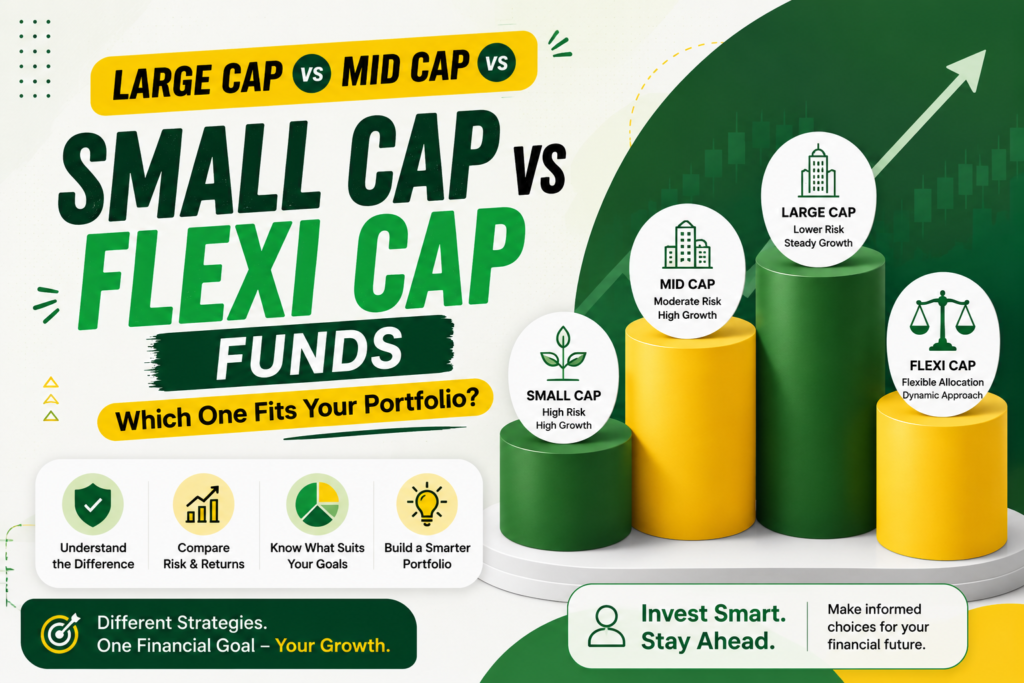
When investors compare equity mutual funds, one question comes up repeatedly: should they invest in Large Cap, Mid Cap, Small Cap or Flexi Cap funds?
The answer is not simply about choosing the category that has delivered the highest returns recently. Each category carries a different level of risk and has a different role in portfolio construction. Large-cap funds generally focus on established companies, mid-cap funds target businesses with greater growth potential, small-cap funds take on higher uncertainty, while flexi-cap funds give the fund manager freedom to move across market-cap segments.
For investors building a long-term portfolio, understanding this difference is more important than chasing whichever category is currently performing well.
Quick Take: Large Cap funds generally offer relatively lower volatility, Mid Cap funds provide a balance between stability and growth, Small Cap funds offer higher growth potential with higher risk, and Flexi Cap funds allow the fund manager to allocate across all three segments.
What Are Large Cap, Mid Cap, Small Cap and Flexi Cap Funds?
Market capitalisation refers to the total market value of a company’s outstanding shares. In India, SEBI’s framework categorises companies based on their market-cap ranking, with AMFI publishing the relevant stock categorisation list.
The broad distinction is straightforward:
| Fund Category | Primary Investment Universe | Relative Risk | Growth Potential |
|---|---|---|---|
| Large Cap | Top 100 companies | Lower | Moderate |
| Mid Cap | 101st to 250th companies | Moderate to High | High |
| Small Cap | 251st onwards | High | Very High |
| Flexi Cap | Large, Mid and Small Cap | Depends on allocation | Depends on portfolio |
This classification does not mean that one category is automatically better than another. The right choice depends on how much equity risk an investor can accept and how long they can remain invested.
Large Cap Funds: The Relatively Stable End of Equity
Large Cap funds invest predominantly in the largest companies in the market. These businesses generally have established operations, stronger market presence and longer operating histories compared with smaller companies.
That makes large-cap funds relatively less volatile than mid-cap and small-cap funds, although they are still equity investments and can fall significantly during broad market corrections.
For investors looking to build the relatively stable part of an equity portfolio, large-cap funds can play an important role. Their appeal is less about chasing the highest possible return and more about gaining exposure to established businesses over the long term.
Mid Cap Funds: More Growth, More Volatility
Mid Cap funds invest predominantly in companies ranked between 101st and 250th by market capitalisation.
These businesses are often further along than small companies but still have room to expand their operations and market share. That creates an attractive growth opportunity, but it also comes with greater volatility than large-cap investing.
Mid-cap funds can therefore suit investors who are comfortable taking more risk in exchange for higher growth potential and who have a sufficiently long investment horizon.
The key is to avoid viewing mid-cap funds as a simple upgrade from large-cap funds. The additional return potential comes with additional uncertainty.
Small Cap Funds: Higher Potential, Higher Risk
Small Cap funds invest predominantly in companies ranked 251st onwards.
Smaller companies can have significant room to grow, particularly when they successfully expand their products, markets or competitive position. However, they can also be more sensitive to economic conditions, liquidity changes and shifts in investor sentiment.
This makes small-cap funds the most volatile of the three market-cap-specific categories discussed here.
For an investor, the important consideration is not whether small caps can deliver strong returns. They can. The more important question is whether the investor can remain invested when those returns come with substantial interim declines.
Small-cap exposure therefore generally requires a higher risk tolerance and a long-term approach.
Flexi Cap Funds: Letting the Manager Decide
Flexi Cap funds take a different approach. Instead of restricting the portfolio to a particular market-cap segment, the fund manager can invest across large-cap, mid-cap and small-cap companies. SEBI’s current framework recognises Flexi Cap as an equity mutual fund category, and scheme documents describe the category as investing dynamically across these segments.
This flexibility can be useful because market opportunities change over time. A manager may prefer larger companies when valuations or market conditions make them more attractive and increase exposure to mid- or small-cap companies when the potential opportunity justifies the additional risk.
However, flexibility also means that two flexi-cap funds can have very different portfolios. Investors should therefore look beyond past returns and understand how a particular fund actually manages its allocation.
For investors who prefer a single diversified equity fund rather than managing separate large-, mid- and small-cap allocations themselves, flexi-cap funds can be worth considering.
Large Cap vs Mid Cap vs Small Cap vs Flexi Cap: Key Differences
The simplest way to understand the categories is to focus on their role within a portfolio.
| Factor | Large Cap | Mid Cap | Small Cap | Flexi Cap |
|---|---|---|---|---|
| Company size | Largest companies | Medium-sized companies | Smaller companies | Any market-cap segment |
| Risk | Relatively lower | Higher | Highest | Variable |
| Volatility | Relatively lower | Moderate to high | High | Depends on allocation |
| Growth potential | Moderate | High | Higher, with greater uncertainty | Variable |
| Investment approach | Stability and established businesses | Growth-oriented | Aggressive growth | Manager-led allocation |
| Portfolio role | Potential core equity exposure | Growth allocation | Higher-risk growth allocation | Flexible diversified equity exposure |
The table should be viewed as a broad framework rather than a prediction of returns. Actual performance can vary significantly between funds and across market cycles.
Flexi Cap vs Multi Cap: Are They the Same?
No. Although both categories can invest across large-, mid- and small-cap companies, the investment approach is different.
A Flexi Cap fund gives the fund manager flexibility to decide how much exposure the portfolio should have to each market-cap segment. A Multi Cap fund follows specific allocation requirements across large-, mid- and small-cap stocks.
This distinction matters because an investor choosing between the two is effectively choosing between greater manager discretion and a more defined market-cap allocation framework.
Which Mutual Fund Category Is Right for You?
There is no single category that is appropriate for every investor.
Large Cap funds may be more suitable for investors looking for relatively lower volatility within equity. Mid Cap funds may appeal to investors willing to accept additional risk for greater growth potential. Small Cap funds require greater tolerance for volatility and uncertainty. Flexi Cap funds may suit investors who prefer to leave market-cap allocation decisions to the fund manager.
Before choosing a category, investors should consider the role the fund is expected to play in the overall portfolio. Adding multiple categories simply because they offer different return profiles can also increase equity exposure without necessarily improving diversification.
If you are new to mutual fund investing, our guide on what are mutual funds provides a broader starting point. Investors comparing equity with other asset classes can also read our guide on equity vs debt vs hybrid mutual funds.
What Should Investors Focus On?
The biggest mistake is selecting a fund category solely because it has recently delivered strong returns.
Market leadership changes. A category that performs strongly during one phase of the market can experience a sharp correction in another. The better approach is to match the category with your risk tolerance, investment horizon and broader portfolio.
A practical way to think about it is:
- Large Cap: Focus on relatively greater stability within equity.
- Mid Cap: Accept more volatility for higher growth potential.
- Small Cap: Take significantly higher risk for potentially higher growth.
- Flexi Cap: Give the fund manager flexibility to allocate across market caps.
The objective should be to build a portfolio that you can remain invested in through different market conditions, rather than one that looks attractive only when markets are rising.
Conclusion
Large Cap, Mid Cap, Small Cap and Flexi Cap funds serve different purposes within an equity portfolio. Large caps generally provide greater stability, mid caps offer a higher-growth opportunity with additional volatility, small caps provide greater growth potential but substantially higher risk, and flexi caps allow the fund manager to move across market-cap segments.
The right choice is therefore not about identifying the “best” category. It is about understanding how much risk you are taking and whether that risk is appropriate for your financial goals and investment horizon.
If you are unsure how different mutual fund categories should fit into your portfolio, a professional review can help you make the decision with greater clarity. SJS Finserve can help you evaluate your investment approach and make more informed long-term financial decisions.