
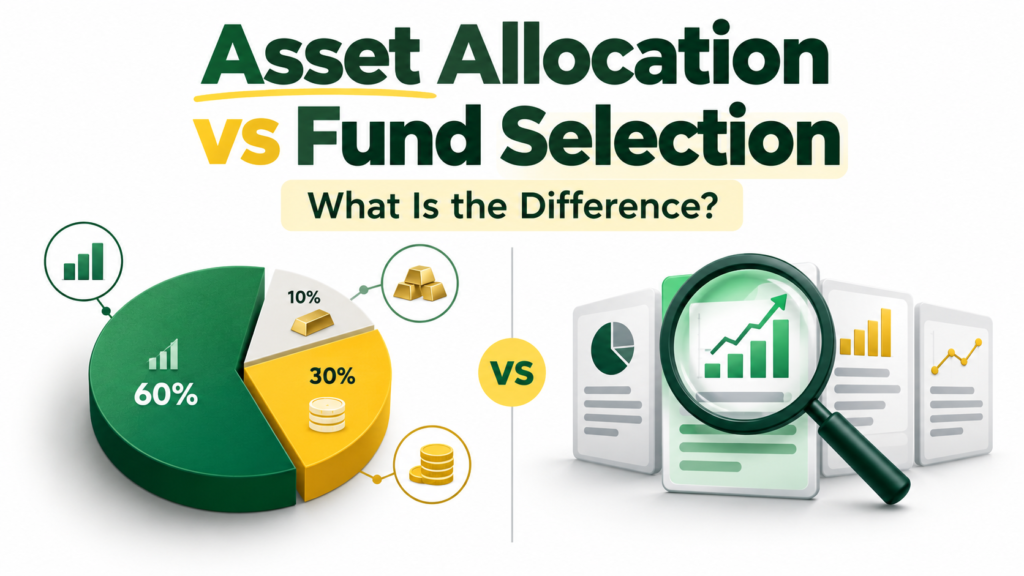
Asset Allocation vs Fund Selection: What Is the Difference?
Asset allocation is the decision of how much money goes into each asset class. For Indian investors the main ones are equity (shares and equity mutual funds), debt (bonds, debt funds, fixed deposits, PPF), gold (gold ETFs and gold funds) and cash. A typical allocation reads like this: 60% equity, 30% debt, 10% gold.
Fund selection comes after that. Once you have decided on 60% equity, you pick the funds that fill it, such as an index fund, a flexi-cap fund or a large-cap fund, and the fund houses that run them.
What Does the Research Say?
The most quoted number in this debate is 90%. It comes from studies by Brinson, Hood and Beebower, and it is often repeated wrongly. It does not mean that asset allocation produces 90% of your returns. In 2000, Roger Ibbotson and Paul Kaplan separated the question into three parts in the Financial Analysts Journal. Using data on balanced mutual funds and pension funds, they found:
• About 90% of the ups and downs in a fund’s returns over time are explained by its asset allocation. When markets move, the mix explains most of how the portfolio moves.
• About 40% of the difference in returns between two funds is explained by their asset allocation. The rest comes from fund selection, costs and timing.
• About 100% of the average level of returns is explained by the return of the asset allocation policy. The average fund earned roughly what its asset-class benchmarks earned.
The accurate summary is this: your asset mix explains most of how your portfolio behaves and a large part of why one investor ends up with more than another. Fund selection explains the remainder, and its contribution is smaller and less reliable.
What Does Indian Data Show?
Most active funds struggle to beat their benchmark
S&P Dow Jones Indices publishes the SPIVA India scorecard, which compares actively managed funds with their benchmark indices. In the year-end 2025 report, 74.2%, 84.4% and 76.3% of active large-cap funds underperformed their benchmark over 3, 5 and 10 years. Over 10 years, 79.0% of mid- and small-cap funds also underperformed. In the first half of 2026, most funds again lagged in every equity category.
Benchmark choice in SPIVA is debated, since large-cap funds are measured against a large- and mid-cap index, but the direction is consistent. Picking a winning fund in advance is hard, and a weak pick costs you every year through lag and fees.
The best asset class changes every few years
In 2025, gold returned about 61.5% on MCX according to Axis Securities, while the Nifty 50 gained roughly 10%. Over the past 10 to 15 years the picture is reversed: Business Standard reports 12% to 15% a year for Nifty 50 ETFs against 8% to 9% for gold. Over 20 years, a December 2025 report put the four main asset classes close to the figures below.
|
Asset class |
Approx. 20-year return a year |
Role in a portfolio |
|
Equity (Nifty 50) |
13.5% to 14.4% |
Main growth driver. Can fall sharply in bad years. |
|
Gold |
About 15% |
Often holds up when equities fall. Rupee weakness added to this figure. |
|
Real estate |
About 7.8% |
Needs large amounts and is hard to sell quickly. |
|
Debt |
About 7.6% |
Adds stability and income. Lags equity over long periods. |
Equity range reflects different sources and end dates, including FundsIndia data for Nifty 50 TRI. Past returns do not predict future returns.
No asset class led in every period. An investor who put everything into last year’s winner would have been wrong several times. A planned mix keeps you invested through those switches.
Indian households hold money in a narrow set of assets
A Jefferies analysis reported by Cafemutual put property at 50.7% and gold at 15.5% of Indian household assets in March 2023, with bank deposits at 14% and equities at 4.7%. That is an asset allocation, and for most families it was never planned.
Investors are also contributing steadily. AMFI data for September 2026 shows record monthly SIP contributions of ₹32,490 crore from about 10.06 crore SIP accounts, in a month when industry assets fell 5.1% to ₹82.64 lakh crore. SIPs build the habit. The split between equity, debt and gold still decides the outcome.
A Simple Example With Numbers
The figures below are assumptions for illustration, not forecasts. Assume equity earns 12% a year and debt earns 7% a year over 15 years. Each investor starts with ₹10 lakh and uses equally good funds.
|
Investor |
Equity / Debt |
Blended return |
Value after 15 years |
|
A: higher equity mix |
80 / 20 |
11% a year |
₹47.9 lakh |
|
B: lower equity mix |
20 / 80 |
8% a year |
₹31.7 lakh |
|
B with a fund that adds 1% a year |
20 / 80 |
9% a year |
₹36.4 lakh |
Even if Investor B finds a fund that beats its peers by a full percentage point every year, the portfolio still ends about ₹11.4 lakh behind Investor A. The mix created the gap. Investor A would also have faced much larger falls in bad years and might not stay invested through them. The right mix is the one that fits your goal, your time horizon and your ability to absorb a loss.
Does Fund Selection Still Matter?
Yes, within limits. Differences between funds are real. The SPIVA data showed that in 2025 bottom-quartile ELSS funds trailed top-quartile peers by more than 6% (SPIVA India report). Costs also add up: a fund that charges 1% more every year takes a visible share of returns over 15 to 20 years. Sensible selection means:
• Checking that the fund fits its stated category and your goal.
• Comparing it with the right benchmark and with peers over several market cycles, not just the last year.
• Reviewing the expense ratio and the consistency of the fund manager’s approach.
• Avoiding several funds that hold the same stocks.
How to Build Your Asset Allocation in 5 Steps
1. List your goals with dates. For example, a home down payment in 5 years, a child’s education in 12 years and retirement in 25 years. Each goal has its own time horizon and its own mix.
2. Secure the base first. Keep an emergency fund of about six months of expenses and have adequate term and health insurance before taking market risk.
3. Separate risk capacity from risk tolerance. Capacity depends on income stability, dependants and loans. Tolerance is how you would react to a 25% to 30% fall. Use the lower of the two.
4. Match the mix to the time horizon. The ranges below are commonly used in planning. They are illustrative and not a recommendation for any individual.
|
Time to goal |
Typical equity share |
Typical debt and gold share |
|
Under 3 years |
0% to 20% |
80% to 100%, mostly debt |
|
3 to 7 years |
30% to 60% |
40% to 70% |
|
More than 7 years |
60% to 80% |
20% to 40% |
Many planners keep gold to a smaller slice of the portfolio, often 5% to 15%.
5. Implement with suitable funds and SIPs. Under SEBI rules, multi asset allocation funds must hold at least 10% in each of three asset classes, so one fund can give a spread, though you do not control the exact split. Tax also affects the choice: per the FY 2026-27 tax reckoner, equity fund gains held over 12 months are taxed at 12.5% above ₹1.25 lakh a year, while debt funds bought after 1 April 2023 are taxed at your slab rate.
To see what monthly SIP a goal needs, use the SJS Finserve calculators.
Rebalancing: Keeping the Mix on Track
Markets move your mix over time. A 60:40 equity-debt portfolio can drift to about 65:35 after a strong equity year. Rebalancing means bringing it back to target, either by directing new SIP money to the lagging asset or by selling part of the one that has grown. Review at least once a year, or when any asset class moves 5 percentage points from its target. Rebalancing also forces you to trim what has risen and add to what has lagged, which is hard to do alone during a rally or a crash. Check the tax impact before selling.
Common Mistakes to Avoid
• Choosing funds before deciding the mix.
• Holding many overlapping funds and calling it diversification.
• Buying an asset after a sharp rally, as many investors did with gold and small caps.
• Keeping most savings in one asset by habit, such as property or fixed deposits.
• Using one allocation for every goal.
• Never reviewing or rebalancing.
How SJS Finserve Can Help
SJS Finserve Private Limited is an AMFI-registered mutual fund distributor and insurance broker serving clients in Delhi NCR and Gurugram. Our wealth advisory process follows the same order as this article. We start with your income, family responsibilities, loans and existing investments, set an asset allocation for each goal, implement it through SIPs and mutual funds, and review it at regular intervals. We explain the risk in every product and we do not promise guaranteed returns.
If your money is spread across fixed deposits, policies, mutual funds and property with no single plan, a portfolio review is the logical first step. You can read more about us, meet our team, browse our blog, or contact SJS Finserve to book a free consultation.
Frequently Asked Questions
What is asset allocation in simple words?
It is the way you divide your money between equity, debt, gold and cash, based on your goals, time horizon and ability to handle losses.
Is asset allocation really more important than fund selection?
For most investors, yes. Research by Ibbotson and Kaplan found that asset allocation explains about 90% of a fund’s ups and downs over time and about 40% of the return differences between funds. Fund selection still matters, but it works inside the mix you have chosen.
What is a good equity-debt split for an Indian investor?
There is no single answer. A longer horizon usually supports more equity, and a goal under three years usually needs mostly debt. Income stability and comfort with falls also matter, so a personal review is better than a fixed rule.
How often should I rebalance my portfolio?
At least once a year, or when an asset class drifts about 5 percentage points from target. Directing fresh SIP money to the lagging asset can reduce the need to sell and the tax that follows.
Should I invest in gold?
Many investors hold a small share for diversification. Gold led in 2025, but over 10 to 15 years Nifty 50 funds returned more, so gold works better as a diversifier than as the main holding.
Can one mutual fund give me asset allocation?
Multi asset allocation funds and balanced advantage funds spread money across asset classes. You do not control the exact split, so check that the fund’s mix fits your goal and horizon.
Does a good asset allocation guarantee returns?
No. It reduces dependence on one market and helps you stay invested, but all market-linked investments carry the risk of loss.
Mutual fund investments are subject to market risks. Read all scheme-related documents carefully. Past performance is not indicative of future returns. Examples in this article are illustrative and are not investment advice or a recommendation. SJS Finserve Private Limited | AMFI-registered Mutual Fund Distributor | ARN-332811.


