When you start investing in mutual funds, one question appears very quickly: Should I invest in equity, debt or hybrid mutual funds?
The question sounds simple, but it can lead a new investor in the wrong direction. Many beginners start by searching for the best mutual funds in India in 2026. They compare recent returns, look at star ratings and try to find the fund that has performed the best. But a fund that delivered a strong return last year may not be the right investment for your financial goal.
A person investing for retirement 20 years from now has very different needs from someone saving for a house down payment in three years. Similarly, an investor who can comfortably handle a 20% temporary fall may need a different portfolio from someone who would panic and sell after a market decline.
This is why the better question is not: Which mutual fund is best?
It is: Which type of mutual fund is right for my goal, time horizon and risk level?
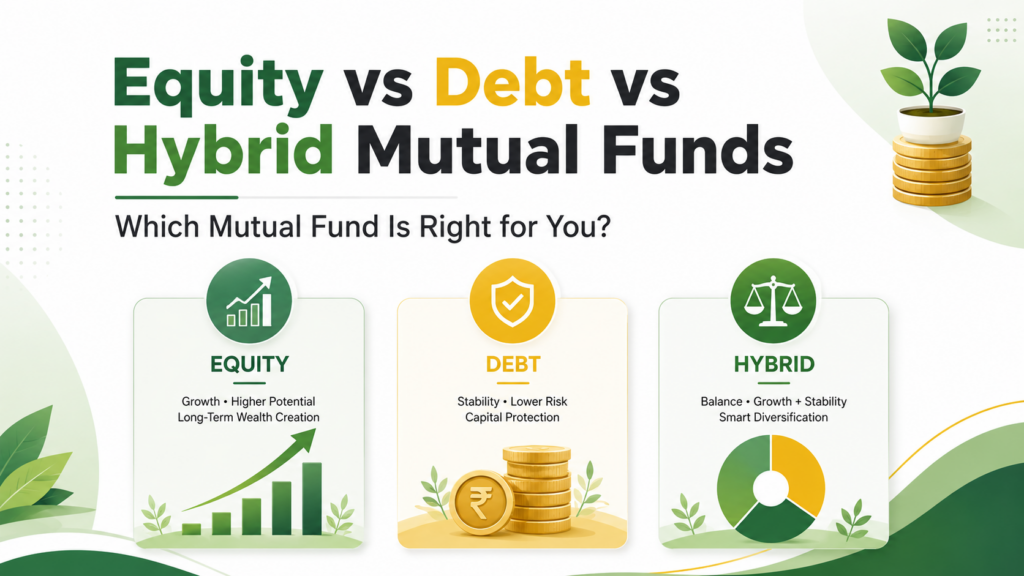
Equity funds are generally used for long-term growth. Debt funds invest mainly in fixed-income instruments and can play a role where stability is more important. Hybrid funds combine equity and debt. Understanding this difference is the first step towards building a portfolio that matches your actual financial needs.
If you are completely new to mutual funds, our simple guide to mutual funds for first-time investors is a useful starting point.
Equity Mutual Funds
Equity mutual funds invest predominantly in equity and equity-related instruments. For a beginner, the simplest way to understand equity funds is to think of them as long-term growth investments.
When you invest in an equity mutual fund, your money is ultimately invested in businesses. If those businesses grow and create value over time, your investment has the potential to grow as well.
But that growth comes with a price which is volatility. Equity markets can move sharply in both directions. Company earnings, interest rates, economic conditions, global events, elections and investor sentiment can all affect stock prices.
This means an equity fund can show a loss even when your long-term investment idea is still sound. That is why time horizon matters so much.
Suppose you are investing for retirement and the money will not be needed for 20 years. A market correction today may be uncomfortable, but you still have many years for the portfolio to recover and potentially compound.
Now consider money that you need for a house purchase in 18 months. A major equity market fall shortly before the purchase could create a very different problem. For this reason, equity funds are generally more suitable for long-term financial goals and investors who can tolerate market volatility.
The key lesson is simple: Higher growth potential usually comes with higher short-term uncertainty.
Debt Mutual Funds
Debt mutual funds invest in fixed-income instruments such as government securities, corporate bonds and money market instruments. The easiest way to understand debt investing is to think of it as lending rather than owning.
With equity, you become an indirect owner of businesses through the shares held by the fund. With debt securities, the fund invests in instruments where the issuer has an obligation to pay interest and repay the principal according to the terms of the security.
Debt funds can therefore play an important role in portfolios where investors want a different risk and return profile from equity. However, there is an important misconception to avoid.
Debt funds are not risk-free.
They can be affected by interest-rate movements, changes in bond prices, credit quality and other factors. The level of risk also varies across different debt fund categories.
A debt fund investing in high-quality short-duration instruments can have a very different risk profile from a fund taking greater credit or duration exposure. Therefore, choosing a debt fund should not be based only on the assumption that “debt means safe”.
The investment horizon and the specific type of debt fund matter. For shorter or medium-term goals, debt-oriented investments may sometimes make more sense than taking a large amount of equity risk. But the correct choice depends on the goal, the time available and the investor’s risk profile.
Hybrid Mutual Funds
Hybrid mutual funds combine equity and debt in the same investment strategy.
This can make them attractive to investors who want exposure to equity but also want another asset class in the portfolio. However, “hybrid” does not mean that every hybrid fund has the same level of risk.
Some hybrid categories have a much higher equity allocation. Others have a larger debt allocation. Balanced Advantage or Dynamic Asset Allocation funds can also change their equity and debt exposure according to their stated strategy.
AMFI provides the official categorization of mutual fund schemes, including different hybrid fund categories. You can refer to the AMFI guide to mutual fund scheme categorization for the formal category structure.
The attraction of a hybrid fund is the combination. The equity portion can provide long-term growth potential, while the debt portion can provide diversification and a different source of risk and return.
But there is a trade-off. During a strong equity market, a hybrid fund may not rise as much as a pure equity fund because part of its portfolio is invested in debt or other assets. That is not necessarily a weakness. It is simply the result of having a more diversified asset mix.
The important thing is to understand what the specific hybrid fund actually owns rather than assuming that every hybrid fund is automatically conservative. For a wider explanation of mutual fund categories, you can also read our complete guide to types of mutual funds in India.
Equity vs Debt vs Hybrid Mutual Funds: Comparison
The broad differences become easier to understand when you compare them side by side.
| Feature | Equity Funds | Debt Funds | Hybrid Funds |
|---|---|---|---|
| Main investment | Equity and equity-related instruments | Bonds, government securities and money market instruments | Combination of equity and debt |
| Main objective | Long-term growth | Stability and income-oriented investing | Combination of growth and stability |
| Market volatility | Generally higher | Generally lower than equity, but varies by fund | Depends on equity allocation |
| Main risks | Equity market volatility | Interest-rate, credit and other debt-market risks | Equity and debt-related risks |
| Typical use | Long-term goals | Goals where stability is important | Investors seeking a mixed allocation |
| Tax treatment | Depends on equity-oriented classification | Depends on tax classification | Depends on underlying allocation and tax classification |
The Bigger Question Is Not Equity vs Debt vs Hybrid
For a first-time investor, it can be tempting to choose between equity, debt and hybrid mutual funds as if only one can be right.
But your financial life usually has more than one goal. You may be investing for retirement 20 years from now, a house purchase in three years, or another goal somewhere in between. Each goal can require a different mix of growth and stability.
This is where asset allocation becomes important. Instead of searching for one fund that does everything, you can use equity, debt and hybrid funds for different roles in your portfolio. Equity can provide long-term growth potential, debt can add stability, while hybrid funds can provide a combination of both within a single fund.
How Asset Allocation Can Change With Your Goal
Consider a retirement goal that is 20 years away. With a long time horizon, an investor may be comfortable with a higher equity allocation for growth, along with debt or hybrid exposure for diversification.
For example, an illustrative portfolio could have 60% Equity Funds, 20% Hybrid Funds and 20% Debt Funds.
Now consider a house down payment that is three years away. Since the money will be needed sooner, stability becomes more important. An investor might consider 70% Debt Funds, 20% Hybrid Funds and 10% Equity Funds, depending on their risk profile and financial situation.
These are only illustrations, not universal recommendations.
| Financial Goal | Time Horizon | Illustrative Allocation | Main Thinking |
|---|---|---|---|
| Retirement | 20 years | 60% Equity + 20% Hybrid + 20% Debt | Higher growth potential with diversification |
| House down payment | 3 years | 70% Debt + 20% Hybrid + 10% Equity | Greater focus on stability |
The key lesson is simple: your goal should come before your fund selection.
Which Mutual Fund Is Right for You?
There is no universal answer. If you have a long-term goal and can handle market volatility, equity funds may have a larger role in your portfolio. If capital stability is more important, debt funds may be more relevant.
If you want both equity and debt exposure in one investment strategy, a hybrid fund may be worth considering.
For a first-time investor, start with five questions:
- What is my financial goal?
- When will I need the money?
- How much market volatility can I tolerate?
- Should my portfolio use equity, debt, hybrid funds, or a combination?
- Which specific fund category fits that allocation?
What Matters More Than Finding the “Best” Fund
Past returns can make a fund look attractive, but the best-performing fund is not automatically the best choice for you.
A high-growth equity fund may suit a long-term goal but may be unsuitable for money needed in three years. A debt fund may offer greater stability but may not provide enough growth for a long-term goal. A hybrid fund can provide a middle path, but its risk still depends on its equity and debt allocation.
Experienced investors therefore think about portfolio construction, not just individual fund selection. The objective is not to eliminate risk. It is to take the right amount of risk for each financial goal.
The Bottom Line
Equity, debt and hybrid mutual funds are different tools, and each can play a different role in a portfolio.
Equity funds can focus on long-term growth. Debt funds can add stability. Hybrid funds can combine equity and debt exposure for investors looking for a more balanced approach.
The right strategy is therefore not always about choosing one category. It is about understanding when and why each category may have a place in your portfolio.
If you are unsure how to structure your portfolio across equity, debt and hybrid funds, you can book a consultation call with SJS Finserve to discuss your financial goals and investment decisions.
If you are unsure whether equity, debt or hybrid funds fit your financial goals, book a call with SJS Finserve to discuss your investment needs and make more informed financial decisions.
Frequently Asked Questions
Common questions about equity, debt and hybrid mutual funds.
Which is better, equity or debt mutual funds? +
Equity funds are generally suited to long-term growth, while debt funds focus more on stability. The right choice depends on your goal and time horizon.
Are hybrid mutual funds good for beginners? +
They can be suitable for beginners who want a mix of equity and debt, but their risk depends on the specific hybrid fund.
How long should I invest in equity mutual funds? +
Equity funds are generally more suitable for long-term goals, especially when you can stay invested for 5 years or more.
Which mutual fund is suitable for short-term goals? +
Debt-oriented investments may be more suitable when capital stability is important, depending on the goal and fund selected.
Can I invest in equity, debt and hybrid funds together? +
Yes. Different fund categories can be used for different goals as part of an overall asset allocation strategy.