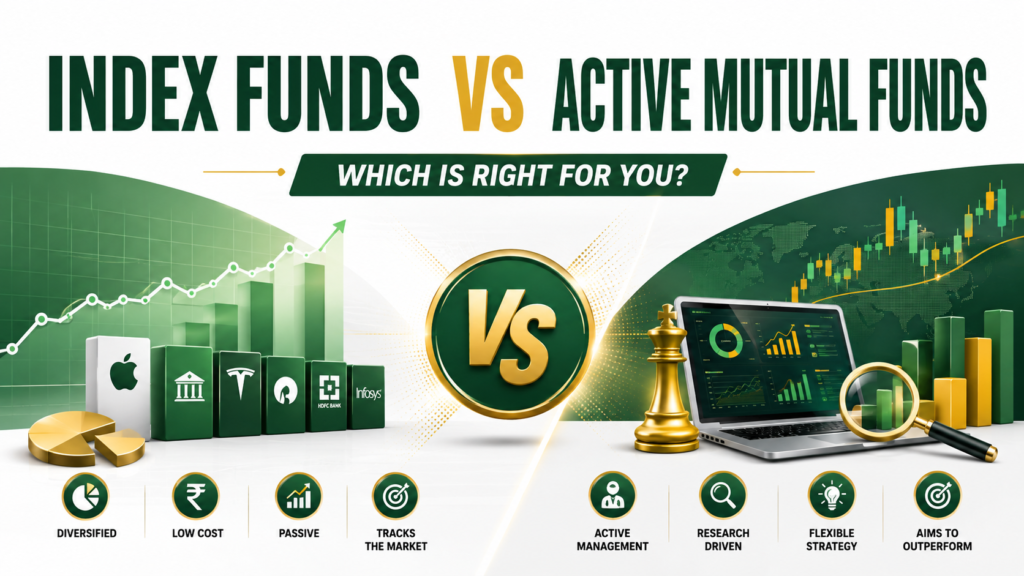
If you are new to mutual funds, you may have come across index funds and active mutual funds and wondered which one is better.
There is one important clarification first. An index fund is itself a type of mutual fund. The real comparison is between passive investing through index funds and actively managed mutual funds.
The choice comes down to how you want your money managed, how much you want to pay, your investment horizon and whether you want to simply track the market or try to outperform it.
Index Funds vs Active Mutual Funds at a Glance
| Factor | Index Funds | Active Mutual Funds |
|---|---|---|
| Investment style | Passive, tracks an index | Active, managed by a fund manager |
| Objective | Closely match benchmark performance | Aim to outperform the benchmark |
| Cost | Generally lower | Generally higher |
| Portfolio changes | Mainly when the index changes | Based on research and market opportunities |
| Key dependency | Underlying index | Fund manager and strategy |
| Investor involvement | Relatively simple | Requires more fund evaluation |
For investors who want to understand the broader market, resources from AMFI and SEBI Investor can provide additional investor education.
What Are Index Funds?
An index fund is a mutual fund that aims to replicate a market index. For example, a fund may track the Nifty 50 or Sensex by investing in the companies that form part of the index.
You can check the composition and details of the NSE Nifty 50 Index and the BSE Sensex directly from the respective exchanges.
The objective of an index fund is not to beat the market. It is to closely follow its chosen benchmark. Since there is generally less active research and trading, index funds tend to have lower expense ratios than actively managed funds.
However, the fund’s performance may not exactly match the index. The difference can arise from expenses and tracking error.
Why Investors Consider Index Funds
- Lower costs: Passive funds generally have lower expenses.
- Simplicity: The investment strategy is easier to understand.
- Diversification: A single index can provide exposure to multiple companies and sectors.
- Less dependence on fund manager decisions: The portfolio primarily follows the chosen index.
What Are Active Mutual Funds?
An actively managed mutual fund uses professional fund managers and research teams to select investments.
The objective is to outperform a relevant benchmark. Managers can change the portfolio based on their research, valuations, market conditions and investment strategy.
This flexibility can create opportunities that a broad index may not capture. But active management generally comes with higher costs, and outperformance is not guaranteed.
For investors comparing mutual fund categories, understanding where a fund invests is important. You can also read our guide on Large Cap vs Mid Cap vs Small Cap vs Flexi Cap Funds to understand how different equity fund categories can behave.
Cost Can Make a Difference
Costs may look small when viewed annually, but they can become significant over a long investment period.
The supplied illustration shows that a Rs 10 lakh investment in a passive fund charging 0.50% can grow to roughly Rs 54 lakh over 15 years at an assumed 13% gross return, compared with about Rs 50 lakh for the same investment in an active fund charging 1.00%.
This is an illustration, not a return expectation. It shows why investors should consider expense ratios when comparing funds.
You can also read our article on The Power of Compounding in Mutual Funds to understand why costs and time can matter significantly to long-term wealth creation.
Which Is Better for You?
There is no single answer.
An index fund may suit an investor who wants simple, diversified market exposure with relatively low costs and does not want returns to depend heavily on a fund manager’s stock selection.
An active mutual fund may suit an investor who is comfortable with professional management and wants the possibility of outperforming the benchmark.
Your decision should focus on four things:
- Investment goal: What are you investing for?
- Risk tolerance: How much market volatility can you accept?
- Investment horizon: How long can you stay invested?
- Cost and strategy: Does the fund’s cost and investment approach make sense for you?
It is also important not to assume that index funds are automatically low risk. Their risk depends on the index they track. Similarly, an active fund is not automatically riskier. Its risk depends on its portfolio and investment strategy.
Can You Invest in Both?
Yes. Index and active funds do not necessarily have to be competing choices.
Some investors may use index funds for broad market exposure and selected active funds for specific investment strategies. The key is to give every fund a clear role rather than adding funds simply to create the appearance of diversification.
For a new investor, the objective should be to build a portfolio that is simple enough to understand and appropriate for the financial goal.
What Should You Check Before Investing?
Do not select a fund only because it delivered strong returns recently.
For an index fund, look at:
- The underlying index
- Expense ratio
- Tracking error
- Portfolio composition
For an active mutual fund, consider:
- Investment strategy
- Fund manager’s approach
- Portfolio composition
- Expense ratio
- Historical performance and consistency
Investors can also use the SEBI website and SEBI Investor portal for regulatory and investor education resources.
Index Funds vs Active Mutual Funds: The Bottom Line
Index funds aim to follow the market at relatively low cost. Active mutual funds aim to outperform the market through professional investment decisions.
Neither is automatically better for every investor. The right choice depends on your financial goals, risk tolerance, investment horizon, costs and how comfortable you are with active management.
Starting Small or Building for Long-Term Goals?
If you are just starting your investment journey and want a simple way to begin with small amounts, index funds can be a straightforward option. They provide diversified exposure to a market index without requiring you to evaluate individual stocks or actively managed fund strategies.
But if you are serious about investing for long-term financial goals, the decision may require more than simply choosing an index fund. Your portfolio may need to consider your goals, investment horizon, risk profile, asset allocation and the right combination of mutual fund categories.
This is where professional guidance can add value. A financial professional can help you evaluate suitable actively managed mutual funds, select schemes based on your financial objectives and risk profile, and build a diversified portfolio rather than relying on a single fund or recent performance.
The objective is not to promise higher returns or eliminate risk. It is to create a well-structured portfolio that is aligned with your goals and has the potential to outperform a simple market-tracking approach over the long term, while keeping portfolio risk appropriate to your circumstances.
If you are unsure whether you should start with an index fund or build a professionally guided mutual fund portfolio, SJS Finserve can help you understand the options and make an informed investment decision based on your financial goals and risk profile.
Contact SJS Finserve to discuss your investment requirements and take the next step with greater clarity.
Frequent Answer Questions
Are index funds and mutual funds the same?
An index fund is a type of mutual fund. The key difference is that index funds follow a passive investment strategy and aim to track a market index, while actively managed mutual funds are managed by fund managers who aim to outperform their benchmark.
Are index funds better than active mutual funds?
Neither is automatically better for every investor. Index funds may suit investors looking for simple, diversified market exposure at relatively low cost. Active mutual funds may suit investors who want professional management and the potential for benchmark outperformance. The right choice depends on your financial goals, risk profile and investment horizon.
Are index funds low risk?
Index funds are still subject to market risk. Their risk depends on the index they track and the securities within that index. A diversified index fund can spread exposure across several companies, but it does not protect investors from market declines.
Why do index funds usually have lower costs?
Index funds follow a predefined market index and generally require less active research, stock selection and portfolio changes. This can result in lower expenses compared with actively managed mutual funds.
Can active mutual funds outperform index funds?
Active mutual funds aim to outperform their benchmarks, but outperformance is not guaranteed. Results depend on the fund’s strategy, portfolio, market conditions, costs and the effectiveness of the investment decisions made by the fund manager.
Should a beginner invest in index funds?
Index funds can be a relatively simple starting point for investors who want diversified market exposure without selecting individual stocks. However, the suitability of any investment depends on the investor’s goals, risk profile and investment horizon.
Can I invest in both index funds and active mutual funds?
Yes. Investors can use both approaches within a portfolio when appropriate. An index fund can provide broad market exposure, while selected active mutual funds can be used for specific investment strategies. The overall portfolio should have a clear purpose and remain aligned with the investor’s financial goals.
Should I choose a mutual fund based only on past returns?
No. Past performance should not be the only factor when selecting a mutual fund. Investors should also consider the fund’s investment strategy, risk, costs, portfolio, consistency and suitability for their financial objectives.
When should I consider professional financial guidance?
Professional guidance can be useful when you have multiple financial goals, a longer investment horizon or are unsure how to select and combine mutual funds. A suitable portfolio should consider your goals, risk profile, investment horizon and overall financial situation.
Can SJS Finserve help me choose mutual funds?
SJS Finserve, an AMFI-registered Mutual Fund Distributor, can help investors understand mutual fund options and select suitable schemes based on their financial goals and risk profile. You can contact SJS Finserve to discuss your investment requirements.