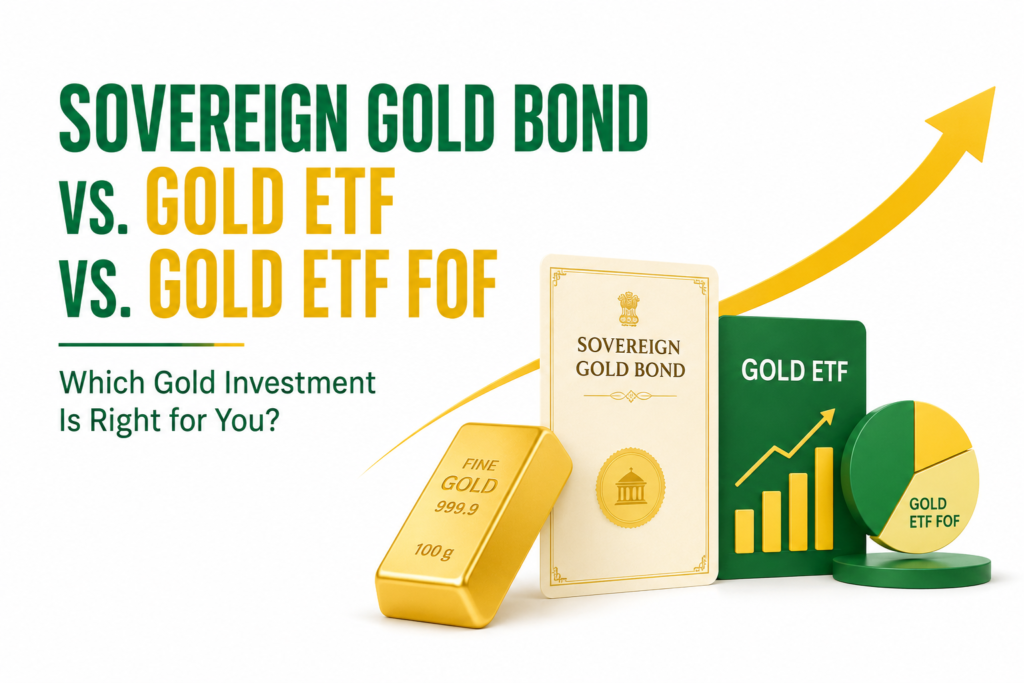
Gold investors today have more choices than simply buying jewellery, coins or bars. Sovereign Gold Bond vs Gold ETF vs Gold ETF FoF is now a practical portfolio decision, particularly for investors who want gold exposure without holding physical metal.
But the comparison is not as simple as asking which product gives the highest return.
An investor with a long-term horizon, limited need for liquidity and an existing SGB may look at the decision very differently from someone who wants to buy gold every month through a SIP. Similarly, an investor who already uses a demat account may find a Gold ETF straightforward, while another investor may prefer the mutual fund route through a Gold ETF Fund of Fund.
There is also an important 2026 consideration that changes the SGB comparison: the Government of India has not announced a new SGB tranche after the February 2024 Series IV issue. RBI’s official SGB records currently show redemption activity for existing bonds rather than a new issuance calendar.
So for a new investor today, the question is not simply “Should I buy an SGB?” It is first whether an SGB is actually available through a new issue, or whether the investor is considering an existing bond in the secondary market.
Sovereign Gold Bond vs Gold ETF vs Gold ETF FoF at a Glance
| Factor | Sovereign Gold Bond | Gold ETF | Gold ETF FoF |
|---|---|---|---|
| Basic structure | Government security linked to gold price | Exchange-traded fund providing gold exposure | Mutual fund investing in Gold ETFs |
| How investor buys | Issued by designated channels when a tranche is offered; existing bonds can also trade in the secondary market | Through stock exchange | Through mutual fund route |
| Liquidity | Secondary-market liquidity can vary; premature redemption is subject to scheme rules | Exchange-based liquidity during market hours | Redemption through mutual fund at applicable NAV |
| Interest | 2.5% p.a. for the SGB series that carried this rate | No assured interest | No assured interest |
| SIP convenience | Not designed primarily as a recurring SIP product | Recurring purchases can be made through the market, depending on platform | Mutual fund SIP route can be convenient |
| Demat requirement | Depends on how the SGB is held | Generally yes for exchange trading | Not necessarily |
| Main return driver | Gold price plus applicable interest | Gold price, less expenses and tracking difference | Gold price through underlying ETF, less applicable expenses |
| Cost considerations | Product and transaction related considerations | Expense ratio, brokerage and other transaction costs | FoF expenses plus expenses of underlying ETF |
| Best evaluated for | Existing holders and investors comfortable with longer holding structures | Liquidity and direct exchange access | Mutual fund convenience and systematic investing |
The table is the useful starting point, but it is not the final decision. The investor’s time horizon, liquidity requirement, existing portfolio and preferred investment route should determine the product.
This is exactly the kind of decision SJS Finserve helps investors work through. Instead of selecting a gold product in isolation, we look at your goals, risk profile, investment horizon and existing asset allocation before evaluating the available options.
Sovereign Gold Bonds: What Has Changed for Investors?
Sovereign Gold Bonds were introduced as a financial alternative to physical gold. Investors received exposure linked to the price of gold without having to store physical bullion.
The attraction of SGBs historically came from the combination of gold-price exposure and interest. The standard SGB structure carried an interest rate of 2.5% per annum, payable semi-annually. For example, on a ₹1 lakh face-value investment, the annual interest component would be ₹2,500, subject to the applicable terms and taxation. This interest is separate from any gain or loss arising from changes in the gold-linked value of the bond.
The more important issue for a new investor in 2026 is availability.
The RBI’s official records show the 2023-24 Series IV subscription window ran from February 12 to February 16, 2024, with issuance on February 21, 2024. No subsequent fresh SGB tranche appears on the RBI’s current official SGB issuance records.
That changes how SGBs should be discussed in a current investment article.
An investor cannot simply assume that another government SGB issue is available for subscription. Existing SGBs can continue through their scheduled life and RBI continues to publish premature and final redemption information for outstanding series.
Where SGBs can make sense
For an investor who already owns an SGB, the combination of gold-linked value and the contractual interest component can remain relevant to the overall portfolio.
The structure can also discourage frequent trading. That can be useful for investors who know that short-term price movements tempt them to repeatedly change their allocation.
Where SGBs can be a poor fit
SGBs are less suitable for an investor whose primary requirement is immediate liquidity or who expects to adjust gold exposure frequently.
There is another practical issue for new investors: availability of fresh issues cannot be assumed. Buying an existing SGB through the secondary market is a different decision from subscribing to a fresh issue, because the purchase price, market liquidity, remaining maturity and tax implications need to be evaluated separately.
For current SGB terms and RBI announcements, investors should refer to the Reserve Bank of India’s official SGB page.
Gold ETFs: Liquidity Is the Main Difference
A Gold ETF provides gold exposure through an exchange-traded fund structure. Unlike physical gold, the investor does not need to manage storage or purity of individual bars or coins.
The units are traded on the stock exchange, which makes liquidity one of the most important reasons investors consider Gold ETFs.
SEBI regulates India’s securities and mutual fund markets, and investors can use the SEBI website for regulatory and investor information.
The investment return, however, should not be confused with the spot price of gold. Fund expenses, tracking difference and transaction costs can affect the investor’s realised return.
Gold ETFs also do not provide the fixed interest component associated with SGBs. Their investment outcome is primarily driven by the performance of the underlying gold exposure after applicable costs.
Where Gold ETFs can make sense
Gold ETFs can suit investors who value:
- Exchange-based buying and selling
- Greater flexibility in adjusting gold exposure
- Electronic ownership rather than physical gold
- The ability to make investment decisions based on market prices
Who may not need a Gold ETF
An investor who does not have a demat account, does not want to transact through an exchange, or prefers a conventional mutual fund investment experience may find a Gold ETF less convenient than a Gold ETF FoF.
The key point is that liquidity is an advantage only when the investor actually values liquidity. If the objective is to hold a strategic gold allocation for many years, the ability to trade every market session may not be the most important feature.
What Is a Gold ETF FoF?
A Gold ETF Fund of Fund provides gold exposure through a mutual fund structure.
Instead of buying a Gold ETF directly on an exchange, the investor purchases units of a mutual fund that invests in Gold ETFs. AMFI describes a Fund of Funds as a mutual fund scheme that invests in units of other schemes. It also highlights an important cost consideration: an FoF can have expenses at both the FoF level and the underlying scheme level.
This makes the Gold ETF FoF particularly relevant for investors who prefer the mutual fund ecosystem.
For example, an investor looking to allocate a fixed amount toward gold every month may find the mutual fund SIP mechanism more convenient than placing repeated exchange orders for an ETF.
The convenience comes with a cost consideration. Investors should look at the total expense structure, including the FoF’s own expenses and those of the underlying Gold ETF.
Where Gold ETF FoFs can make sense
A Gold ETF FoF may be considered when an investor prioritises:
- Mutual fund-based investing
- Systematic investment through SIPs
- Convenience over exchange-based trading
- A simple route to gain gold exposure without directly trading an ETF
Who may not need a Gold ETF FoF
An investor who already has a demat account, understands ETFs and places a high value on exchange liquidity may prefer to access gold exposure directly through a Gold ETF rather than adding another fund layer.
The distinction between the two is recognised within the regulatory framework as well. SEBI’s investor material has historically distinguished Gold ETFs, which trade on exchanges, from Gold ETF FoFs, where transactions take place with the mutual fund based on applicable NAV rules.
For mutual fund information, NAV data and investor resources, investors can refer to AMFI, the Association of Mutual Funds in India.
Gold ETF vs Gold ETF FoF: Which Route Is More Practical?
The decision between a Gold ETF and a Gold ETF FoF is primarily about the investment mechanism rather than choosing between two completely different forms of gold exposure.
Consider two investors.
Investor A already has a demat account, understands exchange orders and wants to rebalance the gold allocation when required. A Gold ETF may fit that workflow.
Investor B invests regularly through mutual funds and wants to add a fixed amount to gold each month without placing separate exchange transactions. A Gold ETF FoF may be more convenient.
Neither investor necessarily has a different view on gold. They simply need a different investment mechanism.
That distinction is often overlooked when Gold ETF and Gold ETF FoF comparisons focus only on returns.
Gold Investment Taxation: What Investors Need to Check
Taxation is one area where old Gold ETF articles can quickly become misleading. The tax treatment of gold-related investments has changed over time, and the applicable rules depend on the instrument, acquisition date, holding period and current tax law.
For Gold ETFs, AMFI classifies them as non-equity-oriented mutual fund products for capital-gains purposes. Current scheme documentation reflects a 12.5% long-term capital gains rate after the applicable long-term holding period of 12 months for listed units, while short-term gains are generally taxed at the applicable slab rates.
Gold ETF FoFs require additional attention because they are mutual fund units and the taxation depends on the applicable classification and holding period. Current mutual fund scheme documentation reflects a 24-month long-term holding threshold for unlisted units in the relevant non-equity category, with long-term gains taxed at 12.5% where the conditions are met.
SGB taxation is different. For an individual holding an SGB from the original issue date through maturity, the capital gain arising on redemption at maturity is treated separately under the tax provisions. The interest component remains taxable in the hands of the investor.
Because tax rules can change and individual circumstances differ, investors should verify the applicable rules for the specific instrument and transaction before making a decision.
How Much Gold Should Be in Your Portfolio?
Product selection is a smaller decision than your overall gold allocation. An investor can choose the most efficient Gold ETF available and still have a poorly constructed portfolio if gold represents an inappropriate share of total assets.
The right allocation depends on the purpose gold serves. Is it being used as a diversification asset? A hedge against specific risks? A long-term store of value? Or simply as an investment because gold prices have recently performed strongly?
These are different reasons, and they can lead to different portfolio decisions.
Our detailed guide on Gold Allocation in Portfolio: How Much Gold Should You Hold? explores how gold allocation can be considered within a broader portfolio rather than in isolation.
For many investors, the more important decision is not whether to own gold, but how much gold is enough.
A Simple Framework for Choosing the Right Gold Investment
At SJS Finserve, the product would ideally come after the portfolio decision, not before it.
Our approach can be thought of as a four-step process:
1. Risk profiling: Understand how much market volatility the investor can realistically tolerate.
2. Horizon mapping: Connect the investment to the time available before the money may be needed.
3. Product selection: Compare the available gold instruments based on liquidity, cost, tax treatment, convenience and portfolio role.
4. Periodic review: Reassess the allocation as the investor’s goals, portfolio and market environment change.
This is important because the same gold product can be appropriate for one investor and unsuitable for another. The objective is not to find the product with the longest list of features. It is to find the structure that fits the investor’s financial plan.
How SJS Finserve Helps Investors Make the Decision
Gold is only one part of an investment portfolio. Choosing between an SGB, Gold ETF and Gold ETF FoF without considering existing equity, debt, cash requirements and financial goals can result in an allocation that looks sensible in isolation but does not work as part of the complete portfolio.
SJS Finserve’s approach is built around understanding the investor first, mapping financial goals and risk, evaluating suitable investment options and reviewing the portfolio over time. The firm’s stated approach is goal-based rather than product-first, with an emphasis on matching investments to an investor’s risk profile and time horizon.
If you are unsure whether you need gold exposure, how much gold belongs in your portfolio, or which investment route is appropriate for your circumstances, you can book a consultation with SJS Finserve. The discussion can start with your existing portfolio, goals and investment horizon before moving to the question of which gold investment, if any, makes sense for you.
FAQs
1. Is SGB better than Gold ETF?
It depends on your investment horizon, liquidity needs and portfolio goals.
2. Can I invest in Gold ETF through SIP?
Yes. A Gold ETF FoF can offer a convenient SIP-based route.
3. What is Gold ETF FoF?
It is a mutual fund that invests in Gold ETFs, offering gold exposure through the mutual fund route.
4. Are new SGBs available in 2026?
The latest fresh SGB issue was in February 2024. Check RBI announcements for future issues.
5. How much gold should I hold?
The right allocation depends on your goals, risk profile and overall portfolio.