What would happen if your salary stopped tomorrow?
Your rent, EMIs, groceries, utility bills and insurance payments would not necessarily stop with it. If you do not have money set aside for such situations, you may be forced to borrow, use a credit card or sell investments at an inconvenient time.
This is why an emergency fund should be considered a foundation of personal financial planning, not an afterthought.
For Indian households, the broader savings picture also makes financial buffers relevant. According to RBI data reported by Business Standard, net household financial savings increased to 7% of gross national disposable income (GNDI) in 2024-25, from 5.8% in 2023-24.
The important question, however, is not simply whether you save. It is how much emergency fund you actually need and whether that money is available when you need it.
What Is an Emergency Fund?
An emergency fund is a dedicated pool of money kept aside for unexpected and necessary financial expenses.
It can help cover situations such as:
- Sudden loss of income
- Unexpected medical expenses
- Essential home repairs
- Urgent vehicle repairs
- Other unavoidable financial emergencies
The purpose is straightforward: meet short-term financial needs without disrupting your long-term financial plan.
An emergency fund is therefore different from both regular savings and investments. Regular savings may be used for planned expenses, while investments are generally intended to grow wealth over a longer period. An emergency fund prioritises accessibility and financial stability.
SEBI’s financial education material also distinguishes savings from investments, noting that savings are intended to maintain liquidity for short-term or urgent requirements, while investments are made to grow money over time.
You can also refer to SEBI’s official financial planning guide for broader financial planning concepts.
Why Do You Need an Emergency Fund?
An emergency fund matters because financial emergencies can affect more than your current month’s budget.
Suppose you lose your job while equity markets are going through a downturn. Without a cash reserve, you may have to sell investments to meet essential expenses. That could interfere with your long-term investment strategy.
Alternatively, you may borrow through credit cards or personal loans, creating additional interest and repayment obligations.
Recent reporting on RBI’s Financial Stability assessment has also highlighted the rise in household borrowing, with household debt reported at around 41.3% of GDP by March 2025 and non-housing retail loans accounting for more than 55% of total household borrowings.
This does not mean borrowing is inherently bad. It does highlight why having a financial buffer can be valuable. An emergency fund gives you another option when an unexpected expense arrives.
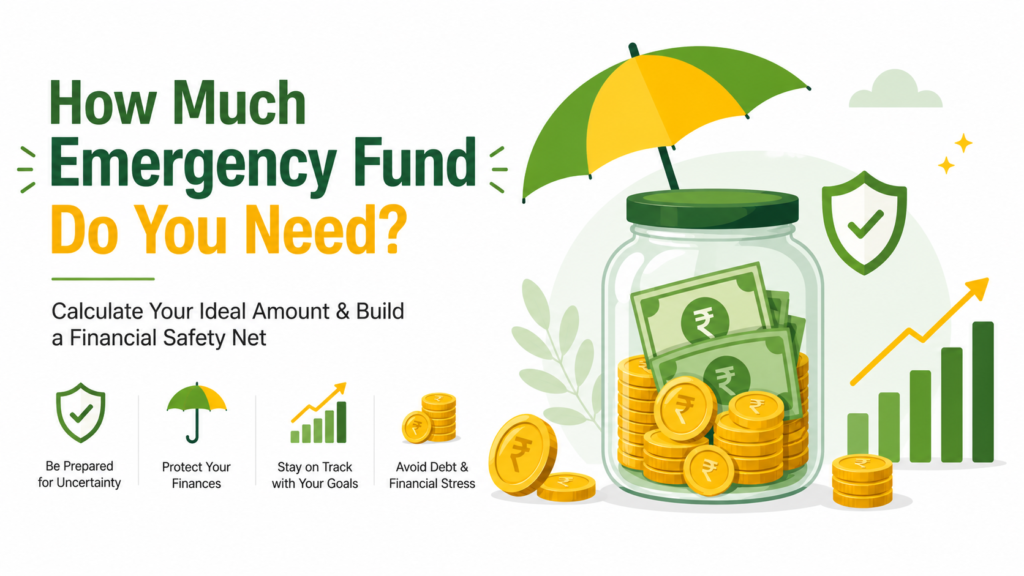
How Much Emergency Fund Do You Need?
There is no universal emergency fund amount.
The right amount depends on your essential monthly expenses, income stability, family responsibilities and financial commitments.
A practical starting point is to calculate your unavoidable monthly expenses.
Include:
| Expense | Include? |
|---|---|
| Rent | Yes |
| Home loan or other essential EMIs | Yes |
| Food | Yes |
| Utility bills | Yes |
| Insurance | Yes |
| Essential transportation | Yes |
| Shopping | No |
| Vacations | No |
| Entertainment | No |
| Non-essential purchases | No |
Once you know your essential monthly expenses, a commonly used starting range is three to six months of expenses. Investopedia also notes that three to six months of expenses is a commonly suggested emergency fund range.
For individuals with stable income, three to six months may provide a useful framework. Those with less predictable income or higher financial responsibilities may need to assess whether a larger buffer is appropriate.
SEBI also provides a Financial Health Check tool that investors can use as part of their broader financial assessment.
Emergency Fund Formula
Emergency Fund Target = Essential Monthly Expenses × Number of Months of Buffer
For example, if your essential monthly expenses are ₹40,000 and you target six months:
₹40,000 × 6 = ₹2,40,000
Your emergency fund target would therefore be ₹2.40 lakh.
The objective is not to save ₹2.40 lakh overnight. The objective is to establish the target and build it consistently.
Emergency Fund Calculator: Rahul’s Example
Consider Rahul, who earns ₹75,000 per month.
He invests in stocks and mutual funds but realises that he has no emergency fund. He calculates his essential monthly expenses as follows:
| Essential Expense | Monthly Amount |
| Rent | ₹15,000 |
| Food | ₹8,000 |
| EMI | ₹7,000 |
| Utilities | ₹3,000 |
| Fuel & Transport | ₹4,000 |
| Insurance | ₹3,000 |
| Total | ₹40,000 |
Rahul excludes shopping, vacations, entertainment and other discretionary expenses.
If he chooses a six-month emergency fund:
₹40,000 × 6 = ₹2,40,000
Rahul now has a clear target instead of an arbitrary savings number.
He decides that he can save ₹10,000 every month toward this goal.
| Period | Amount Accumulated |
| Month 1 | ₹10,000 |
| Month 6 | ₹60,000 |
| Month 12 | ₹1,20,000 |
| Month 18 | ₹1,80,000 |
| Month 24 | ₹2,40,000 |
This illustrates an important point for amateur investors: an emergency fund is built through consistency, not timing the market or waiting for a large surplus.
How to Build Your Emergency Fund
Start with a specific target rather than saving without a defined purpose.
First, calculate essential monthly expenses. Next, select an appropriate number of months based on your circumstances. Then decide how much you can realistically set aside every month.
If the full target feels difficult, start with a smaller amount and increase your contribution as your income or savings capacity improves.
The key is to keep the emergency fund separate from money intended for discretionary spending or long-term investments.
Your broader financial plan should also be reviewed periodically because expenses, income and financial responsibilities can change. SEBI’s financial education material recommends regularly reviewing and revising financial plans as circumstances change.
Want to know how your emergency fund fits into your broader investment strategy? Talk to SJS Finserve about your financial plan.
Emergency Fund vs Regular Savings
Emergency funds and regular savings may both involve keeping money aside, but their purposes are different.
| Factor | Emergency Fund | Regular Savings |
| Purpose | Unexpected financial emergencies | Planned expenses |
| Examples | Medical bills, income loss, essential repairs | Travel, shopping, planned purchases |
| Priority | Financial security | Lifestyle or short-term goals |
| Access | Should be readily accessible | Accessed when the planned expense arises |
Not every savings balance should automatically be treated as an emergency fund.
Keeping the purpose separate can make it easier to avoid spending emergency money on expenses that could have been planned in advance.
When Should You Use Your Emergency Fund?
An emergency fund should generally be used when an expense is unexpected, urgent and necessary.
Examples include an unexpected medical bill, sudden loss of income, essential home repairs or urgent vehicle repairs.
It should not normally be used for planned vacations, shopping, entertainment or impulse purchases.
The test is simple: Is this an unavoidable expense that cannot reasonably wait?
If the answer is yes, the emergency fund may serve its intended purpose.
Emergency Fund vs Investment Portfolio
Your emergency fund and investment portfolio have different jobs.
An investment portfolio is designed to help you achieve long-term financial goals. An emergency fund is designed to provide liquidity when an unexpected financial requirement arises.
Using investments for an emergency can therefore create a difficult choice, particularly if markets are down when you need the money.
For investors building a mutual fund portfolio, it is useful to keep emergency planning separate from decisions about fund selection and long-term wealth creation. SJS Finserve’s resources on evaluating a mutual fund before investing, mutual fund costs and charges and the power of compounding in mutual funds can help investors understand the separate role of long-term investments.
The objective is not to maximise every rupee’s return. It is to assign money to the right purpose.
What Should You Do After Using Your Emergency Fund?
Using your emergency fund during a genuine crisis is exactly what it is designed for.
The next step is to rebuild it.
Suppose you had ₹2.40 lakh saved but used ₹80,000 for an unexpected financial emergency. Your new emergency fund balance is ₹1.60 lakh. Once your financial situation stabilises, rebuilding the reserve should become a priority.
This creates a simple cycle:
Build → Use when necessary → Rebuild → Protect
An emergency fund is therefore not a one-time financial task. It is an ongoing part of financial planning.
Key Takeaways
An emergency fund is a financial safety net, not an investment designed to generate high returns.
For most individuals, the calculation starts with one question: What are my unavoidable monthly expenses?
From there:
- Calculate essential monthly expenses.
- Exclude discretionary spending.
- Set a target of around three to six months based on your circumstances.
- Build the fund through regular contributions.
- Keep it readily accessible.
- Use it only for genuine financial emergencies.
- Replenish it after using it.
- Review the target whenever your income, expenses or responsibilities change.
The most important benefit of an emergency fund is not the return it generates. It is the financial flexibility it provides when circumstances change.
A well-structured financial plan should account for both unexpected short-term needs and long-term wealth creation. If you want help determining an appropriate emergency fund target and integrating it with your broader investment strategy, you can book a financial consultation with SJS Finserve.
Frequently Asked Questions About Emergency Funds
How much emergency fund do I need?
A commonly used starting point is three to six months of essential monthly expenses. The appropriate amount depends on your income stability, financial commitments, dependants and personal circumstances.
How do I calculate my emergency fund?
Calculate your essential monthly expenses and multiply that amount by the number of months you want to cover. For example, if your essential expenses are ₹40,000 per month and you choose a six-month buffer, your emergency fund target would be ₹2,40,000.
Can I use my emergency fund for a vacation or shopping?
An emergency fund should generally be reserved for unexpected, urgent and necessary expenses such as medical bills, loss of income or essential repairs. Planned discretionary expenses such as vacations and shopping should be funded separately.
Should I invest my emergency fund?
The primary purpose of an emergency fund is accessibility and financial security rather than maximising returns. It should therefore be kept in a suitable, easily accessible option based on your financial circumstances and liquidity requirements.
What should I do after using my emergency fund?
Once the emergency has passed and your financial situation stabilises, prioritise rebuilding the amount you used. Review your target if your income, essential expenses or financial responsibilities have changed.