 SIF
SIF
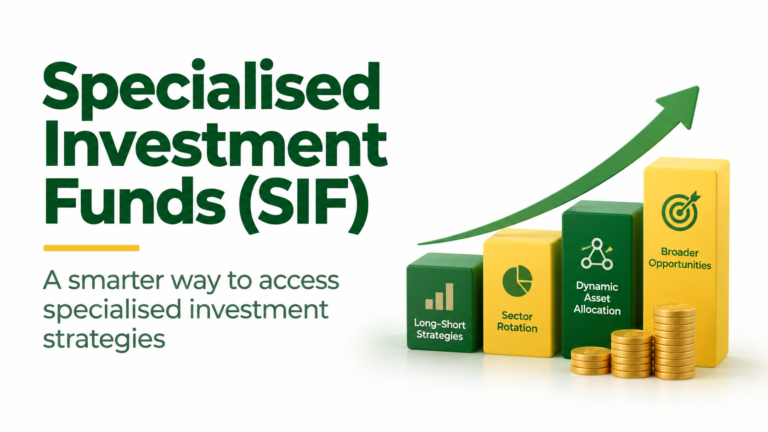
Specialised Investment Funds (SIF) Explained: The New Middle Ground Between Mutual Funds and PMS
A practical breakdown of SEBI's new SIF category minimum investment, strategies, risk, liquidity and taxation and how it compares to…

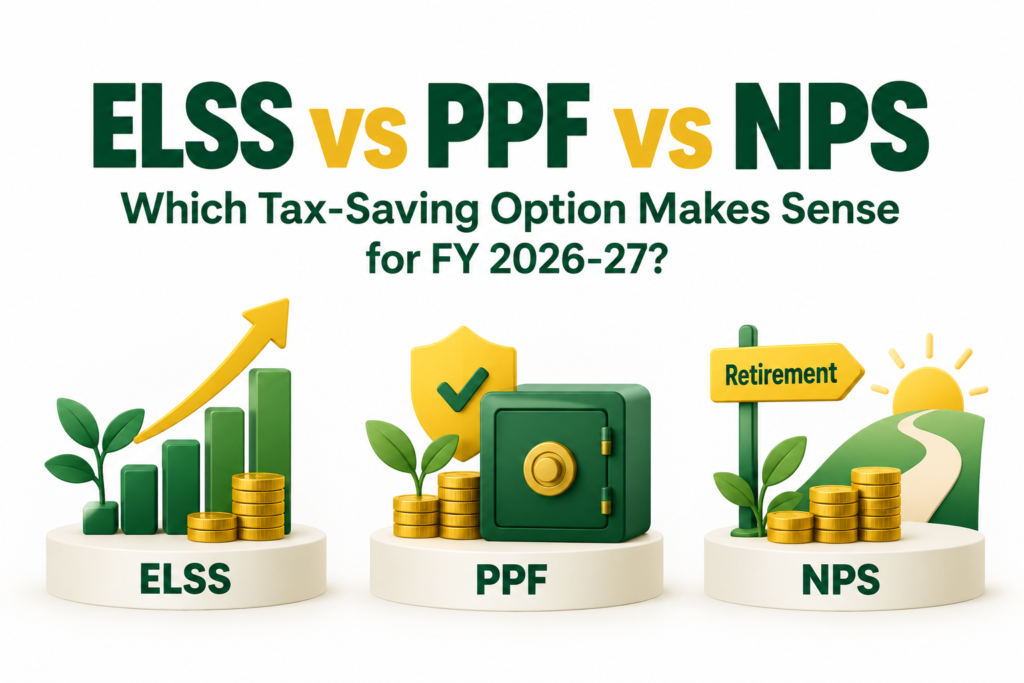
For FY 2026-27, choosing between ELSS, PPF and NPS starts with a tax question, but the right answer ultimately depends on what your portfolio needs.
ELSS offers equity exposure with a three-year statutory lock-in. PPF is a government-backed long-term savings option with a 15-year maturity. NPS is designed primarily for retirement and provides market-linked exposure across equity, corporate debt and government securities.
The first step is to identify your tax regime. The New Tax Regime is the default regime for FY 2026-27, while the Old Tax Regime continues to allow eligible deductions such as Section 80C and Section 80CCD(1B).
This distinction is important because ELSS, PPF and personal NPS contributions should not be selected for tax saving without first establishing whether the relevant deduction is actually available to you.
Under the Old Tax Regime, eligible investments under Section 80C qualify for a combined deduction of up to ₹1.5 lakh. ELSS and PPF fall within this limit. NPS can also qualify under Section 80C where applicable, while eligible taxpayers can claim an additional ₹50,000 under Section 80CCD(1B).
The New Tax Regime works differently. Personal contributions to ELSS and PPF do not provide the Section 80C deduction under the New Regime, and the additional personal NPS deduction under Section 80CCD(1B) is also not available.
However, employer contributions to NPS under Section 80CCD(2) remain relevant under the New Tax Regime, with the deduction available up to the applicable limit of 14% of Basic Salary plus Dearness Allowance for eligible employees.
That creates an important distinction. Under the Old Regime, ELSS, PPF and personal NPS contributions can have a direct tax-planning role. Under the New Regime, these products should primarily be assessed on their investment characteristics, while employer NPS contributions can retain a tax advantage.
Before investing, investors should also calculate how much of the ₹1.5 lakh Section 80C limit is already being used through EPF, life insurance premiums, home-loan principal repayment and other eligible items.
If ₹1 lakh of the limit is already occupied, for example, only ₹50,000 of additional eligible investment is required to fully utilise the ₹1.5 lakh limit.
Income Tax Department provides the applicable tax rules and deductions that investors should check before making tax-planning decisions.
| Feature | ELSS | PPF | NPS |
|---|---|---|---|
| Primary role | Equity wealth creation and tax saving | Conservative long-term savings | Retirement corpus |
| Return profile | Market-linked | Government-notified interest | Market-linked based on asset allocation |
| Lock-in / access | 3 years | 15 years, subject to scheme rules | Retirement and exit rules apply |
| Risk | High due to equity exposure | Relatively low | Depends on asset allocation |
| Old Regime benefit | Section 80C within ₹1.5 lakh limit | Section 80C within ₹1.5 lakh limit | Section 80C where applicable + additional ₹50,000 under Section 80CCD(1B) |
| New Regime benefit | No personal 80C deduction | No personal 80C deduction | Employer contribution under Section 80CCD(2), subject to applicable limits |
| Return taxation | Equity capital gains rules apply | EEE treatment | Depends on withdrawal and annuity structure |
The table makes the central point clear: these are three different financial tools rather than three versions of the same investment.
ELSS, or Equity Linked Savings Scheme, is an equity-oriented mutual fund category with a statutory three-year lock-in. ELSS invests predominantly in equity and equity-related instruments, so its returns are market-linked.
The main attraction is the combination of equity exposure and tax-saving eligibility under Section 80C for investors using the Old Tax Regime.
The three-year lock-in is relatively short compared with PPF and NPS, but investors should not confuse the lock-in period with an ideal investment horizon. Equity can experience significant volatility over shorter periods. ELSS is better considered in the context of a medium to long-term financial goal.
The tax treatment also needs to be understood separately from the investment deduction. Equity-oriented mutual fund gains held for more than one year are generally treated as long-term capital gains. The current LTCG rate is 12.5% on gains exceeding ₹1.25 lakh in a financial year, subject to applicable tax rules. Short-term capital gains on equity-oriented investments are currently taxed at 20%, subject to the applicable conditions.
In other words, ELSS provides a tax deduction on eligible investment under the Old Regime, but it is not completely tax-free on exit.
For an investor whose portfolio already contains substantial equity mutual funds or direct stocks, the more important question is whether another equity allocation is actually required.
AMFI India provides information on mutual funds and ELSS and is a useful reference for investors researching the category.
PPF, or Public Provident Fund, serves a very different purpose.
It is a government-backed long-term savings scheme with a 15-year maturity. The interest rate is notified by the government and can change periodically. The PPF rate applicable for the relevant quarter should therefore be checked before making an investment decision.
PPF is generally used by investors who prioritise stability over market-linked growth. It does not fluctuate with equity markets in the way an ELSS investment does.
The trade-off is liquidity. PPF provides specified loan and partial-withdrawal facilities subject to scheme conditions, but it remains fundamentally a long-term commitment.
PPF can therefore play a useful role when an investor needs a conservative component in the portfolio. It may be particularly relevant for long-term objectives where capital stability is more important than maximising equity exposure.
For investors under the Old Tax Regime, eligible PPF contributions can fall within the ₹1.5 lakh Section 80C limit.
India Post provides official information on PPF account rules and operations.
NPS is designed primarily to build a retirement corpus. It allows investment across asset classes including equity, corporate debt and government securities, depending on the selected allocation and applicable scheme options.
Under the Old Tax Regime, eligible taxpayers can claim an additional ₹50,000 deduction under Section 80CCD(1B) over and above the broader Section 80C limit.
For employees under the New Tax Regime, employer contributions under Section 80CCD(2) can remain tax-efficient, subject to the applicable conditions and limits. For eligible employees, the deduction can be available for employer contributions of up to 14% of Basic Salary plus Dearness Allowance.
The more significant change investors need to understand is the exit structure.
For eligible non-government subscribers under the updated NPS exit framework, the traditional assumption that every investor must follow a fixed 60:40 lump-sum-to-annuity structure is outdated.
For a corpus above ₹12 lakh, eligible subscribers can withdraw up to 80% as a lump sum, with at least 20% used for annuity purchase under the applicable PFRDA exit rules.
There are also specific corpus-based provisions. Where the total corpus is up to ₹8 lakh, the entire amount can be withdrawn as a lump sum without mandatory annuity purchase. For a corpus between ₹8 lakh and ₹12 lakh, the applicable rules permit a lump-sum withdrawal of up to ₹6 lakh, with the balance subject to the prescribed exit framework.
There is, however, an important distinction between what PFRDA permits to be withdrawn and what the Income Tax Act exempts from tax.
The current tax exemption under Section 10(12A) covers 60% of the NPS corpus at the relevant exit. Therefore, investors should not assume that an 80% permitted lump-sum withdrawal automatically means the entire 80% is tax-free. Any amount beyond the tax-exempt portion needs to be evaluated under the applicable tax rules.
The annuity portion also has a different tax treatment. The annuity purchase itself is structured as part of the retirement exit, while the pension or annuity income received subsequently is taxable according to the applicable rules.
This distinction makes NPS more nuanced than a simple “60:40” comparison suggests.
PFRDA provides the regulator’s information on NPS, including its structure, exits and withdrawals.
The decision becomes more useful when mapped to the portfolio requirement rather than the product’s tax label.
| If your priority is… | More relevant option |
|---|---|
| Additional equity exposure with tax-saving eligibility under the Old Regime | ELSS |
| Conservative long-term savings | PPF |
| Dedicated retirement corpus | NPS |
| Additional ₹50,000 personal NPS deduction under the Old Regime | NPS |
| Employer NPS contribution under the New Regime | NPS |
| No need for an 80C deduction under the New Regime | Compare products primarily on investment suitability |
There is no reason to force all three into a portfolio.
An investor who already has adequate equity exposure may not need ELSS simply because ₹1.5 lakh of 80C capacity is available. Similarly, someone with sufficient fixed-income exposure may not need to increase it through PPF.
NPS can make sense when retirement is a genuine long-term objective and the investor is comfortable with its exit structure.
The three can coexist, but each should have a clear purpose.
A portfolio could use ELSS for equity exposure, PPF for a conservative allocation and NPS for retirement. The exact combination depends on the investor’s existing holdings, income, tax regime, financial goals and risk capacity.
The important sequence is:
Tax regime → Existing deductions → Financial goals → Time horizon → Asset allocation → Product selection
This sequence prevents tax saving from becoming the reason for making an otherwise unsuitable investment.
Consider an investor in the Old Tax Regime who already has ₹1.5 lakh of eligible 80C expenses through EPF and other investments. Buying another ₹1.5 lakh of ELSS or PPF would not create another ₹1.5 lakh Section 80C deduction.
If the same investor has a retirement objective and is eligible for the additional NPS deduction, NPS could deserve consideration. But even then, the decision should account for the investor’s overall retirement allocation and the restrictions associated with NPS.
Step 1: Identify your tax regime.
If you are in the New Regime, do not assume ELSS or PPF contributions will provide a personal Section 80C deduction. Instead, evaluate them based on risk, liquidity and goals. If your employer offers NPS, examine the Section 80CCD(2) benefit.
If you are in the Old Regime, calculate your existing Section 80C utilisation before investing.
Step 2: Identify the portfolio gap.
Need equity exposure and have a 5+ year horizon? ELSS may be relevant.
Need a conservative long-term allocation? PPF may be relevant.
Need retirement-focused investing and can accept restricted access? NPS may be relevant.
Step 3: Check the exit implications.
Do not compare only the entry-stage tax benefit. Consider capital gains taxation for ELSS, maturity treatment for PPF and the withdrawal, annuity and taxation rules applicable to NPS.
For FY 2026-27, the most important change in the decision-making process is the prominence of the New Tax Regime.
If the New Regime is financially more efficient for you, purchasing ELSS or PPF solely to claim an 80C deduction may not make sense. The products still have investment value, but the reason for owning them changes.
For Old Regime taxpayers, the ₹1.5 lakh Section 80C limit and additional ₹50,000 NPS deduction can make tax planning more relevant. But the deduction should be considered alongside asset allocation rather than in isolation.
NPS requires particular attention because the permitted exit structure has evolved. Investors should distinguish between the amount that PFRDA permits them to withdraw and the amount that the Income Tax Act currently exempts from tax.
Ultimately, ELSS, PPF and NPS should be selected according to the job they perform in the portfolio.
ELSS is primarily an equity decision. PPF is primarily a stability decision. NPS is primarily a retirement decision. The tax treatment then determines how efficiently each option fits into your financial plan.
For investors unsure about which combination fits their income, tax regime, existing investments and long-term objectives, professional financial planning can help bring these decisions together. SJS Finserve can help evaluate tax-saving choices alongside asset allocation, liquidity requirements and retirement goals, so that tax planning becomes part of a broader investment strategy rather than a year-end exercise.
ELSS offers equity exposure and a 3-year lock-in, while PPF offers stability with a 15-year maturity. Under the Old Tax Regime, both qualify under the ₹1.5 lakh Section 80C limit.
Yes. ELSS can provide equity exposure, PPF stability, and NPS retirement-focused investing. Your overall portfolio should guide the combination.
No. Personal ELSS and PPF investments do not qualify for the Section 80C deduction under the New Tax Regime.
Under the Old Tax Regime, eligible investors can claim an additional deduction of up to ₹50,000 under Section 80CCD(1B).
PPF offers conservative long-term savings, while NPS is specifically designed for retirement and provides market-linked exposure. The right choice depends on your goals and risk tolerance.
SIF
A practical breakdown of SEBI's new SIF category minimum investment, strategies, risk, liquidity and taxation and how it compares to…
 Investment Strategies
A data-backed comparison of daily, weekly, and monthly SIP returns across five equity fund categories and five investment horizons. Find…
 Market Analysis
Equity mutual fund inflows rose to ₹29,329 crore in August 2026, up 19% from July, driven by record small-cap inflows…