 SIF
SIF
Specialised Investment Funds (SIF) Explained: The New Middle Ground Between Mutual Funds and PMS
A practical breakdown of SEBI's new SIF category minimum investment, strategies, risk, liquidity and taxation and how it compares to…

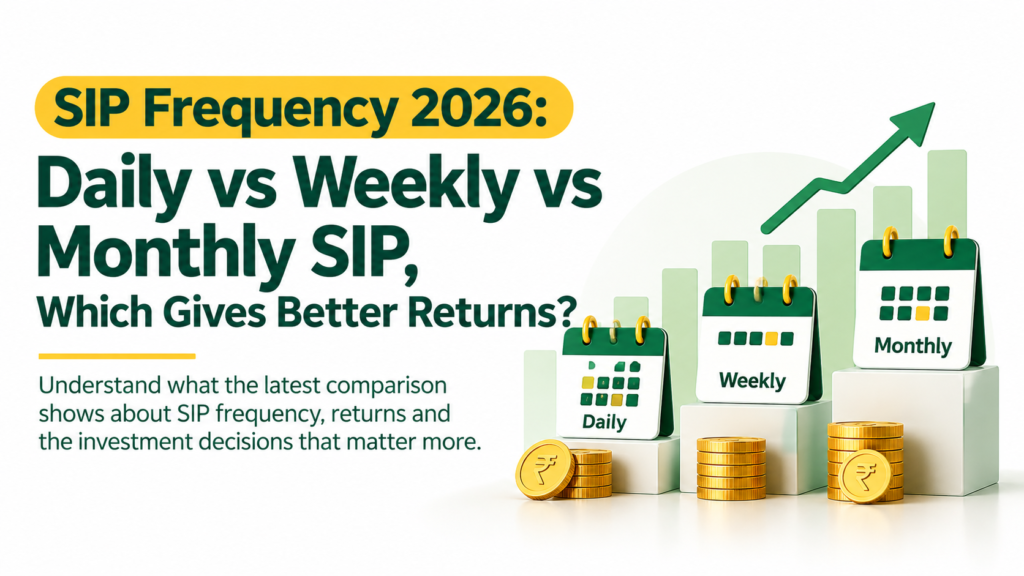
Investors often assume that a daily SIP must be better than a monthly SIP because money is invested more frequently. A weekly SIP appears to offer a middle ground. But does investing more often actually improve long-term returns?
An ET Wealth comparative analysis of daily, weekly and monthly SIPs across five active equity fund categories and five investment horizons suggests that the difference is much smaller than many investors assume.
Across the observations, the maximum difference between daily and monthly SIP XIRRs was 0.88 percentage points, while no single SIP frequency consistently delivered the highest return.
For investors, the implication is straightforward: SIP frequency can affect the timing of investments, but it should not be treated as a major return-generating strategy. The more important questions are how much you invest, where you invest, how much risk you take and whether the portfolio is aligned with your financial goals.
The ET Wealth comparison covered Large Cap, Flexi Cap, Mid Cap, Multi Cap and Small Cap funds across 1-year, 3-year, 5-year, 7-year and 10-year investment horizons.
The methodology kept the total contribution comparable while changing the frequency of investment.
| Parameter | Study methodology |
|---|---|
| SIP frequencies | Daily, weekly and monthly |
| Equity categories | Large Cap, Flexi Cap, Mid Cap, Multi Cap and Small Cap |
| Investment horizons | 1, 3, 5, 7 and 10 years |
| Return measure | XIRR |
| Daily SIP | ₹500 on every trading day |
| Weekly SIP | ₹500 total across trading days in a week |
| Monthly SIP | ₹500 total in the month |
| Data period | Through 31 August 2026 |
| Fund eligibility | Schemes with NAV data available for the relevant period |
Source: ET Wealth
The study uses XIRR because the three approaches invest money at different points in time. XIRR accounts for the timing of individual cash flows when calculating the annualised return. Investors looking for a broader explanation of the methodology can refer to Value Research’s XIRR explainer.
The central finding is that more frequent investing did not consistently produce better returns. Daily SIPs were ahead in some categories and periods, while weekly or monthly SIPs were ahead in others. The maximum observed difference was 0.88 percentage points.
A daily SIP puts money into the market on more trading days. This changes the purchase prices at which the investor accumulates units.
That can be beneficial when markets decline during part of the investment period. But if markets rise consistently, investing later portions of the monthly amount can result in purchasing at higher prices.
There is therefore no reliable rule that investing every trading day will produce better returns than investing once a month.
The comparison is useful because it tests the question across multiple equity categories and investment horizons rather than drawing a conclusion from a single market phase.
Once the frequency question is put into context, the larger portfolio decisions become more important.
| Investment decision | Portfolio implication |
|---|---|
| SIP amount | Determines the amount of capital being accumulated |
| Investment horizon | Determines the time available for compounding |
| Asset allocation | Determines the portfolio’s overall risk exposure |
| Fund selection | Influences diversification and portfolio construction |
| SIP continuity | Helps maintain the investment process through market cycles |
| SIP frequency | Changes cash-flow timing, but showed a comparatively limited difference in the ET Wealth analysis |
This is also why investors should be careful about splitting investments simply to create the appearance of greater diversification or precision. For a related analysis, see SJS Finserve’s article on whether having two SIPs in the same mutual fund can improve returns.
If you are debating whether to move from a monthly SIP to a daily SIP, first check whether your current SIP amount, asset allocation and fund selection are appropriate for your financial objective.
SJS Finserve offers a free 15-minute portfolio review for investors who want to benchmark their current SIP against their financial goals and identify the portfolio decisions that deserve greater attention.
The exact SIP date is another area where investors can spend too much effort trying to optimise a relatively small variable.
Markets can rise or fall after any particular SIP date. Trying to identify a universally superior day therefore requires a level of short-term market predictability that investors generally do not have.
For a salaried investor, aligning the SIP with the regular cash-flow cycle may be more practical than attempting to identify the best day of the month.
The priority should be maintaining a sustainable investment process.
There is no single frequency that the ET Wealth analysis establishes as the best choice across categories and periods.
Monthly SIP: Often practical for investors whose income arrives monthly and who want a simple, predictable investment schedule.
Weekly SIP: Can suit investors who prefer more frequent deployment without managing daily transactions.
Daily SIP: Provides the most frequent deployment, but the comparison does not establish a consistent return advantage over weekly or monthly SIPs.
For an existing monthly SIP, changing the frequency solely in the expectation of substantially higher returns is not supported by this comparison.
The more consequential questions are:
These are portfolio-construction decisions rather than transaction-frequency decisions.
Investors should also rely on credible regulatory and industry resources when evaluating mutual fund information. SEBI’s Investor Education material hub provides investor education resources, while AMFI’s official website provides information and resources relating to the Indian mutual fund industry.
SJS Finserve’s focus should be on the complete investment decision rather than presenting SIP frequency as a standalone return strategy.
That means assessing the investor’s financial goals, investment horizon, required investment amount, asset allocation, fund selection and risk exposure before deciding how the investment should be implemented.
The ET Wealth comparison provides a useful data point: across the categories and periods examined, there was no consistently superior SIP frequency, and the maximum difference observed between daily and monthly SIP XIRRs was 0.88 percentage points.
For an investor, that makes SIP frequency a secondary decision. The primary task is ensuring that the overall investment strategy is appropriately structured and sustainable.
SJS Finserve can position its advisory process around goal-based portfolio review rather than frequency-based product selection. A review should establish whether the investor is investing enough, taking appropriate equity exposure and using a portfolio structure that matches the intended financial outcome.
For investors: If you want to know whether your current SIP amount and portfolio are appropriate for your financial goals, SJS Finserve’s free 15-minute portfolio review can provide a focused starting point. The review can assess your existing SIP, investment horizon, portfolio allocation and the areas where your strategy may require attention.
Not consistently. The ET Wealth comparison found that no SIP frequency consistently delivered the highest XIRR across the five equity categories and five investment horizons. The maximum difference observed between daily and monthly SIPs was 0.88 percentage points.
Yes. Different frequencies result in different investment dates and purchase prices, which can affect XIRR. However, the ET Wealth comparison indicates that the difference between daily, weekly and monthly SIPs was relatively limited.
A monthly SIP can be practical when income is received monthly because it aligns investments with the cash-flow cycle. The appropriate frequency should ultimately reflect the investor’s circumstances and ability to maintain the investment plan.
Not solely because daily investing is more frequent. The available comparison does not establish a consistent return advantage for daily SIPs. Investors should first review their SIP amount, asset allocation, fund selection and financial goals.
The SIP amount, asset allocation, fund selection, investment horizon and ability to remain invested are generally more important portfolio considerations than whether contributions are made daily, weekly or monthly.
SIF
A practical breakdown of SEBI's new SIF category minimum investment, strategies, risk, liquidity and taxation and how it compares to…
 Investment Strategies
A data-backed comparison of daily, weekly, and monthly SIP returns across five equity fund categories and five investment horizons. Find…
 Market Analysis
Equity mutual fund inflows rose to ₹29,329 crore in August 2026, up 19% from July, driven by record small-cap inflows…