 SIF
SIF
Specialised Investment Funds (SIF) Explained: The New Middle Ground Between Mutual Funds and PMS
A practical breakdown of SEBI's new SIF category minimum investment, strategies, risk, liquidity and taxation and how it compares to…

Investors with ₹10 lakh or more to deploy now have another option between conventional mutual funds and PMS: Specialised Investment Funds (SIFs).
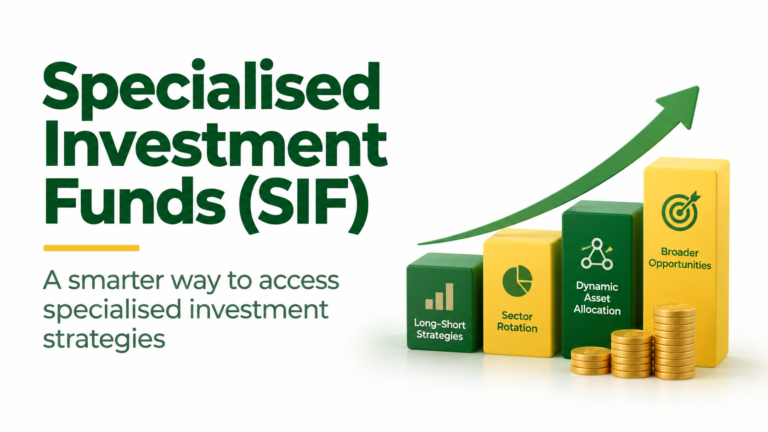
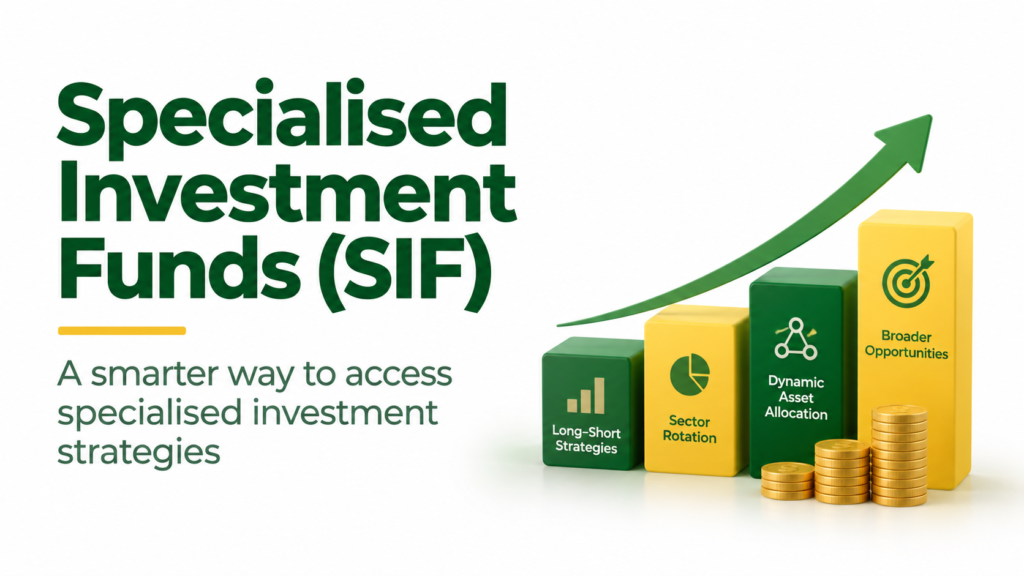
The appeal is straightforward. SIFs can use strategies that go beyond traditional long-only investing, including long-short equity, sector rotation, dynamic asset allocation and specialised debt strategies. They operate within SEBI’s mutual fund framework, but with a broader investment toolkit.
That flexibility is useful only when it serves a clear portfolio objective. A more sophisticated product is not automatically a better investment.
SEBI introduced the SIF framework in February 2025, followed by a clarification in April 2025.
Before looking at the strategies, it helps to understand where SIFs actually fit.
| Feature | Mutual Funds | SIFs | PMS | AIFs |
|---|---|---|---|---|
| Structure | Pooled | Pooled | Individual portfolio | Pooled |
| Minimum investment | Can be very low | ₹10 lakh for most investors | ₹50 lakh | ₹1 crore |
| Strategy flexibility | Scheme-dependent | Higher | High | High |
| Portfolio customisation | Limited | Limited | High | Strategy-dependent |
| Typical role | Core portfolio | Specialised allocation | Customised portfolio | Alternative strategies |
SIFs are therefore not a replacement for mutual funds or PMS. They address a different requirement: access to specialised strategies without moving to an individually managed PMS portfolio.
A Specialised Investment Fund is a SEBI-regulated investment category within the mutual fund framework. It allows eligible AMCs to offer more specialised investment strategies across equity, debt and hybrid categories.
For most investors, the minimum investment is ₹10 lakh at the PAN level across SIF strategies of the same AMC. Investments in the AMC’s regular mutual fund schemes do not count toward this threshold. Accredited investors are exempt from the minimum requirement.
The framework permits strategies that can use equity, debt, derivatives and, depending on the strategy, REITs, InvITs and commodity derivatives. Certain SIF strategies can also take unhedged short exposure through derivatives, subject to the applicable limits.
For an investor, this changes the question from “Which mutual fund should I buy?” to a more useful one:
What specific investment capability is missing from my existing portfolio?
SIFs are not one homogeneous product. The strategy determines the risk, return drivers and liquidity profile.
Equity-oriented SIFs include:
Equity Long-Short: Primarily equity exposure with permitted short exposure through derivatives.
Equity Ex-Top 100 Long-Short: Focuses on companies outside India’s top 100 by market capitalisation.
Sector Rotation Long-Short: Concentrates exposure across a limited number of sectors and changes positioning as opportunities shift.
The framework permits certain equity strategies to have up to 25% unhedged short exposure through derivatives.
That can change portfolio behaviour materially. If a manager is long 100 units of equity exposure and takes a permitted short position, returns can be influenced by both legs. A correct short thesis can cushion a falling market. A wrong one can create losses even when the broader portfolio is not declining sharply.
Debt SIFs can use specialised approaches to interest rates, duration and sector positioning.
A Debt Long-Short strategy can use exchange-traded debt derivatives, while a Sectoral Debt Long-Short strategy can allocate across different sectors subject to applicable concentration limits.
For investors accustomed to judging debt funds mainly by credit quality and duration, these strategies require a broader understanding of how the manager intends to generate returns.
Hybrid SIFs can combine equity, debt and other permitted asset classes.
An Active Asset Allocator Long-Short Fund, for example, can dynamically change its allocation as market conditions evolve. A Hybrid Long-Short Fund combines equity and debt exposure with permitted derivative positions.
This makes asset allocation itself part of the investment strategy rather than simply a static portfolio constraint.
The ₹10 lakh minimum is easy to understand. Liquidity requires more attention.
SIF strategies do not necessarily provide the same daily redemption experience investors associate with conventional open-ended mutual funds. Depending on the strategy, redemption may be daily, weekly, twice weekly or structured around intervals. Some strategies may also have a redemption notice period, with SEBI providing for a maximum notice period of 15 working days.
That makes SIFs unsuitable for money that may be required at short notice.
A fund’s recent return is only one part of the analysis. For a client portfolio, an SIF should be evaluated across five areas:
| Question | What we would examine |
|---|---|
| What is the edge? | What opportunity is the strategy designed to capture? |
| How is risk taken? | Concentration, derivatives, short exposure and drawdown behaviour |
| What does it add? | Whether the SIF genuinely diversifies the existing portfolio |
| Can the investor live with the liquidity? | Redemption frequency and notice requirements |
| Does the return justify the complexity? | Strategy consistency, costs and implementation |
This is where product research needs to become portfolio advice.
For example, an investor may already have substantial large-cap and mid-cap equity exposure. Adding an equity-focused SIF simply because its strategy appears sophisticated may increase complexity without materially diversifying the portfolio.
A different investor may have a diversified core portfolio but no exposure to a defined long-short or dynamic asset-allocation strategy. In that case, an SIF could have a clearer portfolio role.
The question is not whether the SIF is attractive. It is whether the SIF is useful.
Tax treatment depends on the structure and underlying investments, so investors should not assume that every SIF receives the same tax treatment.
For equity-oriented investments, the applicable capital-gains provisions can differ from those applicable to debt-oriented strategies. Section 50AA is particularly relevant to specified mutual funds. The Income Tax Department’s current provisions define a specified mutual fund, from April 1, 2026, with reference to funds investing more than 65% of total proceeds in debt and money-market instruments, subject to the statutory conditions.
The applicable tax treatment should therefore be checked against the specific SIF’s structure and the tax law prevailing at the time of redemption.
Income Tax Department: Section 50AA
AMFI: Tax Regime for Mutual Funds
SIFs are more relevant for investors who:
Have sufficient investable capital and can meet the minimum threshold.
Understand market-linked investments and are comfortable with greater strategy complexity.
Can tolerate periods of underperformance.
Do not need immediate access to the invested capital.
Already have a core portfolio and are looking for a specialised allocation.
Understand that derivatives and short positions can introduce additional risks.
They are less compelling for investors who are still building their core portfolio, need high liquidity, or are choosing the product primarily because it appears more sophisticated than a conventional mutual fund.
Portfolio review checkpoint: If you already have mutual funds, direct equities, debt and other investments, the right starting point is to map your existing exposures before adding an SIF. A portfolio review can show whether the proposed strategy fills a genuine gap or simply adds another layer of complexity.
The additional flexibility comes with additional responsibilities.
Market risk: SIFs remain market-linked investments and can lose capital.
Strategy risk: A specialised strategy can underperform when its underlying investment thesis is wrong.
Derivative risk: Short positions and derivatives can amplify the consequences of incorrect positioning.
Concentration risk: Strategies focused on a limited number of sectors or market segments can experience larger swings than broadly diversified portfolios.
Liquidity risk: Some SIFs have less frequent redemption windows or notice requirements.
Manager risk: In an actively managed specialised strategy, the quality and consistency of the investment process matter significantly.
SEBI’s framework provides investment limits, disclosure requirements and risk-management parameters. Those safeguards improve transparency and structure, but they do not eliminate investment risk.
There is no universal answer.
A conventional mutual fund may be the better choice when the objective is straightforward diversified market exposure, simplicity and liquidity.
An SIF becomes more interesting when an investor specifically wants a strategy such as long-short investing, sector rotation or dynamic asset allocation and understands the additional complexity involved.
PMS may be more appropriate when the investor needs individual portfolio customisation. AIFs may be appropriate for investors seeking a different class of alternative strategies and who meet their investment requirements.
The right product depends on the job the capital needs to perform.
SIFs expand the investment toolkit available to Indian investors. The ability to use long-short strategies, sector rotation and dynamic asset allocation can be valuable, but only when the strategy has a clear role within the broader portfolio.
For an investor considering an SIF, the most useful analysis is therefore not a comparison of last year’s returns. It is an assessment of what the strategy adds, what risk it introduces, how liquid the capital needs to remain and whether the portfolio actually needs that exposure.
For most investors, the minimum investment is ₹10 lakh, calculated at the PAN level across SIF strategies offered by the same AMC. Accredited investors are exempt from this threshold.
Not necessarily. Redemption frequency depends on the specific strategy. Some SIFs may offer daily, weekly or twice-weekly redemption, while others may be interval-based. A redemption notice period may also apply.
Certain SIF strategies can take unhedged short exposure through derivatives, subject to the regulatory limits applicable to the strategy.
Not automatically. SIFs offer greater strategic flexibility, but that also means greater complexity. The appropriate choice depends on the investor’s objectives, risk tolerance, liquidity requirements and existing portfolio.
Tax treatment depends on the SIF’s underlying investments and applicable tax provisions. Debt-oriented strategies require particular attention to Section 50AA and the definition of specified mutual funds. Investors should verify the current tax treatment of the specific strategy before investing.
No. SIFs are pooled investment vehicles, while PMS provides an individually managed portfolio. PMS also has a higher minimum investment requirement.
SIFs are generally better suited to experienced investors with sufficient capital who understand specialised strategies, can tolerate market risk and do not require immediate liquidity.
SIF
A practical breakdown of SEBI's new SIF category minimum investment, strategies, risk, liquidity and taxation and how it compares to…
 Investment Strategies
A data-backed comparison of daily, weekly, and monthly SIP returns across five equity fund categories and five investment horizons. Find…
 Market Analysis
Equity mutual fund inflows rose to ₹29,329 crore in August 2026, up 19% from July, driven by record small-cap inflows…