 By Sonam Tripathi

The 50-30-20 rule splits your monthly take-home salary into three parts: 50% for needs, 30% for wants and 20% for savings and investments. It is one of the simplest budgeting methods, and it suits salaried Indians who earn well but find little left at the end of the month.
This guide explains how the rule works, how to adjust it for Indian costs such as rent, EMIs and family responsibilities, and where the 20% savings portion should go. It includes worked examples for ₹30,000, ₹50,000 and ₹1,00,000 monthly salaries, along with the latest Indian data on household savings, inflation and SIP investing.
|
Quick answer: Apply 50% of your take-home pay to needs, 30% to wants and 20% to savings. If your needs cross 50%, reduce wants first and protect the savings share. Use your in-hand salary, not your CTC. |
What Is the 50-30-20 Rule?
Elizabeth Warren and Amelia Warren Tyagi popularised the rule in their 2005 book All Your Worth. It works on after-tax income, so you do not need to track every rupee. You only need to decide which of the three buckets each expense belongs to.
|
Category |
Share |
What it covers |
|
Needs |
50% |
Rent or home-loan EMI, groceries, utilities, mobile and internet, commute, health and term insurance, minimum loan and credit-card payments |
|
Wants |
30% |
Dining out, food delivery, shopping, OTT subscriptions, travel, gadgets, hobbies |
|
Savings and investments |
20% |
Emergency fund, SIPs, PPF, NPS, extra loan prepayment |
A simple test separates the first two buckets. A need is an expense you cannot stop without affecting your job, health, housing or legal obligations. A want is anything you can reduce or pause without those consequences.
Why a Budget Matters for Indian Households Right Now
Indian households are investing more, but they are also borrowing faster. The latest official and industry data shows the pattern:
|
Indicator |
Latest figure |
Source |
|
Household financial liabilities |
₹158.5 lakh crore, or 45.8% of GDP (March 2026). Net household financial assets slipped from 97.8% of GDP in June 2022 to 95.8%. |
|
|
Retail inflation (CPI) |
4.82% in August 2026, up from 3.93% in May. Food inflation was 5.95%. |
|
|
Food share of urban spending |
About 40% of average urban household spending. Average urban spend is ₹6,996 per person per month. |
|
|
Monthly SIP contributions |
A record ₹32,297 crore in August 2026, and 14% higher than August 2025. Contributing SIP accounts crossed 10 crore. |
|
|
SIP assets |
₹18.62 lakh crore, about 21.4% of the industry’s AUM (August 2026) |
Two points follow from this data. First, more Indians now invest regularly, which shows that disciplined monthly saving works at scale. Second, rising debt and food-led inflation reduce the room for saving unless you fix the savings amount before you spend. A budget with a set savings share does this.
Use Take-Home Salary, Not CTC
CTC includes items you cannot spend each month, such as the employer’s EPF contribution, gratuity, insurance and variable bonus. Use the amount that credits to your bank account after tax, EPF and other deductions.
Tax also affects take-home pay. Under the default new tax regime, Budget 2026 kept the slabs unchanged, and a salaried person with income up to about ₹12.75 lakh pays no tax after the ₹75,000 standard deduction and the Section 87A rebate (Tata Capital tax guide). For many salaried people, EPF is now a bigger deduction than income tax, so check your payslip rather than estimating.
50% for Needs
Needs are the costs of staying employed, housed, fed and protected:
- • Rent or home-loan EMI
- • Groceries, electricity, water, gas, mobile and internet
- • Commute or fuel
- • Health insurance and term insurance premiums
- • Essential medical costs and family obligations
- • Minimum payments on loans and credit cards
On a ₹50,000 salary, the target for needs is ₹25,000. In Delhi NCR, Mumbai and Bengaluru, rent and EMIs alone can use up half of the salary. When that happens, the framework needs adjustment, as explained in the section on different incomes below. Only the minimum loan payment counts as a need. Any extra prepayment belongs in the savings bucket.
30% for Wants
Wants improve your lifestyle but can be reduced or postponed: restaurants, food delivery, shopping, OTT subscriptions, holidays, gadget upgrades and premium memberships.
Many expenses sit between the two buckets. Groceries are a need, but daily food delivery is a want. A working smartphone is a need, but replacing it every year is a want. Classify honestly, because this is the bucket you cut first when needs rise.
20% for Savings and Investments
The 20% is not one lump that goes entirely into mutual funds. It works better when you fill it in this order:
1. Emergency fund. Build six months of essential expenses first. If your needs are ₹25,000 a month, the target is ₹1.5 lakh. Keep it in a savings account or a liquid fund, not in equity.
2. High-interest debt. Repay credit-card balances and personal loans before investing for long-term goals. Their interest rates are usually higher than the returns you can reasonably expect from investments.
3. Goal-based SIPs. Match each investment to a goal and a time horizon. Money needed within three years should stay in low-risk options. Money for goals five or more years away can go into equity-oriented funds, subject to your risk profile.
4. Tax-saving and retirement products. EPF, PPF, NPS and ELSS fit here. Our guide on ELSS vs PPF vs NPS for FY 2026-27 compares lock-in, risk and returns.
Worked Example: ₹50,000 Take-Home Salary
|
Bucket |
Share |
Monthly amount |
Example use |
|
Needs |
50% |
₹25,000 |
Rent, groceries, bills, commute, insurance premiums, minimum EMIs |
|
Wants |
30% |
₹15,000 |
Dining, shopping, subscriptions, travel |
|
Savings and investments |
20% |
₹10,000 |
For example, ₹3,000 to an emergency fund until it reaches ₹1.5 lakh, and ₹7,000 to SIPs |
|
Total |
100% |
₹50,000 |
|
What ₹10,000 a Month Can Build Over 20 Years
Over 20 years you contribute ₹24 lakh of your own money. The final value depends on returns, which are not guaranteed. The table shows the corpus at three assumed annual returns, with investments made at the start of each month:
|
Assumed annual return |
Approximate corpus |
Your contribution |
|
8% |
₹59 lakh |
₹24 lakh |
|
10% |
₹77 lakh |
₹24 lakh |
|
12% |
₹1.0 crore |
₹24 lakh |
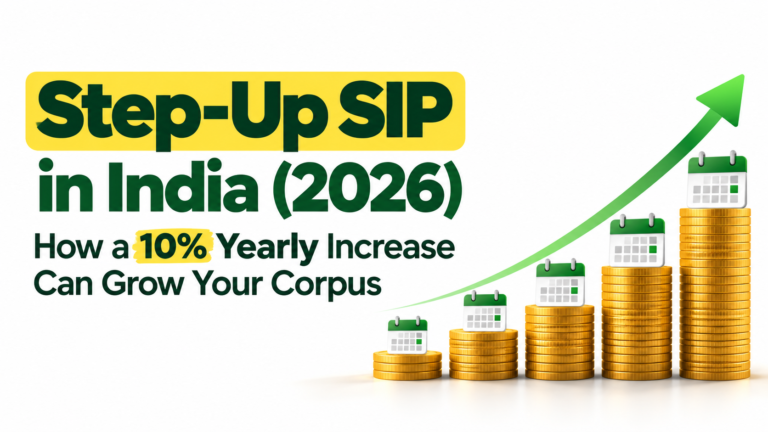
Two adjustments make the picture more realistic. First, inflation: at 5% a year, ₹1 crore after 20 years buys what about ₹38 lakh buys today. Second, income growth: if you raise the SIP by 10% every year, the same ₹10,000 starting SIP at 12% grows to roughly ₹2 crore on total contributions of about ₹69 lakh. Raising the SIP with each salary increment matters more than the starting amount. You can test your own numbers with our SIP calculator.
Adjusting the Rule for Your Income and City
|
Take-home pay |
Standard split |
What to watch |
Practical approach |
|
₹30,000 |
₹15,000 / ₹9,000 / ₹6,000 |
Rent and food often use ₹18,000 to ₹20,000 |
Save 10% first, then raise it by 1 to 2 points with each increment |
|
₹50,000 |
₹25,000 / ₹15,000 / ₹10,000 |
Wants are the largest lever |
Automate the SIP on salary day |
|
₹1,00,000 |
₹50,000 / ₹30,000 / ₹20,000 |
Lifestyle inflation |
Send at least half of each raise to a SIP step-up |
The percentages are a starting point, and the order of cuts matters more than the exact ratio:
• 60-20-20: If needs reach 60% (for example, ₹30,000 on a ₹50,000 salary), reduce wants to 20% and keep savings at 20%. Cutting wants first protects the saving habit.
• 50-25-25: If you have no major EMIs and want faster wealth creation, move 5% from wants to savings.
• Lower incomes: If needs take 70% or more, start with 5% to 10% in savings and increase it gradually.
How to Start in Five Steps
1. Find your take-home income from your payslip or bank credit, not your CTC.
2. Review the last two months of spending from bank and UPI statements, including rent, bills, EMIs, shopping and subscriptions.
3. Sort each expense into needs, wants or savings, using the test above.
4. Automate savings. Set the SIP date a day or two after your salary credit so that you save first and spend what remains.
5. Review every quarter. Revisit the budget when your salary, rent or EMIs change, and add annual costs such as insurance premiums and festival spending to a monthly set-aside.
Common Mistakes to Avoid
• Using CTC instead of take-home pay. This overstates what you can allocate.
• Saving what is left. Month-end balances are usually small. Save first.
• Labelling everything a need. Be strict about the difference between essential and optional costs.
• Ignoring annual expenses. Insurance premiums, festivals and travel can break a monthly budget if you do not plan for them.
• Letting lifestyle rise with every raise. If expenses grow as fast as income, the savings amount stays flat.
• Investing without a goal. A SIP should be linked to a purpose and a time frame, not to a percentage alone.
When Budgeting Alone Is Not Enough
A budget tells you how much to invest. It does not tell you what to invest in, how much insurance cover you need, or how to shift your portfolio as your goals change. These are the areas where most investors need help, especially when they receive tips from friends, banks and social media with no common plan.
At SJS Finserve, we work through this in four steps: understand your income, family and goals, design a plan, implement it with suitable mutual funds and insurance, and review it regularly. Our framework is Protect, Grow and Multiply. Protect means adequate life and health cover first. Grow means disciplined SIPs and long-term funds aimed at your goals.
We are a registered Mutual Fund Distributor (ARN 332811) and Insurance Broker. We do not promise guaranteed returns, and we explain the risks of every product in writing. You can read more about how a financial advisor improves your investments, see how SEBI’s 2026 mutual fund rules affect costs, or review our full list of services.
|
Want a plan for your 20%? Share your income, expenses and goals with our team, and we will show you how much to save, where to invest it and how to review it each year. Book a free consultation or write to info@sjsfinserve.com. |
Frequently Asked Questions
Is the 50-30-20 rule based on gross salary or take-home salary?
It is based on take-home income, which is the amount credited to your bank account after tax and deductions. CTC and gross salary include amounts you cannot spend each month.
Does the 50-30-20 rule work in India?
Yes, as a starting framework. High rent in metro cities, EMIs and family responsibilities often push needs above 50%, so most people adjust the ratio, for example to 60-20-20, rather than abandon the rule.
What if my needs are more than 50% of my salary?
Reduce wants first and keep savings as close to 20% as you can. If that is not possible, protect at least 10% and raise it with each salary increment.
How much should I save from a ₹50,000 salary?
The standard rule gives ₹10,000 a month. Your actual amount depends on your goals, existing loans and emergency fund.
Should SIPs be part of the 20%?
Yes. SIPs belong in the savings bucket once your emergency fund and high-interest debts are in order. Choose funds by goal, time horizon and risk profile.
How big should my emergency fund be?
Six months of essential expenses is a common target. With ₹25,000 in monthly needs, that is ₹1.5 lakh, held in a savings account or liquid fund.
Is saving 20% enough?
Not always. It is a guideline. Someone with a late start or large goals, such as retirement or a child’s education, may need to save more. A goal-based plan gives a more accurate number.