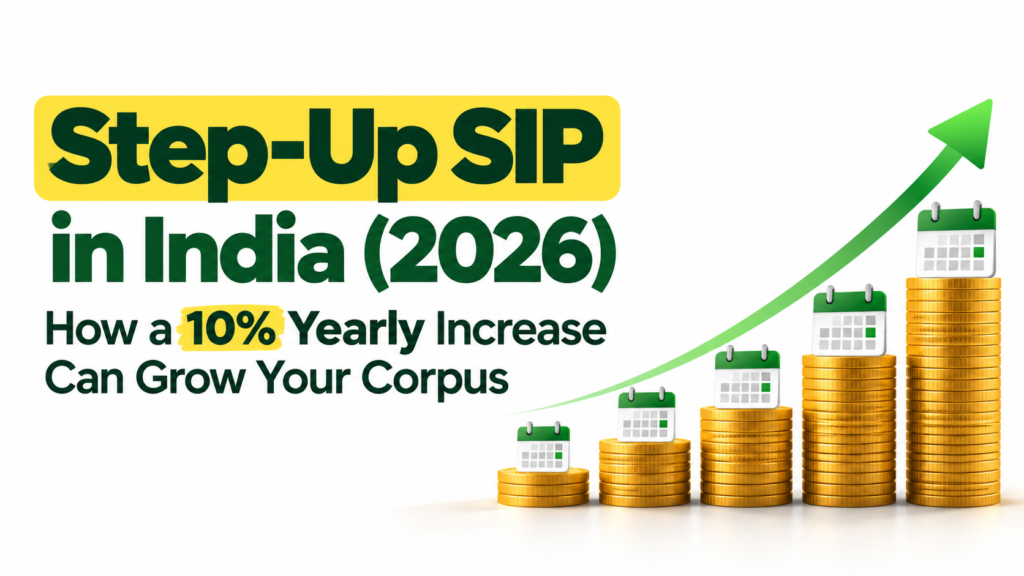
A step-up SIP is a systematic investment plan where the monthly amount increases automatically, by a fixed percentage or a fixed rupee amount, usually once a year. If you start at ₹10,000 a month and step up by 10% every year, you invest ₹10,000 in year one, ₹11,000 in year two, ₹12,100 in year three, and so on.
At an assumed return of 12% a year, this plan grows to about ₹9.75 lakh in 5 years and about ₹33.4 lakh in 10 years. A flat ₹10,000 SIP grows to about ₹8.17 lakh and ₹23.0 lakh over the same periods. These are illustrations based on an assumed return, not guaranteed outcomes.
This guide covers how the calculation works, what Indian market data says about realistic returns, how tax applies, how to choose your step-up percentage, and the mistakes to avoid. You can test your own numbers using the SIP calculator on SJS Finserve.
How a Step-Up SIP Works
In a regular SIP, you invest the same amount every month. In a step-up SIP, the amount rises at the start of each new investment year. The units you buy each month are added to the same fund, so every increase adds new money that stays invested for the remaining years.
Here is how a ₹10,000 SIP with a 10% annual step-up builds over five years:
|
Year |
Monthly SIP |
Annual investment |
Cumulative investment |
|
Year 1 |
₹10,000 |
₹1,20,000 |
₹1,20,000 |
|
Year 2 |
₹11,000 |
₹1,32,000 |
₹2,52,000 |
|
Year 3 |
₹12,100 |
₹1,45,200 |
₹3,97,200 |
|
Year 4 |
₹13,310 |
₹1,59,720 |
₹5,56,920 |
|
Year 5 |
₹14,641 |
₹1,75,692 |
₹7,32,612 |
After five years you have invested ₹7,32,612, which is ₹1,32,612 more than the ₹6,00,000 a flat ₹10,000 SIP would have invested. The monthly amount at that point is ₹14,641.
How Much Can a 10% Step-Up SIP Grow To?
The table below compares a flat ₹10,000 SIP with a ₹10,000 SIP that steps up by 10% every year. It assumes a 12% annual return, monthly compounding, and investment at the end of each month.
|
Period |
Flat SIP: invested |
Flat SIP: corpus |
Step-up: invested |
Step-up: corpus |
Extra corpus |
|
5 years |
₹6.00 lakh |
₹8.17 lakh |
₹7.33 lakh |
₹9.75 lakh |
₹1.58 lakh |
|
10 years |
₹12.00 lakh |
₹23.00 lakh |
₹19.12 lakh |
₹33.41 lakh |
₹10.41 lakh |
|
15 years |
₹18.00 lakh |
₹49.96 lakh |
₹38.13 lakh |
₹85.98 lakh |
₹36.02 lakh |
|
20 years |
₹24.00 lakh |
₹98.93 lakh |
₹68.73 lakh |
₹1.97 crore |
₹97.99 lakh |
If the return is 10% instead of 12%, the 10-year corpus is ₹20.48 lakh for the flat SIP and ₹30.21 lakh for the step-up SIP. The step-up advantage remains, but the absolute numbers change, which is why you should never plan around a single return figure.
What the numbers actually show
The step-up corpus is larger mainly because you invest more money. In the 10-year case you invest 59% more (₹19.12 lakh against ₹12 lakh) and the corpus is 45% larger. The return on each rupee is the same in both plans.
The practical benefit is different: a step-up SIP lets you reach the same goal with a smaller starting amount. To build ₹1 crore in 15 years:
|
Assumed annual return |
Flat SIP needed per month |
Step-up SIP: starting amount |
|
12% |
About ₹20,000 |
About ₹11,600 |
|
10% |
About ₹24,100 |
About ₹13,600 |
The trade-off is that the step-up SIP keeps rising. Starting at ₹11,600, the monthly amount reaches about ₹44,000 by year 15. This is manageable if your income grows at a similar pace, and difficult if it does not.
What Indian Market Data Says in 2026
SIP participation is at a record high
• Monthly SIP contributions reached a record ₹32,490 crore in September 2026, up about 10.7% from ₹29,361 crore in September 2025, according to AMFI data reported by Telangana Today.
• Contributing SIP accounts crossed 10 crore for the first time in August 2026, as reported by Angel One. SIP assets stood at ₹17.86 lakh crore at the end of September, per AMFI figures.
• Investors kept investing through a weak month. Total mutual fund industry assets fell 5.1% to ₹82.64 lakh crore in September, per Kotak Neo, yet SIP contributions still rose.
• In September, 49.68 lakh SIPs were stopped or completed, against 63.26 lakh new SIPs registered. The SIP stoppage ratio, which compares stopped or completed SIPs with new registrations, was 78.5%, down from 81.1% in August (source). It does not mean 78.5% of investors quit.
Realistic return assumptions
Many online calculators default to 12% or higher. The table below shows what the Nifty 50 Total Return Index (TRI) and a monthly SIP in it actually delivered, as of 30 June 2026, from Axis Mutual Fund’s index data.
|
Period |
Nifty 50 TRI (annualised) |
Monthly SIP return (XIRR) |
|
1 year |
-5.4% |
-5.5% |
|
5 years |
10.0% |
7.6% |
|
10 years |
12.5% |
11.7% |
A 12% assumption is consistent with the 10-year record of the broad market index, but the last one to five years have been well below that. For goals more than 10 years away, planning with 10% to 12% is reasonable. For goals under five years, equity returns can be negative, and a step-up SIP in equity funds is not the right tool.
Why Step-Up Matters More When Inflation Is Rising
India’s retail inflation rose to 5.54% in September 2026 from 4.83% in August, with food inflation at 7.74%, according to MoSPI’s CPI release. The RBI’s target is 4%, within a 2% to 6% band, and the RBI raised its inflation projection in its October 7 policy review.
At 5.5% inflation, prices roughly rise 71% in 10 years. A ₹10,000 SIP then buys what ₹5,850 buys today. In today’s purchasing power, the 10-year flat SIP corpus of ₹23.0 lakh is worth about ₹13.5 lakh, while the step-up corpus of ₹33.4 lakh is worth about ₹19.6 lakh. A 10% annual step-up keeps your investment growing faster than inflation, so your savings rate does not shrink in real terms.
Tax on Step-Up SIP Returns
Equity mutual fund gains are taxed as follows for FY 2026-27, with no change from Budget 2026, as summarised by Outlook Money:
• Long-term capital gains (held over 12 months): 12.5% on gains above ₹1.25 lakh in a financial year.
• Short-term capital gains (held 12 months or less): 20%.
Each SIP instalment is a separate purchase with its own holding period. When you redeem, units bought in the last 12 months can attract the 20% rate. Example: if you book ₹3 lakh of long-term gains in a year, the first ₹1.25 lakh is exempt and 12.5% applies to the remaining ₹1.75 lakh, which is ₹21,875 before surcharge and cess. The Income Tax Act 2025 came into force on 1 April 2026 with new section numbers, but the rates above are unchanged (Bigul). Confirm your own position with a tax professional.
How to Choose Your Step-Up Percentage
The table compares three step-up rates for a ₹10,000 starting SIP over 15 years at an assumed 12% return.
|
Annual step-up |
Total invested |
Corpus |
Monthly SIP in year 15 |
Corpus vs flat SIP |
|
0% (flat) |
₹18.00 lakh |
₹49.96 lakh |
₹10,000 |
– |
|
5% |
₹25.89 lakh |
₹64.66 lakh |
₹19,800 |
+29% |
|
10% |
₹38.13 lakh |
₹85.98 lakh |
₹37,975 |
+72% |
|
15% |
₹57.10 lakh |
₹1.17 crore |
₹70,757 |
+135% |
Use these rules to pick a rate:
• Match it to your income growth. If your salary rises 8% a year, a 15% step-up will strain your budget within a few years.
• Cover the basics first. Keep an emergency fund of 6 months of expenses and adequate term and health insurance before raising equity investments.
• Link it to goals. Work backwards from the goal amount and date, then choose the starting SIP and step-up that reach it.
• Consider a fixed rupee step-up. If your income is irregular, adding a fixed ₹1,000 or ₹2,000 each year is easier to sustain than a percentage.
• Review once a year. Adjust the percentage when your income, expenses or goals change.
Common Mistakes to Avoid
• Using one optimistic return figure. Check results at 8%, 10% and 12% before committing.
• Stopping the SIP in a falling market. Units bought during a decline are cheaper, which is the main reason SIPs work. Stopping locks in the loss of that benefit.
• Setting a step-up you cannot sustain. A SIP that you stop after three years does less than a smaller one you continue for fifteen.
• Holding too many funds. Spreading a small SIP across eight or ten funds adds tracking effort without improving diversification.
• Investing without a goal. Without a target amount and date, you cannot judge whether the step-up is too high or too low.
How SJS Finserve Can Help
At SJS Finserve our planning process has four steps: understand your income, family and existing investments; design a goal-wise plan covering insurance, mutual funds and, where suitable, other options; implement it with you; and review it regularly. The annual review is where the step-up percentage is checked against your actual income growth.
If you want a step-up SIP set up for a specific goal such as retirement, a child’s education or a home, you can try the free SIP and lumpsum calculators, or contact us for a consultation. Share your monthly income, goals and current investments, and we will work out a starting SIP, a step-up rate and a fund mix suited to your risk level. You can also read more on our blog or learn about our team.
Frequently Asked Questions
What is a step-up SIP?
A step-up SIP, also called a top-up SIP, increases your monthly investment by a fixed percentage or amount at set intervals, usually every year. You choose the increase when you register the SIP, and it applies automatically.
How much will a ₹10,000 SIP with 10% annual step-up become in 10 years?
At an assumed 12% annual return, it grows to about ₹33.4 lakh on a total investment of ₹19.12 lakh. At 10%, it grows to about ₹30.2 lakh. Actual results depend on market returns.
Is a step-up SIP better than a regular SIP?
It is better if your income grows and you can afford the rising amount. It builds a larger corpus because you invest more, and it lets you reach a goal with a lower starting SIP. A regular SIP is simpler if your income is fixed.
What is a good step-up percentage?
A common range is 5% to 10%, in line with expected salary growth. Choose a rate you can sustain for the full duration, and review it every year.
Are step-up SIP returns guaranteed?
No. Mutual fund returns depend on market performance and can be negative over short periods. The Nifty 50 TRI returned -5.4% over one year to June 2026, though its 10-year return was 12.5% a year.
Can I change or stop the step-up later?
In most cases you can modify or cancel the SIP instruction. The process varies by fund house and platform, so check with your distributor before making changes.
How is a step-up SIP taxed?
It is taxed like any equity mutual fund investment. Gains on units held over 12 months are taxed at 12.5% above ₹1.25 lakh a year, and gains on units held 12 months or less at 20%. Each instalment has its own holding period.
Should I increase my SIP when the market is falling?
The step-up decision should depend on your income and goals, not on market direction. If you can afford it, a lower market means more units for the same amount. If you cannot, keep the existing SIP running rather than stopping it.