
The Nifty 50 fell for eight straight weeks to early October 2026, its longest weekly losing run in 25 years, and about ₹28.29 lakh crore of investor wealth was erased, according to Outlook Money. On 7 October the RBI raised the repo rate to 5.50%, and on 8 October the Nifty touched a 52-week low of 22,179.90, as covered in our note on whether to invest at the 52-week low. Headlines like these push many investors to stop their SIPs or sell.
This article explains what a market correction is, how often corrections happen in India, what the data shows about recovery, and when a fall helps an investor and when it does not.
Quick answer: A market correction is a fall of 10% or more from a recent peak (Investopedia). The Nifty 50 has had 12 such falls since April 2006. In every earlier case the index later regained its previous high, but recovery took from a few months to about five years. Volatility helps investors who have a long horizon, invest regularly and use no borrowed money. It hurts those who need the money soon.
What Is a Market Correction?
A market correction is a decline of 10% or more in an index or security from its recent peak. A fall of 20% or more is generally called a bear market. Corrections matter to ordinary investors because they change the price at which mutual fund units and shares can be bought.
|
Term |
Fall from peak |
How often and why |
|
Correction |
10% to under 20% |
Frequent. Usually linked to interest rates, high valuations or global events. |
|
Bear market |
20% or more |
Less frequent. The 2008 and 2020 falls are examples. |
How Often Do Corrections Happen in India?
Integrato’s analysis of Nifty 50 index fund data counts 12 falls of 10% or more between April 2006 and 8 October 2026, four of them 20% or more. That is roughly one correction every 20 months. The table shows the larger episodes.
|
Episode |
Fall from peak |
What followed |
|
Global financial crisis (Jan to Oct 2008) |
Previous peak regained in December 2013 |
|
|
COVID-19 (Feb to Mar 2020) |
Earlier high regained by November 2020 |
|
|
Oct 2024 to Jan 2025 |
Nifty closed near 26,000 in October 2025 |
|
|
2026 (to 8 October) |
Not yet known |
The pattern is similar in the US. A 2018 CNBC and Goldman Sachs report, cited by Investopedia, found that the average S&P 500 correction lasted about four months and fell about 13% before recovering. The 2008 episode shows the limit of this pattern: the Nifty needed about five years from its October 2008 low to regain its January 2008 peak. Time horizon decides the outcome.
What Is Behind the Current Fall?
Several pressures arrived together. Brent crude rose above $100 a barrel, the rupee weakened past 96 to the dollar, the 10-year government bond yield reached 7.20%, and foreign portfolio investors sold ₹35,861 crore of Indian shares in September, Outlook Money reported. On 7 October the RBI raised the repo rate by 25 basis points to 5.50%, its first increase since February 2023. Retail inflation was 4.82% in August, above the RBI’s 4% target.
Choice Wealth’s head of research views the fall mainly as a valuation reset caused by global factors rather than weaker economic fundamentals. The September-quarter results now being reported will show whether company profits are holding.
Why Volatility Can Work in an Investor’s Favour
Four mechanisms explain how a fall can benefit an investor with the right profile.
1. The same SIP buys more units
A SIP (Systematic Investment Plan) invests a fixed amount on a fixed date. If the NAV (the price of one fund unit) falls from ₹100 to ₹80, a ₹10,000 instalment buys 125 units instead of 100, which is 25% more. Those extra units gain when prices recover. Indian investors are using this at scale: AMFI data shows SIP contributions at a record ₹32,490 crore in September 2026, with 10.06 crore contributing SIP accounts, in a month when the Nifty fell about 6%.
2. Lower prices help only if earnings hold
A lower index level raises future return potential only if company profits do not fall by the same amount. On 28 August 2026, before the latest leg of the fall, the Nifty’s price-to-earnings (P/E) ratio was 20.44, about 12% below its 10-year median of 23.33. The earnings trend matters more than the index level.
3. The best days arrive during the fall
Recovery days cluster near the lows. A FundsIndia study found that missing the 15 best days in 25 years cut the final value of a Nifty 50 Total Return Index investment (which includes dividends) by two-thirds, and seven of the ten best days came within two weeks of the ten worst. In 2008, 22 of the 30 best days since 2005 fell during the crash itself. An investor who sells during a fall is likely to miss them.
4. A fall shows whether your portfolio fits your risk
Corrections show whether your equity share, emergency fund and loans match your situation. An investor who finds a mismatch during a 15% fall can adjust. One who finds it during a 40% fall may have to sell at low prices. Our article on why investors earn less than the funds they own covers this behaviour gap with Indian data.
When Volatility Does Not Help
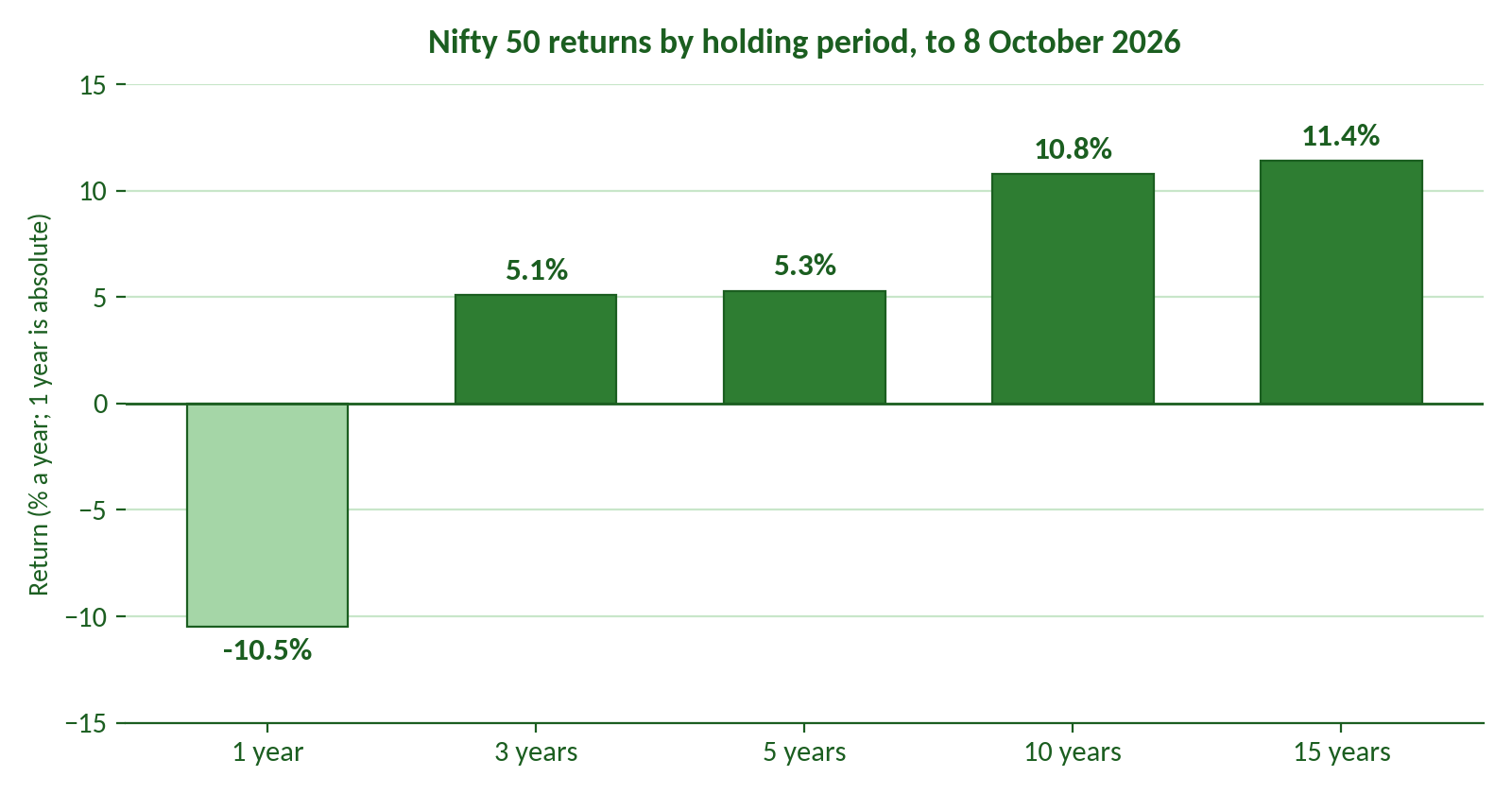
Volatility favours time. As of 8 October 2026, the Nifty 50 returned -10.5% over one year, 5.3% a year over five years and 10.8% a year over ten years. Across all five-year periods since 2006, 98% were positive, against 79% of one-year periods (Integrato).
A correction causes real damage in four situations:
• The money is needed within one to three years. The 2008 fall took about five years to recover.
• The investment is funded by a loan or margin, which can force a sale at low prices.
• One sector or a few stocks make up most of the portfolio.
• There is no emergency fund or insurance cover, so a medical or job emergency forces a sale.
What to Do During a Correction
1. Continue SIPs if the goal is five or more years away and the instalment is affordable. Most Indian investors have continued: contributing SIP accounts rose to 10.06 crore in September from 10.02 crore in August.
2. Keep money needed within three years out of equity. Short-term goals need lower-risk options, because equity can stay below its earlier level for years.
3. Stage large lump sums. Investing a large amount in instalments through an STP (Systematic Transfer Plan) reduces the risk of buying just before another fall. Each transfer is a redemption that can attract tax and exit load. Equity fund gains within 12 months are taxed at 20%, and long-term gains above ₹1.25 lakh a year at 12.5%. See our guide to lump sum versus STP.
4. Rebalance with new money. If a 20% fall in equity has taken it from 60% to about 55% of your portfolio, direct new contributions to equity until you are back at your target. Switching existing funds can trigger tax and exit load.
5. Check your mid-cap and small-cap exposure. These categories usually fall more than large-cap funds. Small-cap and mid-cap funds took about 44% of equity fund inflows in September 2026, so many portfolios may hold more of them than before. Our comparison of large-cap, mid-cap, small-cap and flexi-cap funds explains the differences.
How SJS Finserve Can Help
SJS Finserve Private Limited helps families plan, start and review their investments. The process has four steps: understand your income, loans, family and goals; design a Protect, Grow, Multiply plan that starts with adequate life and health cover; start suitable mutual funds and SIPs at amounts you choose; and review the plan regularly. We explain risks in writing and do not promise returns.
If you are unsure whether to continue, increase or pause your SIPs, book a free consultation with our team. You can test your numbers on the SIP calculator.
Frequently Asked Questions
What is a market correction?
A market correction is a fall of 10% or more in an index or security from its recent peak. Falls of 20% or more are generally called bear markets.
How long does a market correction last in India?
There is no fixed duration. The Nifty 50 regained its pre-COVID high by November 2020, while recovery from the 2008 fall took until December 2013.
Is a market correction a good time to invest?
It can be for long-term money, because SIP instalments buy more units at lower prices. It does not suit money needed within one to three years, and nobody can identify the bottom in advance.
Should I stop my SIP during a correction?
Not automatically. If the goal is five or more years away and the instalment is affordable, continuing is generally sensible. Pause or reduce only if your income is disrupted or you need the money soon.
What is the difference between a correction and a crash?
A correction is a fall of 10% or more from a peak. A crash usually means a very sharp fall over days or weeks, such as the 38.5% drop in 33 trading sessions in March 2020.
Can I lose money in a correction?
Yes. Equity fund NAVs fall when markets fall. The loss stays on paper until you redeem units, but there is no guarantee that the NAV will recover, so equity money should have a long horizon.