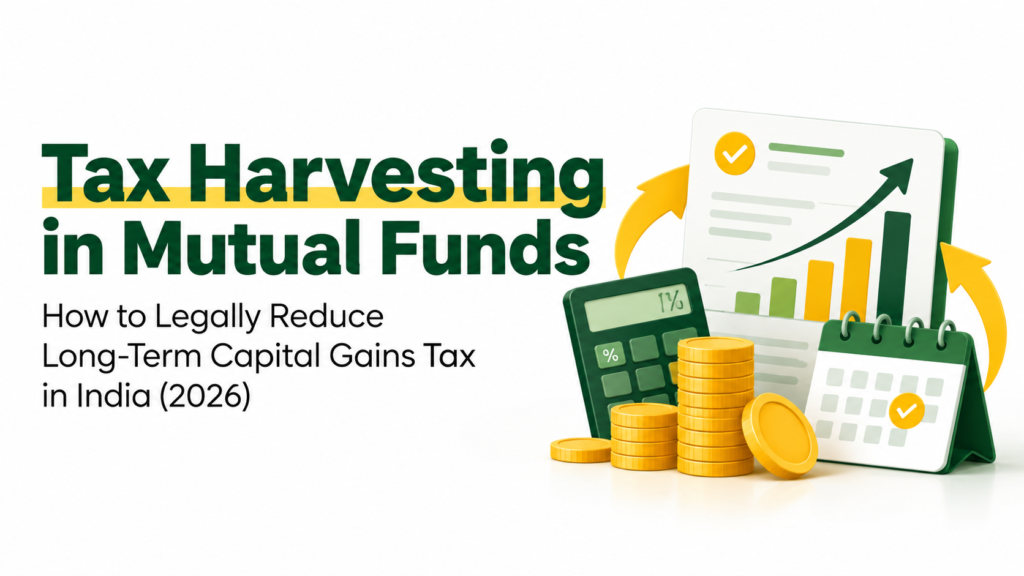
Quick answer: Tax harvesting means selling equity mutual fund units (or shares) and, in most cases, reinvesting the money. Tax-gain harvesting uses the ₹1.25 lakh of long-term capital gains that is tax-free each financial year. Tax-loss harvesting books a loss so that it cancels taxable gains. Both are legal. For FY 2026-27, the sale must be completed on or before 31 March 2027.
Most mutual fund investors only think about capital gains tax when they sell. By then, years of gains may sit in one fund and be taxed in a single year. Tax harvesting spreads that tax over time, or reduces it, using rules that already exist in the Income-tax Act.
This guide explains the FY 2026-27 rules with worked examples and lists the mistakes that cost investors money. It covers equity-oriented mutual funds and listed shares, where the ₹1.25 lakh exemption applies.
Why tax harvesting matters for Indian investors right now
Mutual fund participation has grown fast, and a large share of investors have not yet faced a capital gains calculation. The latest AMFI and NSE numbers show the scale:
|
Indicator |
Latest figure |
Source |
|
Mutual fund investor accounts (Sep 2026) |
28.62 crore, with 27.12 lakh added in the month |
|
|
Monthly SIP contribution (Sep 2026) |
₹32,490 crore, a record high |
|
|
Money held in SIPs (Sep 2026) |
₹17.86 lakh crore, 21.6% of all mutual fund assets |
|
|
Equity fund net inflow (Sep 2026) |
₹38,307 crore, the 67th straight month of inflows |
|
|
Net SIP inflows, FY 2025-26 |
About ₹2 lakh crore, 56% of ₹3.5 lakh crore gross SIP investment |
|
|
NSE registered investors (mid-2026) |
13.2 crore, up from 2.7 crore in FY19 |
Two points follow from this data. First, about four in five registered investors joined after FY19, so many are holding investments long enough, for the first time, to qualify for long-term tax rates. Second, total mutual fund assets fell 5.1% in September, and the Nifty touched a 52-week low of 22,179.90 on 8 October 2026, as covered in our note on whether to invest or wait at the Nifty low. Falling markets leave many portfolios with a mix of profits and paper losses (losses on investments you have not sold yet), which is the situation tax harvesting is built for.
Capital gains tax rules for equity mutual funds in FY 2026-27
An equity-oriented mutual fund is one that keeps at least 65% of its money in shares of Indian compan0.ies. The tax rules below apply to these funds and to listed shares.
|
Item |
Rule for FY 2026-27 |
|
Short-term gain (held up to 12 months) |
Taxed at 20% |
|
Long-term gain (held more than 12 months) |
Taxed at 12.5% only on the part of the gain above ₹1.25 lakh in a financial year |
|
Cess and surcharge |
A 4% cess is added to the tax. Investors with high incomes may also pay a surcharge |
|
Who gets the ₹1.25 lakh limit |
Each person (each PAN), every financial year. If you do not use it, it does not carry over |
|
Unused losses |
Can be carried forward for 8 years, if you file your return on time |
A note on the law: India has a new Income-tax Act, 2025, which replaced the older Income-tax Act, 1961 from 1 April 2026. The section numbers have changed, but the rates, the ₹1.25 lakh limit and the 8-year loss rule remain the same, as Taxguru’s guide explains. For example, the loss carry-forward rule was Section 74 of the 1961 Act and is Section 111 of the 2025 Act, according to Tax2win. Returns for FY 2025-26 are still filed under the 1961 Act.
Debt funds, gold funds and international funds follow different rules and do not get the ₹1.25 lakh tax-free limit. Our guide to debt mutual fund taxation covers the debt side.
Tax-gain harvesting: use the ₹1.25 lakh exemption every year
Tax-gain harvesting means selling units that have a long-term profit of up to ₹1.25 lakh in the financial year, then buying the same fund again. The profit is tax-free, and your buying price is reset to today’s higher price. Future tax is calculated only on growth above that new price. ET Money and HDFC Mutual Fund describe the same method.
Worked example
Riya invested ₹4,00,000 in an equity fund more than 12 months ago. It is now worth ₹5,15,000, a long-term gain of ₹1,15,000, which is below the exemption limit.
• She sells all units and pays no tax. She reinvests ₹5,15,000, so her new buying price is ₹5,15,000.
• A year later the investment is worth ₹5,80,000. Her gain is only ₹65,000, not ₹1,80,000.
• Without harvesting, she would have had a taxable gain of ₹55,000 (₹1,80,000 minus ₹1,25,000), tax of ₹6,875 and cess of ₹275, a total of ₹7,150. With harvesting, the tax is zero.
The most you can save in one year is ₹16,250 per person (₹1,25,000 at 12.5%, plus 4% cess). Over ten years that is ₹1.62 lakh for one investor, and about ₹3.25 lakh for a couple where each spouse invests from their own funds. The saving applies only if you would otherwise have paid tax on those gains later.
Points to check before harvesting gains
• The 12-month clock restarts. The new units count as bought today. If you sell them within 12 months, the profit is taxed at 20%.
• Oldest units are sold first. In mutual funds, the oldest units are sold first. If you invest through SIP, check that the units being sold are more than 12 months old.
• Family members. Each person has their own ₹1.25 lakh limit, but do not gift money to your spouse just to use it. The income is added back to your own. Each person should harvest from their own investments.
Tax-loss harvesting: use losses to reduce taxable gains
Tax-loss harvesting means selling units or shares that are worth less than you paid, so the loss is recorded and can be adjusted against your profits. Groww and ClearTax both explain these rules, which are summarised below.
|
Type of loss |
Reduces short-term profit? |
Reduces long-term profit? |
Reduces salary or other income? |
Carry forward |
|
Short-term loss (held up to 12 months) |
Yes |
Yes |
No |
8 years |
|
Long-term loss (held over 12 months) |
No |
Yes |
No |
8 years |
Example 1: a short-term loss reduces a short-term profit
Arjun sold fund units after 8 months and made a profit of ₹1,20,000. The tax is 20%, or ₹24,000. He also holds another fund, bought 6 months ago, which is down ₹70,000.
• He sells the second fund and books the ₹70,000 loss. His taxable profit falls to ₹50,000.
• Tax on ₹50,000 at 20% is ₹10,000. The saving is ₹14,000 before cess, or ₹14,560 with cess.
Example 2: a long-term loss reduces a long-term profit
Meera has a long-term profit of ₹2,00,000 and a long-term loss of ₹60,000. Her net profit is ₹1,40,000. After the ₹1,25,000 tax-free limit, only ₹15,000 is taxable, so she pays ₹1,875 instead of ₹9,375. The saving is ₹7,500 before cess.
What tax-loss harvesting does not do
It delays tax; it does not remove it. If you sell at a loss and buy back, your new buying price is lower, so your future profit will be larger by the same amount. The benefit is that you pay later and your money stays invested. It also helps only if you have profits to adjust now, or expect some within 8 years.
Carrying losses forward and filing your return
If your losses are more than your profits, the leftover loss can be carried forward for 8 years. This works only if you report the loss in your income tax return and file that return by the due date. Income earned in FY 2025-26 (April 2025 to March 2026) is reported in the return for assessment year 2026-27, and the standard due date for individuals without an audit is 31 July, which was 31 July 2026 for that return, as the Free Press Journal reported. Filing late generally means you lose the right to carry the loss forward. If you have capital gains, you will usually need the ITR-2 form.
Tax-gain harvesting vs tax-loss harvesting
|
|
Tax-gain harvesting |
Tax-loss harvesting |
|
What you sell |
Units with long-term profit up to ₹1.25 lakh |
Units currently below cost |
|
Main benefit |
Raises your buying price and lowers future tax |
Cancels current or future taxable profits |
|
Best when |
Markets are up and you have unused tax-free limit |
Markets are down or your profits are above the limit |
|
Tax effect |
Tax-free now, and less tax later |
Lower tax now, with more profit to tax later |
|
Key risk |
The 12-month clock restarts |
Selling a sound fund only for the tax benefit |
How to do tax harvesting: step by step
1. Download your capital gains statement. Get it from your fund house, from CAMS or KFintech (the companies that keep mutual fund records), or from your broker. It shows what you bought, when, and the profit or loss you have already booked this year.
2. Add up what you have already realised. Include all sales, fund switches and share sales since 1 April. Switching from one fund to another counts as a sale.
3. Find the room or the loss. For gain harvesting, subtract the long-term profit you have already booked from ₹1.25 lakh. For loss harvesting, list the funds that are down and how long you have held them.
4. Check exit load, lock-in and costs. ELSS (tax-saving) funds are locked for 3 years, and some funds charge a fee if you sell early (exit load). Selling shares also costs brokerage and small taxes.
5. Sell the exact amount. Sell by amount or number of units so that the profit stays within your target.
6. Reinvest the same day. The money from a sale takes one to three working days to reach your bank. Buy the new units on the same day from your bank balance, so you are not out of the market while you wait. For large amounts, a lump sum or STP approach may suit your risk level better.
7. Record it and file on time. Keep the statement for your return and report any loss, so it can be carried forward.
Best time to do tax harvesting in FY 2026-27
The financial year ends on 31 March 2027, and only sales completed on or before that day count for this year. Start in January or February. Waiting for the last week risks missed cut-off times, app delays and sharp market moves. You can also harvest earlier in the year, since the ₹1.25 lakh limit applies to the full year.
Common mistakes to avoid
• Selling units that are under 12 months old, which turns a tax-free profit into one taxed at 20%.
• Ignoring exit load. Most equity funds charge about 1% if you sell within the first year. This does not affect older units, but some funds use longer periods, so check the fund details.
• Selling ELSS units inside the 3-year lock-in. Each SIP instalment has its own lock-in date.
• Selling and rebuying shares again and again in a short period. India has no specific rule against it like the US wash-sale rule, but the trades should be genuine. Discuss frequent trades with a chartered accountant.
• Filing the return late, which can end your right to carry losses forward.
• Letting tax decide the portfolio. A sound fund should not be sold only for a small tax benefit. Our notes on common mutual fund mistakes and the behaviour gap show how hasty decisions reduce returns.
When tax harvesting may not be worth it
• Your profits are small and you do not expect to cross ₹1.25 lakh in any single year.
• You have already booked more than ₹1.25 lakh of long-term profit this year, so no tax-free limit is left.
How SJS Finserve can help
Tax harvesting looks simple in an example, but it depends on your own details: purchase dates, SIP instalments, existing profits, family holdings and your goals. To request a portfolio review, contact SJS Finserve. We do not promise returns, and all mutual fund investments are subject to market risk.
Frequently asked questions
What is tax harvesting in mutual funds?
It is the practice of selling equity mutual fund units to either use the yearly ₹1.25 lakh tax-free limit on long-term profit, or to book losses that reduce taxable profit. The money is usually reinvested. It is legal and uses rules already in the tax law.
How much long-term profit is tax-free on equity mutual funds?
Up to ₹1.25 lakh per person per financial year. Profit above this is taxed at 12.5% plus cess, as set out in Taxguru’s FY 2026-27 guide.
Can I buy the same fund again after selling it?
Yes. India has no specific rule against it. The new units start a fresh 12-month clock, and your buying price becomes the price on the day you buy.
How long can capital losses be carried forward?
For 8 years, if the return that reports the loss is filed before the due date. The 8-year period is the same under the old and the new Income-tax Act.
Does tax harvesting work for SIP investors?
Yes. Each SIP instalment is a separate purchase. Only instalments older than 12 months are long-term, and the oldest units are sold first.
Do debt mutual funds get the ₹1.25 lakh exemption?
No. The tax-free limit applies to listed shares and equity mutual funds. Debt fund taxation is covered in our debt fund tax guide.
What is the last date for tax harvesting in FY 2026-27?
31 March 2027. The sale must be completed on or before that day, so do not leave it for the final days.