
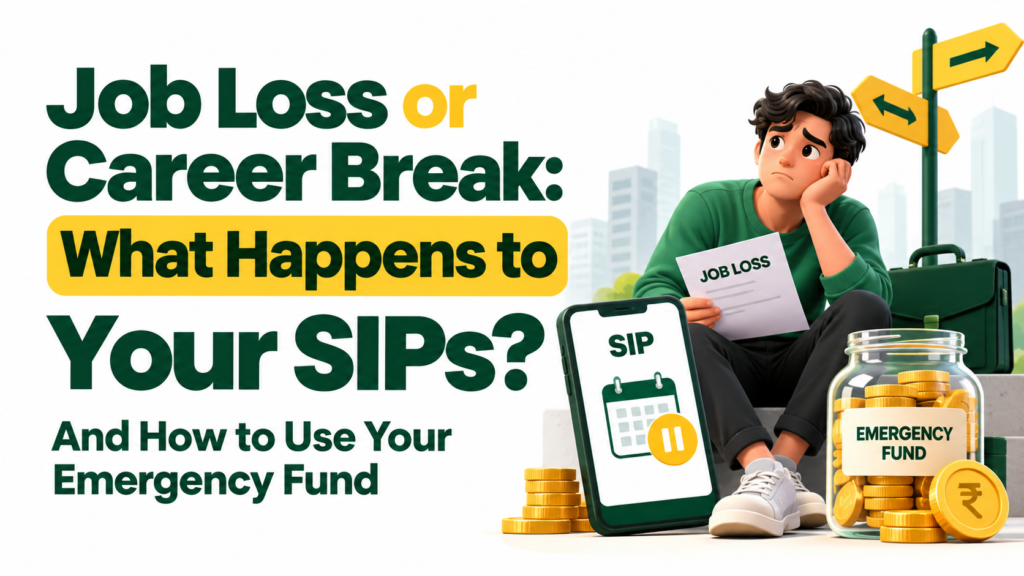
A job loss or career break stops one thing your income.
Rent, EMIs, insurance premiums, school fees and SIP auto-debits all continue on their own schedules. This guide explains what happens to your SIPs and emergency fund, which Indian rules apply in 2026, and the order in which to use your money.
|
Quick answer • A SIP is an instruction, not a loan. You can pause or stop it without a penalty from the fund house. Failed debits, however, can cost you bank charges and lead to automatic cancellation. • Pausing a SIP does not sell your units. Your existing investments stay invested. • Your emergency fund exists for this situation. Spend it before you touch long-term investments. • Employer health insurance usually ends with the job. Arrange a personal policy before your last working day. • EMIs do not pause on their own. Speak to your lender early. |
Why job loss planning matters more in India now
India’s five largest IT services companies (TCS, Infosys, Wipro, HCLTech and Tech Mahindra) reported a net fall in headcount in FY26, the first in about two decades, with reported figures between roughly 7,000 and 7,400 (Forkast). TCS announced a cut of about 2% of its workforce, around 12,000 jobs, mainly in middle and senior levels (Gulf News). Cognizant has also announced a restructuring of 12,000 to 15,000 jobs globally, with most of it in India, and AI-related IT hiring rose 16% year on year in June 2026 while overall IT hiring fell 3% (Forkast).
The cause is debated. TCS management has attributed its cuts to skill mismatches rather than AI productivity gains, while analysts point to AI-led efficiency and weaker client spending. For a household, the cause matters less than the result. Most announced cuts have focused on mid and senior roles (India layoffs tracker, October 2026), which are the people most likely to carry a home loan and a running SIP.
Career breaks create the same cash-flow gap by choice: childcare, studies, health recovery or a business launch. The mechanics below apply to both.
What happens to your SIP when income stops
The SIP keeps debiting until you act
Your mutual fund SIP is linked to your bank account through a mandate. If you do nothing, the debit is attempted every month, whether or not your salary arrives.
Failed debits cost money and can cancel the SIP
If the account balance is short, the debit fails and your bank may charge a penalty for each failed attempt. AMFI’s framework treats three consecutive failed instalments on a monthly SIP as a discontinued SIP (Moneycontrol). Fund houses such as HSBC state in their forms that they may discontinue a SIP after three consecutive dishonoured instructions (HSBC Mutual Fund form). A cancelled SIP needs fresh registration to restart.
Your existing units stay invested
Pausing or stopping a SIP does not redeem anything. The units you already own remain in the fund and move with the market (Edelweiss Mutual Fund).
Pause or stop: which one to choose
|
|
Pause |
Stop |
|
What it does |
Suspends debits for a fixed period, then the SIP restarts automatically |
Cancels all future instalments permanently |
|
Restart |
Automatic after the pause ends |
You must register a new SIP |
|
Typical limits |
Usually 1 to 3 months; some fund houses allow up to 6. Often for monthly SIPs only, and sometimes once per SIP |
Needs notice, commonly 21 to 30 days |
|
Best for |
A short gap, such as a notice period or a quick job search |
A long gap with no clear return date |
Rules differ by fund house. Some require six completed instalments before you can pause, and notice periods range from about 5 days to 30 days before the debit date (Geojit). Check your AMC’s terms today, not after the first failed debit. If the maximum pause is shorter than your expected job search, reducing the SIP amount is often better than cancelling it.
Pausing has a cost: you miss instalments that would have bought units. That cost is smaller than the alternative of selling equity units at a market low to pay bills. Our note on why market corrections help long-term investors explains how to think about those periods, and our Nifty 52-week low analysis shows the same decision during a fall.
What happens to your emergency fund
Drawing on your emergency fund after a job loss is the intended use, not a failure. It keeps you from selling long-term investments or borrowing at high rates. Axis Mutual Fund makes the same point: a basic buffer should exist before you increase SIP commitments (Axis Mutual Fund).
How much you need
Count essential expenses only: rent or EMI, groceries, utilities, insurance premiums, school fees and minimum loan payments. Leave out dining out, travel and shopping. Multiply by the number of months you want to be covered.
Example with essential expenses of ₹60,000 a month:
|
Months covered |
Fund needed |
Who it suits (our view) |
|
3 months |
₹1.8 lakh |
Two earners, no large loans, skills in demand |
|
6 months |
₹3.6 lakh |
Salaried with a home loan EMI |
|
9 months |
₹5.4 lakh |
Single income, dependents, or a role exposed to automation |
|
12 months |
₹7.2 lakh |
Senior roles with fewer openings, or a planned career break |
Why the longer targets for mid and senior roles: Value Research notes that finding a comparable position in IT can take six to nine months when roles are being restructured (Value Research Online). Notice pay, severance and leave encashment are extra, but count them only after you have them in writing.
Where to keep it
Liquid funds are a common choice for emergency money, and Kotak Mutual Fund notes that redemption timelines and exit loads should be checked first (Kotak Mutual Fund). Liquid fund redemptions normally credit the next working day, so do not keep the entire fund there. A layered structure works better:
• First 1 to 2 months: savings account or fixed deposit, available the same day.
• Remaining months: liquid fund, for better returns than a savings account with low risk.
Health and life insurance after a layoff
Group health cover usually ends on your last working day, and your family loses cover on the same date (Outlook Money). IRDAI’s framework lets you migrate from a group policy to an individual or family policy with the same insurer, subject to underwriting, and you generally need to apply before or shortly after the cover ends (Outlook Money).
• Ask HR for the exact end date while you are still serving notice.
• Apply for migration early. Migration carries forward waiting periods you have already served, while a brand new policy restarts them.
• Group term life cover generally cannot be ported to a personal plan (Ditto Insurance), so buy a personal term plan while you are employed.
This is why we recommend personal cover before investing. Our guide on term insurance vs health insurance covers how much to take.
Should you withdraw your EPF?
EPFO changed its withdrawal rules in October 2025. On unemployment, up to 75% of the balance can be withdrawn, 25% must remain as a minimum balance, and full settlement is allowed only after 12 months of unemployment instead of the earlier 2 months (Drishti IAS; Outlook Money). Confirm the current process on the EPFO member portal before applying.
Treat EPF as one of the last sources. It is your retirement money and keeps earning interest while it stays invested. Use it only when cash, liquid funds and other options are exhausted.
What to do in the first week
1. Calculate your runway: liquid cash plus emergency fund, divided by essential monthly expenses.
2. Pause or reduce your SIPs before the next debit date.
3. Contact your lenders before you miss an EMI. RBI’s financial education guidance encourages borrowers to approach lenders instead of ignoring the problem, and any relief depends on the lender and loan type (Moneycontrol).
4. Secure health insurance for your family.
5. Cut discretionary spending and avoid new credit card or personal loan debt.
6. Do not sell equity funds yet unless cash is truly short.
In what order to use your money
|
Step |
Source |
Notes |
|
1 |
Notice pay, severance, leave encashment |
Count only what is confirmed in writing. |
|
2 |
Savings account and fixed deposit |
Same-day access. Keep the first 1 to 2 months here. |
|
3 |
Liquid and debt funds |
Gains on debt funds bought after 1 April 2023 are taxed at your slab rate (Outlook Money tax reckoner), which may be lower in a year with less income. |
|
4 |
Equity funds held over 12 months |
Long-term gains up to ₹1.25 lakh a year are tax-free, and above that 12.5%. Gains on units held under 12 months are taxed at 20% (Outlook Money). See our tax harvesting guide. |
|
5 |
Loan against mutual funds |
A short-term bridge only. See the risks below. |
|
6 |
EPF |
Last resort, for the reasons above. |
Loan against mutual funds: useful, but risky without income
A loan against mutual funds (LAMF) lets you pledge units and borrow without selling them. Rates in 2026 are broadly 9% to 13% a year, lower than most personal loans (Upstox; smallcase). Lenders usually lend only part of the value, often around half for equity funds and more for debt funds, and ELSS units are generally excluded (JM Financial).
The risks are specific to a job loss. Interest still has to be paid when you have no salary. Many loans carry floating rates. If the market falls, the lender can ask for more collateral or sell your units at the low. Use LAMF only for a short gap when you have a visible path back to income, such as a confirmed offer.
Worked example: what a SIP pause is worth
This is an illustration, not a client case. A 34-year-old professional has essential expenses of ₹70,000 a month, a SIP of ₹20,000 and an emergency fund of ₹4.2 lakh, and loses the job.
|
|
SIP continues |
SIP paused |
|
Monthly outflow |
₹90,000 |
₹70,000 |
|
Runway from ₹4.2 lakh |
About 4.7 months |
6 months |
|
Equity units sold |
None, but cash runs out sooner |
None |
Pausing alone adds roughly 1.3 months of runway and keeps the existing units invested. Add notice pay or severance and the runway extends further. Your numbers will differ, so run your own figures.
Planning a career break
A planned break gives you time that a layoff does not. Use it.
• Set the length and cost. Multiply your essential monthly expenses by the months you plan to be out, then add 20% for surprises.
• Keep a separate break fund. Your emergency fund should stay untouched for real emergencies during the break.
• Buy personal insurance first. Waiting periods start from the day a policy begins, and premiums rise with age.
• Keep a small SIP running if you can. A reduced SIP keeps the habit and the mandate alive without straining cash flow.
• Plan the return. Decide in advance when you will restart your full SIP and rebuild the fund.
Rebuilding after you start earning again
1. Refill the emergency fund to at least three months of expenses.
2. Restart the SIP at its previous amount.
3. Continue to a six-month fund, then resume your SIP step-ups.
A budget framework helps here, and our 50-30-20 rule guide shows how to split a salary. If you receive a lump sum such as a joining bonus, our guide on lump sum vs STP explains how to invest it in stages.
How SJS Finserve can help
Most households discover gaps in their plan only when income stops. At SJS Finserve, a review before that point covers three things:
• How many months your savings and liquid funds can cover your actual expenses.
• Whether your SIPs, loans and insurance are structured to survive an income gap.
• Which investments to use first and which to leave alone, with tax in mind.
You can try our calculators, read about our services and contact us for a free consultation. We will review your numbers and explain the options in plain terms.
Frequently asked questions
What happens to my SIP if I lose my job?
Nothing happens automatically. The SIP keeps debiting until you pause or stop it. If the debit fails repeatedly, the fund house can cancel it. Units you already own stay invested.
Can I pause a SIP without a penalty?
Yes. Fund houses do not charge a penalty for pausing, though your bank may charge for failed debits if you do not pause in time. Pause limits and notice periods vary by fund house.
How many failed SIP debits cancel the SIP?
Under the AMFI framework, three consecutive failed instalments on a monthly SIP cause it to be treated as discontinued. Many fund houses state the same in their forms.
Do I lose my mutual fund units if I stop my SIP?
No. Stopping or pausing only affects future instalments. Your accumulated units remain in your folio.
How big should my emergency fund be if I work in IT?
We suggest at least six months of essential expenses, and nine to twelve months if you have dependents, a single income or a role exposed to automation.
Does health insurance continue after a layoff?
Employer group cover usually ends on your last working day. You can generally migrate to an individual policy with the same insurer, subject to underwriting, if you apply within the insurer’s window.
Should I take a loan against my mutual funds after a job loss?
Only as a short bridge with a clear way to repay. Interest accrues, rates may float, and a market fall can trigger a margin call.
Is it better to sell equity funds or pause the SIP?
Pause first. Sell equity only after cash, the emergency fund and debt funds are used, and check the tax on the units you sell.


