 SIF
SIF
Specialised Investment Funds (SIF) Explained: The New Middle Ground Between Mutual Funds and PMS
A practical breakdown of SEBI's new SIF category minimum investment, strategies, risk, liquidity and taxation and how it compares to…

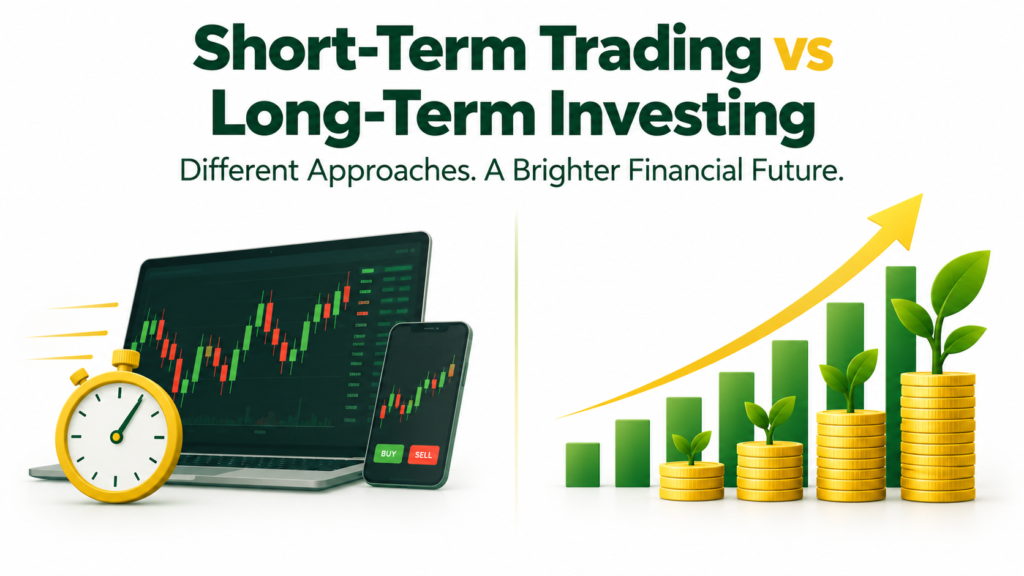
The question many investors ask is simple: should you try to make money from short-term market movements, or should you invest patiently and allow your wealth to compound over many years?
The answer depends on your goal, risk tolerance, financial capacity and investment horizon. But for investors focused on building sustainable wealth, there is an important distinction to understand. Short-term trading is primarily an attempt to capture relatively quick price movements. Long-term investing is an approach built around allowing capital to participate in business and market growth over extended periods.
That difference is more important than it may initially appear.
Short-term and long-term investing are not simply two versions of the same strategy. They operate on different time horizons and require different ways of thinking.
The supplied research defines long-term investing as an approach generally involving a 10-year or longer horizon, while short-term investing generally refers to goals requiring money within three years or less. An intermediate period of four to seven years sits between the two.
This distinction matters because the amount of time available before the money is needed influences how much market volatility an investor can reasonably tolerate.
An investor saving for a vacation next year cannot approach the market in the same way as someone investing for retirement several decades away. The first investor has a relatively short window in which the money needs to be available. The second has considerably more time to absorb periods of market weakness.
| Factor | Short-Term Approach | Long-Term Approach |
|---|---|---|
| Typical horizon | 3 years or less | 10 years or more |
| Primary objective | Meet nearer-term financial needs | Build long-term wealth |
| Market volatility | Usually less tolerance | Greater capacity to withstand fluctuations |
| Typical goals | Vacation, wedding, home improvements | Retirement, education, long-term wealth |
| Investment approach | Greater emphasis on capital preservation | Greater scope for growth-oriented investments |
| Key requirement | Protect money needed soon | Patience and discipline |
The important point is that time is not merely a calendar measure. It is an investment resource.
Short-term trading attempts to benefit from relatively quick changes in asset prices. Positions may be held for very short periods, depending on the strategy.
Technical analysis and price movements often play an important role in these approaches. The objective is not necessarily to own an investment through an entire business or economic cycle. Instead, the focus is on identifying opportunities within shorter market movements.
That creates a very different investor experience. Prices can change quickly. Market sentiment can shift. Economic announcements, company results, interest-rate expectations and investor positioning can all influence prices over short periods.
The challenge is therefore not simply identifying a good company or investment. It is also deciding when to enter, when to exit and how much risk to take if the market moves against you.
For investors who do not have the time, experience or temperament to continually monitor markets, this can become difficult. Short-term strategies can have a legitimate role in some portfolios, but they should not automatically be confused with a reliable method of building long-term wealth.
Long-term investing begins with a different question. Instead of asking, “Where will the market move next week?”, the investor is more likely to ask, “What assets can help me achieve my financial objectives over the next 10, 20 or 30 years?”
That changes the way market fluctuations are viewed.
For long-term goals such as retirement, college savings or building wealth, investors may have greater capacity to remain invested through temporary market declines. The supplied material notes that a longer time frame can provide more opportunity for investments to recover from market declines, although recovery is never guaranteed and investments can lose principal.
This is where patience becomes an investment advantage.
A long-term investor does not necessarily need every quarter or every year to be positive. The objective is to allow the portfolio to participate in growth over a much longer period while managing risk appropriately.
One of the most important reasons long-term investing can be powerful is compounding.
When investment returns remain invested, future returns can be generated not only on the original capital but also on previous returns. Over long periods, this can materially affect the growth of wealth.
But compounding requires something that cannot be manufactured through a trading screen: time.
This is why starting early can matter so much. An investor who begins building a portfolio for a long-term objective has more time for contributions and investment growth to accumulate.
The supplied material specifically identifies compounding and market growth as potential ways long-term investing can help build wealth.
There is no universal rule that every investor should hold every investment for decades.
The appropriate strategy begins with the purpose of the money.
If the money is required within a few years, protecting capital and maintaining appropriate liquidity can become more important than pursuing maximum growth. The source material identifies examples such as vacations, weddings and home improvements as short-term goals.
For goals that are many years away, investors may have greater flexibility to accept market volatility in pursuit of long-term growth.
The decision therefore should not start with a particular stock, fund or market trend. It should start with the question:
When will I need this money?
Once that is clear, the investment strategy becomes easier to evaluate.
Investors often describe themselves as conservative, moderate or aggressive. But risk tolerance is only one part of the decision.
There is also risk capacity, which is about how much financial loss an investor can actually afford to withstand.
Someone may be emotionally comfortable with a market decline but financially unable to tolerate a major loss because the money is needed soon.
Conversely, someone investing for a distant retirement goal may have more financial capacity to remain invested through periods of volatility.
The supplied material makes this distinction clearly: risk tolerance relates to comfort with market risk, while risk capacity considers how much financial loss an investor can afford to handle.
That is why portfolio decisions should be based on both the investor’s financial situation and their psychological comfort with volatility.
For long-term investors, daily market noise can easily become a distraction.
The more useful questions are often broader:
Is the portfolio aligned with the investor’s financial goals?
Is the investment horizon long enough to support the chosen level of market risk?
Is the investor contributing consistently?
Is the portfolio appropriately diversified?
Has the investor’s financial situation changed?
Are taxes affecting the overall strategy?
Is the expected return appropriate for the goal and risk being taken?
The supplied material also highlights taxes, investment type, contribution patterns, withdrawal timing and desired returns as important considerations when developing an investment strategy.
This is a more useful framework than reacting to every market headline.
There is an important misconception worth challenging. Long-term investing does not mean that risk disappears.
Stocks and stock mutual funds may provide higher return potential, but they also carry greater market risk. Even investments considered lower risk do not guarantee gains or protect principal.
The advantage of a long horizon is not that losses become impossible. It is that the investor may have more time to manage through market cycles.
Long-term investing is ultimately about giving an appropriate portfolio enough time to work toward its objective, rather than assuming that markets will move upward every day, every month or every year.
The answer should depend on what the money is intended to accomplish.
Short-term strategies may be appropriate for investors with near-term objectives where capital preservation and access to funds are priorities. Long-term investing may be more suitable for investors pursuing objectives such as retirement, education funding or long-term wealth creation.
For most investors, the more important decision is not choosing between “trading” and “investing” as labels. It is building a strategy that matches time horizon, risk tolerance, risk capacity, return expectations and financial goals.
That is where discipline becomes more valuable than prediction.
Instead of trying to constantly forecast the next market move, long-term investors can focus on constructing an appropriate portfolio, investing consistently and giving their capital the time required to compound.
At SJS Finserve, we believe wealth creation should be approached with a long-term perspective rather than being driven by the temptation to chase every short-term market movement.
Markets will continue to experience volatility. Investor sentiment will change. Headlines will create new reasons to buy, sell or wait. But a successful investment strategy should be built around the financial objective, not around the noise of the day.
Long-term investing does not eliminate uncertainty, and it does not guarantee returns. What it can provide is a disciplined framework for investors whose goals extend many years into the future.
If you are unsure whether your current portfolio is aligned with your goals, risk profile and investment horizon, consult SJS Finserve. A structured conversation can help you evaluate whether your investment approach is designed for short-term requirements, long-term wealth creation, or an appropriate combination of both.
Investors looking to strengthen their understanding of risk, diversification and financial planning can also refer to the following official investor-education resources:
SEBI Investor Education: India’s Securities and Exchange Board provides investor-education resources covering investing and financial markets. SEBI Investor Education
RBI Financial Education: The Reserve Bank of India’s financial education portal provides resources to improve financial awareness and understanding. RBI Financial Education
These resources can complement professional financial guidance, particularly when evaluating risk, diversification and investment decisions.
Buying and selling investments to capture short-term price movements.
Holding investments for many years to build wealth through growth and compounding.
Long-term investing can be better suited to investors focused on building wealth over time.
No. All investments carry risk, including possible loss of principal.
SJS Finserve believes in disciplined long-term investing aligned with your financial goals.
SIF
A practical breakdown of SEBI's new SIF category minimum investment, strategies, risk, liquidity and taxation and how it compares to…
 Investment Strategies
A data-backed comparison of daily, weekly, and monthly SIP returns across five equity fund categories and five investment horizons. Find…
 Market Analysis
Equity mutual fund inflows rose to ₹29,329 crore in August 2026, up 19% from July, driven by record small-cap inflows…